







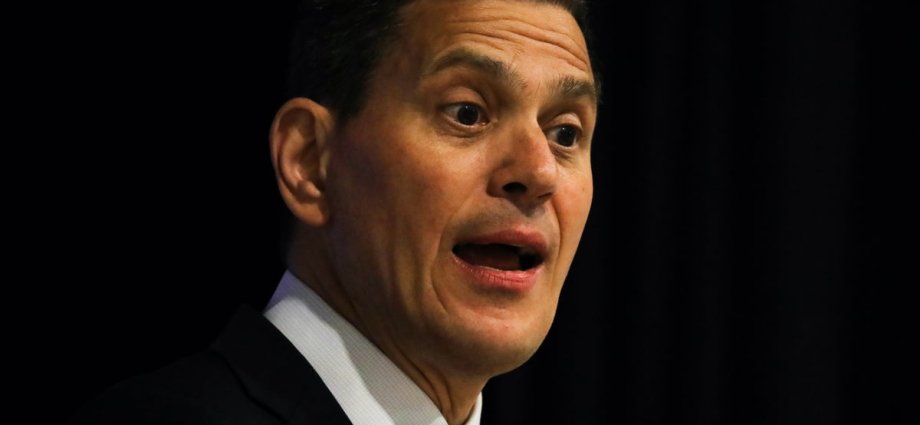
Brexit was a “unilateral declaration of political impotence” which has reduced the rudderless UK to “a bobbing cork in the sea”.
That is the damning verdict of former Labour foreign secretary David Miliband who has added his voice to the growing clamour to reverse Brexit.
In an interview with The Independent Editor-in-Chief Geordie Greig, Mr Miliband said Brexit had proved to be the “exactly the daily anguish” for Britain that he and many others had forecast.
It was time for a new “institutionalised” relationship with the EU, he said.
Mr Miliband criticised former Prime Minister Sir Keir Starmer for lacking the “vision” to achieve this – but was confident his successor Andy Burnham would do so.
His comments came as Mr Burnham refused to rule out a pledge to reverse Brexit in Labour’s next election manifesto, telling The Independent it was a question “for another day.”
.png)
Mr Miliband, foreign secretary from 2007 to 2010, the post now held by his brother Ed, said: “Brexit has been exactly the daily anguish we feared – for cheese manufacturers who are trying to export, for travellers stuck at Berlin Airport in the wrong queue, for fishermen who were promised what was never delivered.
“Britain is weaker because we’ve cut ourselves off economically and issued this unilateral declaration of political impotence.”
He added: “We have made ourselves weaker economically and politically because we’re not influential. Britain is weaker, Europe is weaker and the West is weaker. The EU is less well balanced and we have left Europe without an absolutely critical anchor and contributor.”
The claim by Brexiteers that “geography doesn’t matter” had “turned out to be nonsense,” said Mr Miliband.
“Russian tanks rolling into Ukraine, Russian attacks on Leipzig airport (in Germany) and on Poland and Denmark [the Russians were accused last week of firing flares at a Danish warship] shows that geography does matter.
“We cannot carry on with a Britain that is a sort of bobbing cork in the sea.”
It was a “crazy state of affairs” that Ukraine and Canada were queuing up to have closer formal links to the EU when the UK had left it.
“We have got to find a structured, organised, institutionalised relationship with the EU. We have got to join together in a new project for European security and prosperity,” he said.
Mr Miliband added that the Starmer government’s attempt to re-set UK ties with Brussels “never got going because it didn’t have a vision of where it wanted to go.”
By the end of the next parliament – a maximum of eight years from now – Britain’s links with Europe must be “transformed”, he said.
It would not be easy because the deal Britain once had – full membership of the EU – had gone. But it did not mean it could not be done.
“The EU looks like it is becoming a bit more flexible. That doesn’t mean we can cherry pick, but it also doesn’t mean that, quote unquote, we can’t go backwards. The deal we were offered has gone so we have got to fashion a new one,” he said.
It is too early to say what form it might take but it had to be a “new shared model” which principally repaired the damage to the UK caused by leaving the EU Customs Union and Single Market.
“It is the cheapest way to boost the economy, the fastest way to unite Europe in the face of security threats and the best way to get leverage on a global system that no longer has an American anchor. All politics is local, but local today is not confined to your locality or postcode. We cannot afford to be provincial about it. We have got to be be engaged.”
Asked if he thought Mr Burnham would do this more effectively than Mr Starmer, Mr Miliband said: “I do – because he has said he will. When Andy says we have got to be bold and ambitious, he doesn’t say things by accident. We should take him at his word.”
Mr Miliband denied that negotiating a new deal to unpick Brexit would revive the bitter divisions of the 2016 referendum.
“It’s not about reopening old wounds, it’s about stopping future wounds,” he said.