









Want to bookmark your favourite articles and stories to read or reference later? Start your Independent Premium subscription today.
Subscribe
`;
document.body.appendChild(modal);
modal.addEventListener(‘click’, () => {
document.cookie=”mos-plan-select=; Max-Age=0; path=/; expires=Thu, 01 Jan 1970 00:00:00 UTC;”;
});
modal.querySelector(‘.subscribe-link’)?.addEventListener(‘click’, (e) => {
e.preventDefault();
document.cookie=”mos-plan-select=; Max-Age=0; path=/; expires=Thu, 01 Jan 1970 00:00:00 UTC;”;
setTimeout(() => {
window.location.href=”https://www.independent.co.uk/subscribe/app”;
}, 500);
});
});
Stocks in London rose sharply on Thursday, boosted by falling bond yields and a lower oil price, as investors weighed a “hawkish” hold by the Bank of England.
In London, the FTSE 100 index ended up 127.67 points, 1.2%, at 10,816.14.
The FTSE 250 advanced 281.94 points, 1.2%, to 24,352.14, and the AIM all-share climbed 4.27 points, 0.5%, to 792.63.
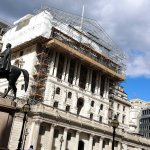
The Bank of England’s Monetary Policy Committee voted 6-3 to maintain bank rate at 3.75%, repeating July’s split, with Huw Pill, Megan Greene and Catherine Mann again backing a 25 basis point increase.
But the unchanged vote concealed a shift within the majority.
Five of the six members who supported a hold explicitly outlined circumstances that could lead them to vote for tighter policy, as the prolonged Middle East conflict pushes energy prices and the near-term inflation outlook higher.
Governor Andrew Bailey said “policy may have to tighten” if the Middle East conflict persists.
Sarah Breeden said that a hike would be appropriate if “second-round effects crystallise”.
Clare Lombardelli said the “case for raising bank rate is building” and Dave Ramsden said that “there could be a case for increasing bank rate”.
Alan Taylor said the emergence of second-round effects “would build the case for tightening”.
Kallum Pickering, chief economist & deputy head of research at Peel Hunt, said: “While the meeting decision was in line with our own call and with market pricing, the tone of the minutes has a more hawkish tilt compared to July.”
Mr Pickering still expects the Bank of England to hold at its November meeting but accepts the risks to that call have “grown”.
He pointed out that with five of the six holders having set out the conditions for a hike, only two need to switch.
Citigroup analyst May Rostom thinks a quarter-point rate hike is on the cards in November.
“Overall, we think the MPC are bracing us for a hike in Q4,” she said, adding that everything rests on what happens in the Middle East.
JPMorgan analyst Allan Monks said the Bank of England is “gearing” up to hike and sees rate increases in November and next February.
Mr Monks said the bigger surprise was the Bank of England shifting to multi-year guidance on quantitative tightening, with the intention of providing greater clarity on the path ahead.
“This is a clear and assertive plan designed to reduce uncertainty at a time when market conditions are volatile,” he added.
The pound was quoted at 1.3356 dollars on Wednesday, down from 1.3449 dollars at the same time on Wednesday.
Against the euro, sterling fell to 1.1627 euro from 1.1658 euro.
In European equities on Thursday, the Cac 40 in Paris rose 0.6%, while the Dax 40 in Frankfurt added 0.8%.
In New York, the Dow Jones Industrial Average was up 0.5% at the time of the closing bell in London.
The S&P 500 rose 1.0%, and the Nasdaq Composite advanced 1.5%.
Stocks rallied on Wall Street after Wednesday’s falls, which followed a quarter-point interest rate increase by the US Federal Reserve, the first in just over three years.
Fed chairman Kevin Warsh said inflation has been “too high and has been for too long” as he reiterated his aim to achieve price stability.
“Inflation is the problem and has been for the last five-and-a-half years,” he said after the US central bank lifted the target range for the federal funds rate to 3.75%-4.00%.
Analysts at Morgan Stanley noted that Mr Warsh characterised the hike as “removing accommodation, which we think suggests the Fed has more work to do. Combined with the discussion of ongoing geopolitical risks, we think this leans in the direction of more hikes than we previously expected”.
The bank expects the US central bank to raise rates again in December and in March 2027.
The euro eased to 1.1480 dollars from 1.1537 dollars.
Against the yen, the dollar was trading at 155.80 yen, up from 155.09 yen.
Elsewhere, stocks took encouragement from a further modest drop in the oil price and lower bond yields.
Brent oil was quoted at 103.65 dollars a barrel in London on Thursday, down from 104.54 dollars late on Wednesday.
The yield on the US 10-year Treasury was quoted at 4.95%, narrowed from 4.97%.
The yield on the US 30-year Treasury was quoted at 5.30%, trimmed from 5.34%.
On the FTSE 100, miners Endeavour Mining, Antofagasta and Anglo American were prominent risers, up 3.6%, 3.0% and 3.6% respectively.
SSE rose 3.6% as Berenberg raised its share price target and reiterated a “buy” rating.
Berenberg said an “unprecedented, extended and highly visible growth opportunity lies before SSE, which is not reflected in its valuation”.
Elsewhere, Kingfisher perked up 2.9% as Deutsche Bank Research took the do-it-yourself retailer, which reports results next week, off its “sell” list.
Next climbed 2.5% as it raised profit guidance once more despite taking a more cautious view on UK growth.
The Leicester-based clothing and homewares retailer now expects full-year pre-tax profit of £1.26 billion, raised modestly from £1.24 billion previously.
This would be up from £1.19 billion posted in the 52 weeks to January 31 2026.
“The company’s ability to manage expectations is unrivalled and once again it has delivered results materially ahead of previous expectations,” said AJ Bell investment director Russ Mould.
Despite the overall profit upgrade, Next reduced guidance for full-year sales growth in the UK to 2.0% from 2.8%.
“Our primary concerns are rising inflation, higher mortgage interest costs and a weak employment market,” the company said.
“These worries will only be compounded if they are accompanied by tax increases.”
Next expects a “slow, steady decline” in consumer spending but not a “precipitous” drop.
Reflecting the cautious commentary on the UK, Marks & Spencer fell 1.6%.
On the FTSE 250, Bytes Technology shot up 12% as it upgraded its annual outlook after reporting the “positive momentum” in the first half of its financial year.
Well-received results, a higher dividend and a new share buyback sent Galliford Try 6.2% higher, while an upgrade by UBS lifted Man Group 6.4%.
Gold was quoted at 4,356.36 dollars an ounce on Thursday, up from 4,345.07 dollars on Wednesday.
The biggest risers on the FTSE 100 were Endeavour Mining, up 164.0p at 4,674.0p, SSE, up 86.0p at 2,487.0p, Anglo American, up 140.0p, at 4,053.0p, Fresnillo, up 89.0p at 3,004.0p and Antofagasta, up 108.0p, at 3,702.0p.
The biggest fallers on the FTSE 100 were Pershing Square Holdings, down 72.0p at 3,666.0p, Marks & Spencer, down 6.1p at 365.0p, Coca-Cola Europacific Partners, down 100.0p at 7,600.0p, Reckitt Benckiser, down 50.0p at 5,006.0p and Intertek, down 40.0p at 5,840.0p.
Friday’s local corporate calendar has full-year results from DXS International.
Friday’s global economic calendar includes an interest rate decision by the Bank of Japan overnight and Japan inflation data.
This will be followed by UK retail sales figures and a US industrial production reading.
– Contributed by Alliance News