










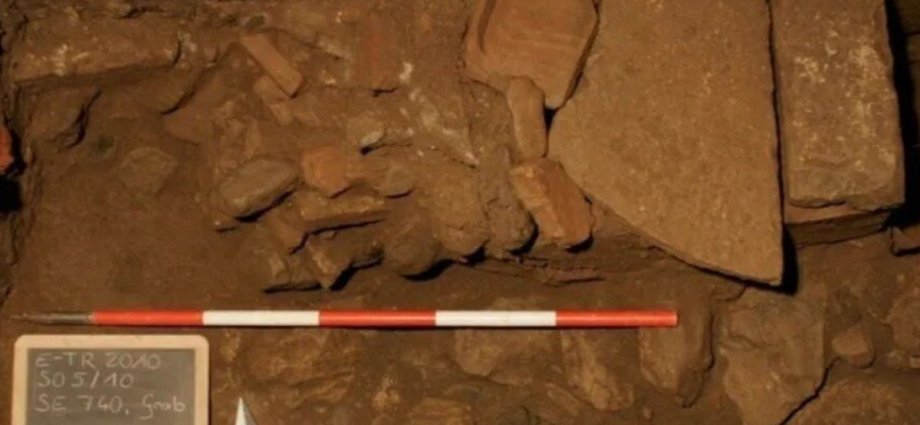
Archaeologists have unearthed the remains of a pair of infants buried together more than 1,000 years ago near the Temple of Artemis, one of the seven wonders of the ancient world, providing rare insights into the funerary practices of the time.
The burial site was once part of a building in the city of Ephesus, the capital of the Roman province of Asia, about 55km south of the modern city of Izmir in western Turkey.
The building was likely a Roman Odeon, built around the first century AD for music and speeches, with a toilet section added a century later. It was abandoned after a fire, only to be used to discard butcher’s scraps and broken pottery.
The infants, who were likely twins, were likely buried in the 8th or 9th century, long after the latrine was built.
“One of the infants had a tiny extra rib, only the second ever found in an archaeological context,” researchers from the Austrian Archaeological Institute noted in a study published in the journal Childhood in the Past.
“To our knowledge, the Odeon case constitutes only the second archaeological case of perinatal cervical rib published to date.”
-and-after-opening-(right-scale-of-10-cm).jpeg)
The ancient toilet’s underground channel provided a sheltered grave, hidden from the outside world, where the babies were laid side by side. The twins were born about six weeks early and it was unclear whether they drew breath from a world outside their mother’s womb at all.
Their remains were carried and wrapped in shrouds, pointing to care in the funerary treatment.
“The results highlight the particular care devoted to the interment, while the unusual location of the grave suggests a concern with protection rather than disposal,” archaeologists wrote.
One of the infants had an extra rib growing from a neck vertebra, just about five millimetres long.
Such growths are linked to genetic or developmental problems, including tumours and stillbirths, researchers say.
-Individual-1-and-(b)-Individual-2.jpeg)
They likely died due to internal factors or complications during, or just after, childbirth. As the infants were likely twins, their birth could have been considered an ill omen, researchers said.
Considering the funerary practices of the Eastern Mediterranean from Late Antiquity up to Middle Byzantine period of 4th to 11th centuries AD, researchers said, the Ephesus grave showed features characteristic of “Christian burial customs”.
The babies were buried in an east-west orientation, seemingly mirroring how Jesus Christ was buried.
“This discovery provides insight into the complex responses to perinatal death in Middle Byzantine Ephesus, at the intersection of biological, social, and religious factors,” the study concluded.