










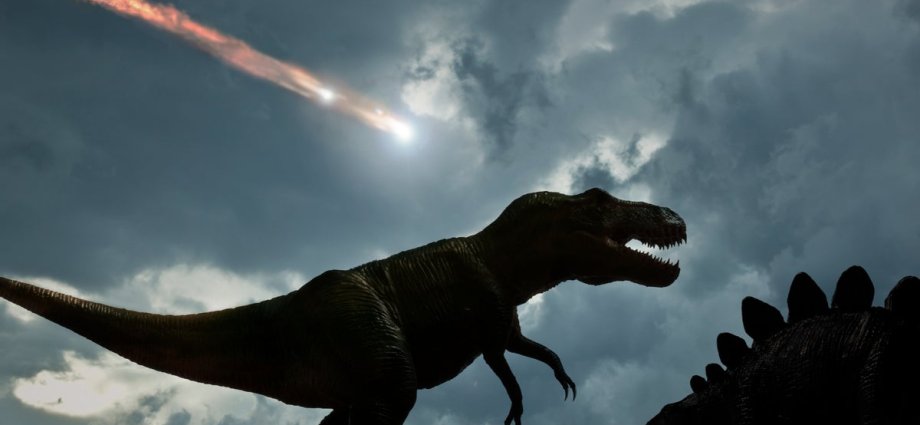
The cataclysmic meteorite impact that wiped the dinosaurs also inadvertently forged a subterranean haven for life, sustaining it for an astonishing eight million years, a new study reveals.
Researchers led by the University of Glasgow suggest this remarkable discovery could profoundly reshape our understanding of how life first emerged on early Earth and guide the ongoing quest for extraterrestrial organisms.
Scientists uncovered this surprising finding by examining samples extracted from Mexico’s Chicxulub crater, the colossal scar left by the 10km-wide asteroid that struck 66 million years ago.
That immense impact triggered an extinction-level event, obliterating approximately three-quarters of the planet’s flora and fauna, including all non-avian dinosaurs.
The resulting crater stretched nearly 200km across, with the impact’s crushing force penetrating deep into the Earth’s crust.
Despite the widespread devastation on the surface, the researchers found that the immense heat generated by the collision gave rise to a unique “hydrothermal system” deep beneath the crater.
Here, rocks melted by the impact mingled with seawater from the Gulf of Mexico, creating a porous material riddled with countless tiny pockets of water, all heated by the impact – conditions perfectly suited for microbial life to flourish and persist for millions of years.
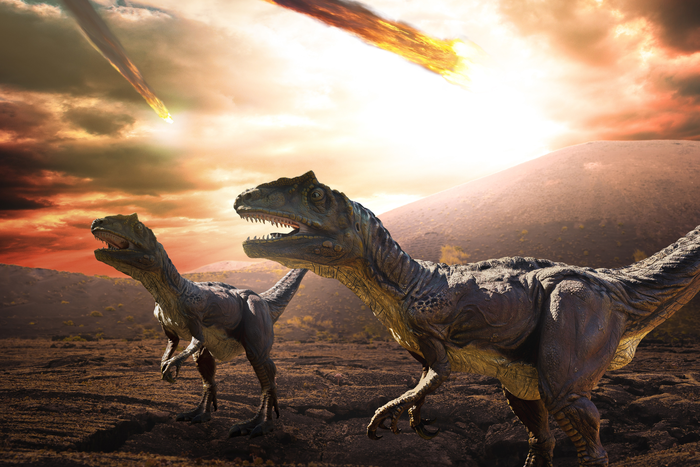
The team’s analysis of samples taken from the crater in 2016 showed the life-supporting environment lasted for eight million years – making it the longest-lived system of its kind yet documented.
Dr Annemarie Pickersgill of the Scottish Universities Environmental Research Centre (SUERC) used a technique called argon-argon dating to accurately determine the age of the samples.
This showed they had ages ranging from between 66 million years ago to approximately 58 million years ago.
Dr Pickersgill said: “Wherever on Earth you find flowing warm water, you find life, and we’ve known for a while that asteroid impacts create hydrothermal systems.
“Previous research undertaken in the early 2000s suggested that the system created by the Chicxulub impact lasted for about two million years.
“Those findings were based on computer models which were, even at the time, regarded as conservative estimates, but we were still surprised by the outcomes of our research.”
The team also undertook computer modelling of the geological effects of the meteorite impact.
This suggested a combination of high rock permeability, sustained heat from the impact, and natural geothermal conditions likely helped the system persist for as long as it did.
As well as casting new light on how life may have first been incubated in hydrothermal systems in the earliest chapters of the Earth’s history, the scientists said the findings could also help direct the search for life on other planets.
“We know that planets like Mars, which don’t have the protection of a thick atmosphere like Earth does, have experienced many, many impacts during their history,” Dr Pickersgill said.
“That includes periods when water may have been much more abundant, and big enough impacts could have spurred the formation of long-lived hydrothermal systems which could have supported life.
“The porous, fractured rocks created by impacts create microenvironments where micro-organisms can be protected from radiation and extreme temperatures.
“Those conditions give life the chance to take hold and flourish, and that is likely what happened here on Earth billions of years ago.
“As we look to the future of space exploration, these findings could help future missions to other planets determine which impact craters might have been most likely to sustain life.”
The team included researchers from universities in Scotland, England, Germany, the US and Canada.
The study, A long-lived impact-generated hydrothermal system at the Chicxulub impact structure, is published in the journal Communications Earth & Environment.