









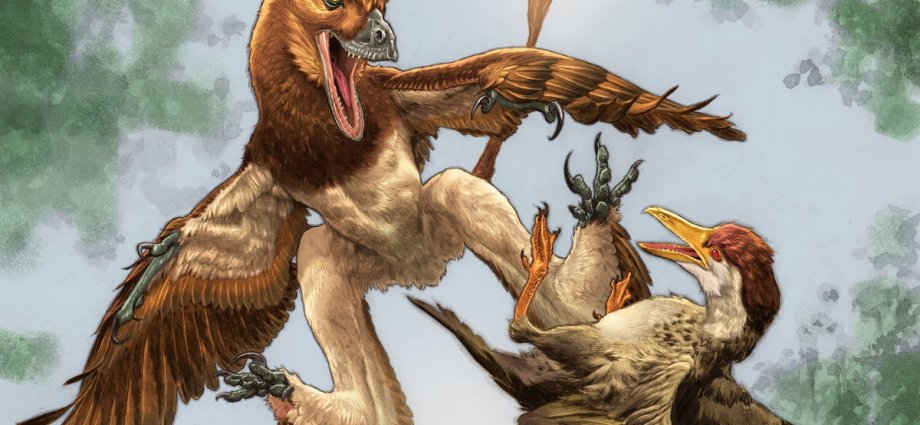
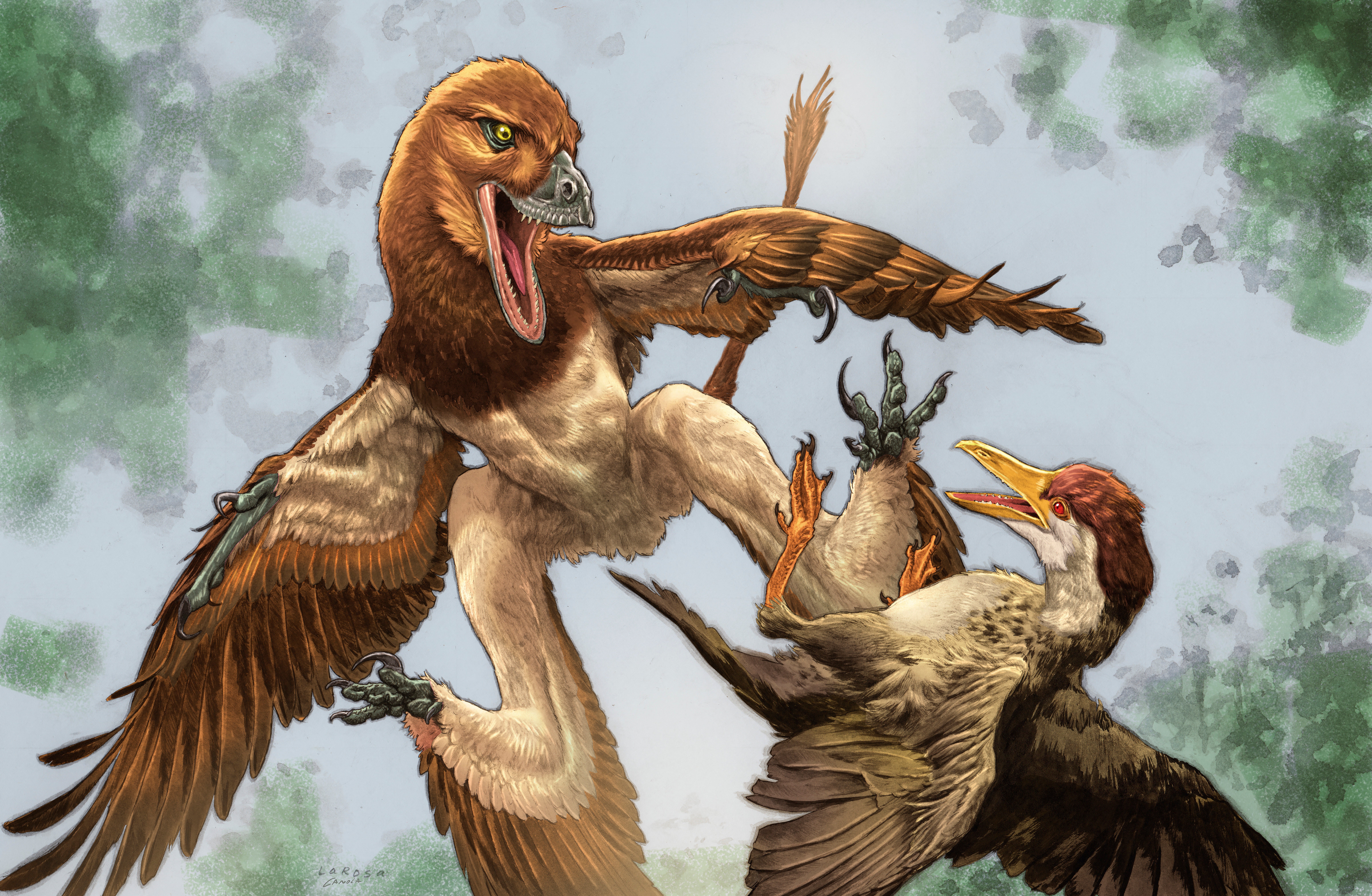
A newly discovered relative of the famed Velociraptor that stalked the ancient lakeside ecosystems of northwestern China about 120 million years ago had a particular fondness for birds, thriving amidst a dense avian population that offered a rich food source.
The opportunistic carnivore, named Jian changmaensis, lived in the Cretaceous Period and was roughly the size of a barn owl, according to a study published in the Annals of Carnegie Museum.
Researchers said that Jian was likely covered in feathers, capable of living both on the ground and in trees, and perhaps glided like a flying squirrel to ambush its prey.
“Jian would look like a small Velociraptor – the real Velociraptor, not the scaly thing in Jurassic Park – but with long feathers on both the forelimbs and hindlimbs instead of just the former,” palaeontologist Matt Lamanna from the Carnegie Museum of Natural History in Pittsburgh, a leader of the study, said.
“I often describe Jian as a Velociraptor trying to be a flying squirrel, except, of course, that Jian was predatory and flying squirrels aren’t.”
The remains of Jian were discovered in China’s Gansu province, a site renowned for its exceptionally preserved bird fossils.
The dinosaur’s bones were accompanied by broken bird bones crushed into pellets, strikingly similar to those regurgitated by modern-day owls after consuming prey. This evidence led researchers to suspect that Jian engaged in a similar digestive process after feasting on birds.
Mr Lamanna said Jian was “of the correct size and suspected ecology to have been the ‘pellet maker’”.
Jian, named after a mythical flying creature in Chinese folklore, was identified from five shoulder and arm bones, which distinguished it from Microraptor, a closely related species that inhabited the same region around the same time.
While its remains are incomplete, researchers believe that Jian resembled Microraptor, which famously possessed feather-covered arms and legs, giving it the appearance of having four wings.
All meat-eating dinosaurs, including Jian, belonged to the group known as theropods, many of which were smaller than giants like Tyrannosaurus rex and filled ecological niches akin to today’s weasels or wolverines.
Birds themselves evolved from small feathered dinosaurs during the Jurassic Period, with the earliest known bird, Archaeopteryx, dating back 150 million years. The ancient Chinese ecosystem would have provided an ample supply of birds for Jian, including the pigeon-sized, semi-aquatic Gansus, which likely had webbed feet and, like Archaeopteryx, a mouth full of teeth.
“They’re extraordinarily closely related to the earliest birds such as Archaeopteryx, really, just about as close as you can be to being a bird without actually being a bird yourself,” Mr Lamanna said, referring to the lineage of Jian and Microraptor.
Jingmai O’Connor, palaeontologist at the Field Museum in Chicago and another study leader, described Jian as “probably an ambush predator, stalking and pouncing on distracted birds that were working on finding their own meals”. She noted that Microraptor was an opportunistic predator, consuming birds, lizards, mammals, and even fish.
“Jian was likely the same, eating whatever it could catch. Dense bird populations may also have been seasonal, forcing Jian to have a diverse diet,” Ms O’Connor added.
Velociraptor, popularised in films, was actually about the size of a large turkey and lived in Asia approximately 45 million years after Jian. Velociraptor, Jian, and Microraptor are all part of the dromaeosaur group, informally known as raptors, characterised by bodies adapted for speed and tenacity.
The largest of the raptors, Utahraptor, lived in North America 15 million years before Jian and could reach up to 23ft. Jian, in comparison, measured a little over 3ft, including its tail.