









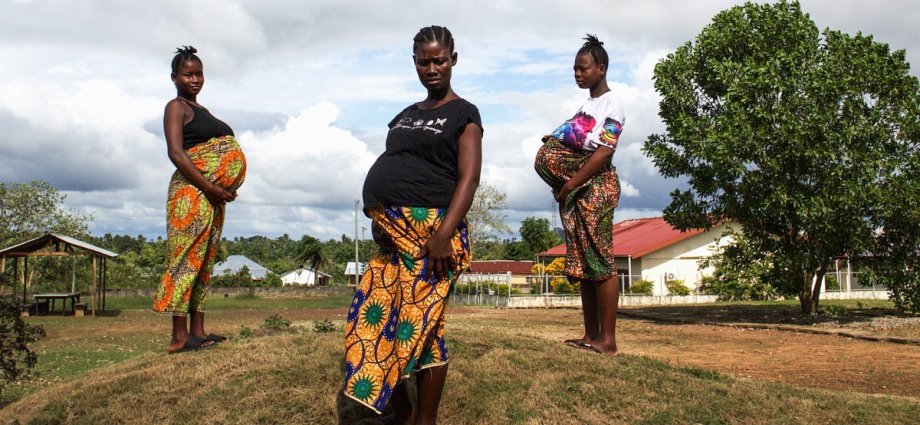
In a crowded room in a town in Sierra Leone’s Tonkolili District, adolescent girls sit shoulder-to-shoulder in plastic chairs. Some walk miles to attend. They talk openly about menstruation, contraception and consent – subjects their mothers were often never allowed to discuss.
Many come from communities where girls are still expected to marry young, leave education behind and remain silent about their bodies.
For these teenagers and young women, the Adolescent Friendly Centre (AFC) has become a rare place where they are listened to. “If this centre didn’t exist, it would be a problem for girls”, 21-year-old Mamah tells The Independent.
Now studying mass communications at university, she is also training as a journalist through the centre.
.jpg)
“Growing up, all I knew is that when someone said ‘let’s do this’, I’d say ‘okay,’” she says. “Most parents don’t have time to sit with their daughters and tell them what to avoid.
“Not having this centre would lead to more girls dropping out of school, getting pregnant at an early age, being forced into early marriage, not knowing their rights, when to say no and when to give consent.”
Across Sierra Leone, child marriage and teenage pregnancy remain deeply entrenched. Thirty per cent of girls marry or enter unions before turning 18.
Meanwhile, up to 40 per cent of maternal deaths occur among teenagers. More than a third of women aged 20 to 24 years gave birth before age 18 years, and 10 per cent gave birth before age 16 years.
The lifetime risk of maternal death in Sierra Leone is one in 52, with this risk believed to be even greater for adolescents. More than two-thirds of maternal deaths result from haemorrhage, hypertension, and sepsis, and roughly a third are linked to unsafe abortions, particularly among adolescents.
Sierra Leone’s government has taken steps to try change those statistics. The Prohibition of Child Marriage Act was passed in 2024, while there are also programmes aimed at reducing teenage pregnancy, while another act introduced in 2021 allows pregnant girls to return to school.
However, across the nation and particularly rural areas, girls still face particularly severe barriers to education, driven by poverty and the social pressure of a push for early marriage.
.jpg)
.jpg)
Medecins Sans Frontiere (MSF) Holland ran the centre from 2019, when it opened to tackle rising rates of teenage pregnancy and unsafe abortions. In early 2025, just as Donald Trump was slashing the US aid budget and reproductive health funding, it withdrew from Sierra Leone altogether.
The MSF decision came with the world facing multiple crises, war in Gaza, Ukraine and South Sudan and a hunger crisis across swathes of Africa.
MSF formally handed the centre to Plan International in March 2025, but full services did not resume until September – six months in which adolescents in Tonkolili had nowhere to go for reproductive health support. But funding for the centre – from a foundation – is secured only until spring 2028 and the broader picture for health aid in Sierra Leone is worsening.
The UK government’s own Equalities Impact Assessment suggests Britain is likely to stop delivering aid programmes with health objectives in Sierra Leone altogether. Sierra Leone’s Ministry of Health cannot sustain the centre alone, staff and activists say.
Inside the centre’s two cramped rooms, adolescents crowd around three ageing computers, often sharing in pairs while others wait their turn for lessons on sexual health, life skills and technology.
Staff say the growing number of young people seeking help has stretched the building beyond capacity, with only one shared toilet serving the centre.
.jpg)
Mariatu Fofanah is 59, a pastor and teacher, and one of 30 school principals in her district. She is the only woman and at meetings of the districts school leaders, she says, the room greets itself as “gentlemen”, but she has learnt to say: “I am here”.
Fofanah was 14 when her uncles told her father she was already too old and should be married. She did not bow to the pressure, but knows what that pressure costs most girls.
“Here, parents don’t guide their children about their bodies. Menstruation is not handled at all. If they are lucky, parents mention one or two things in passing”, she says. In the community, she explains, menstruation is treated as contamination. Some who are on their periods are considered unclean and some stop going to school altogether.
Fofanah recalls: “When I was young, I asked my mother if babies came out of the belly button. She laughed and told me a proverb.”
That is the knowledge gap the centre is trying to close – both clinically and socially. Abdulai Tunkara, who runs the centre for Plan International, describes adolescents arriving with information about sexual health that is wrong and sometimes dangerous: girls believing menstruation means they are “unclean”, or young people relying on misinformation from peers about contraception.
.jpg)
Many, he says, have no money for menstrual products or family planning services and are reluctant to seek help from formal health facilities where they would have to pay. At the centre, counselling, STI treatment and family planning advice are free. Young people have started bringing friends and younger siblings with them.
Amida*, 13, attends the centre after school and says girls in her community were once expected to remain at home while boys were educated.
She says: “Now, both boys and girls can go to school and a girl has a right to choose her partner for herself.”
Amida hopes to become a teacher one day because there are so few female teachers in her community.
Fatmata, 29, who works with a community organisation that partners closely with the centre, knows how unusual that aspiration still is. Her elder sister was married at 15, her other sister at 17.
She says: “In my community, they believe that for girls, marriage is better than education. With marriage, it is believed you bring more dignity to your family.”
She went to university anyway, with her mother selling goods to cover her fees. She is now pursuing a degree in business administration and hopes to complete a master’s afterwards.
“I wanted to show girls in the community that no matter what circumstance you are facing, whether you are poor or rich, you just need to pursue an education”” she says.
Tunkara’s fear is that the centre becomes a story about what once existed, rather than what could still be possible.
He asks: “What if we reach a point where there is no funding to run free family planning and free STI treatment?. What would be the fate of the adolescents? Where can they get the money to afford this?”
*Names changed to protect identities
This article has been produced as part of The Independent’s Rethinking Global Aid project