









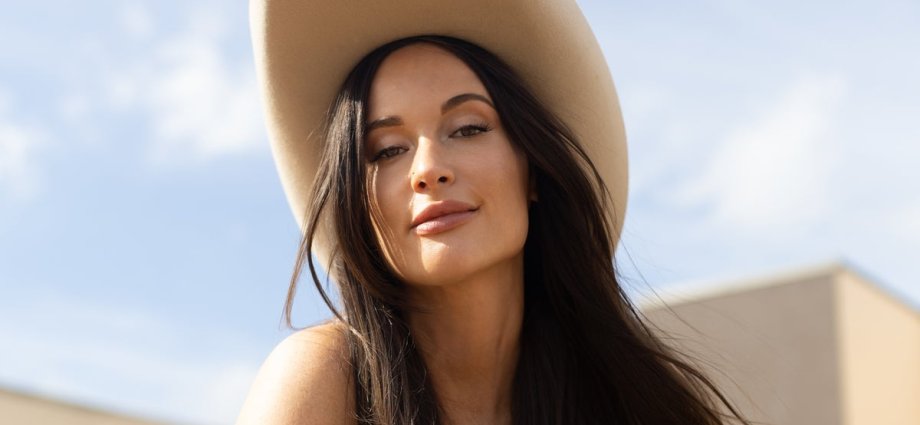
Somewhere in a hotel room several floors above me, Kacey Musgraves wakes up – spontaneously, without an alarm, at the time of our interview. The country-pop star is famously always late (she admits as much on her ethereal Americana track “Slow Burn”, from the double Grammy-winning 2018 album Golden Hour). In this case, it’s because the US to UK jet lag has hit her hard.
Fifteen minutes behind schedule, she pushes through the mahogany doors in not one but two plaid shirts, grey sweatpants and Birkenstocks. Walking across the empty bar, she rubs her eyes, looking like a bare-faced Disney princess who just wandered out of the woods. This is her only written interview with the UK press – she wants to relax and live a little while promoting her new country album, Middle of Nowhere. Everything about Musgraves’ current life is being led at a slower, deliberate register. She seems happy and relaxed, splitting her time between Tennessee (she’s been a “lone wolf” there since moving 15 years ago), her home state of Texas, and Mexico, whose laidback beauty inspired the sounds on the new record. It was written mostly about the time she’s spent intentionally single between romantic relationships. When I ask if she’s dating again, she makes a joking reference to her recent single “Dry Spell”, smiling at the floor as she tells me in her soft southern lilt: “Well, the dry spell has been broken, I’ll just say that.”
Few artists have changed the face of country music like Musgraves. Anyone who worked with her early on in the notoriously rigid Nashville was struck by her refusal to be shaped or manufactured. Whether it was writing about weed, acid trips and same-sex relationships (she was the GLAAD Awards’ first ever country performer), or breaking the genre’s boundaries by incorporating pop, psychedelia, folk and Celtic music, she has blended worlds together with a wry sense of humour. Who else could, off the bat, tour with artists as diametrically opposed as Willie Nelson (who duets with her on the new album) and Katy Perry? You can’t quite predict where she’ll go next. One moment she’s delivering pithy one-liners about minding your own damn business, the next she’s philosophising about the unknowable intentions of God.
But there is a throughline: Musgraves has always understood that aesthetic glitz and spirituality were never at odds. Her hair is occasionally big enough to be considered camp but she likes to theorise about heaven. She gets her nails done but also believes in aliens. Over the years she has naturally evolved into a glam cowgirl probing the depths of the human soul – whether that be the hallucinogenic experience of falling in love on Golden Hour, or the reckoning with possible life after death on 2024’s Deeper Well.
Since Golden Hour, it’s been difficult not to associate her music with the influence of psychedelics – not just in the floating, textured sounds but the exploration of consciousness and connectedness. Has experimenting with psychoactive substances changed her relationship to creativity for good? “I would say so,” she answers, noting that she doesn’t do them often, but when she does, it’s “with respect”. They’ve given her more compassion for the human experience, she thinks. “For me, the inspiration is always when I zero in on the smallest, most mundane experiences – it’s not some far-reaching grandiose place that I try to go to find something,” she says. “I write better songs when I’ve had time to live a regular life, have relationships, make mistakes, learn new things, change up the neural pathways a bit. That’s when the ideas come.”
Middle of Nowhere takes its name, and much of its songwriting, from the idea of existing in liminal spaces. After a “ridiculous” break up a few years ago, Musgraves started to frequently visit family in her tiny hamlet of Golden, Texas, population: 300. One day she took a walk downtown and saw a sign that said “Golden Texas: Somewhere in the Middle of Nowhere.” It amused her – she was in the middle of the album cycle for Deeper Well, with fewer people around her than ever in her personal life too.
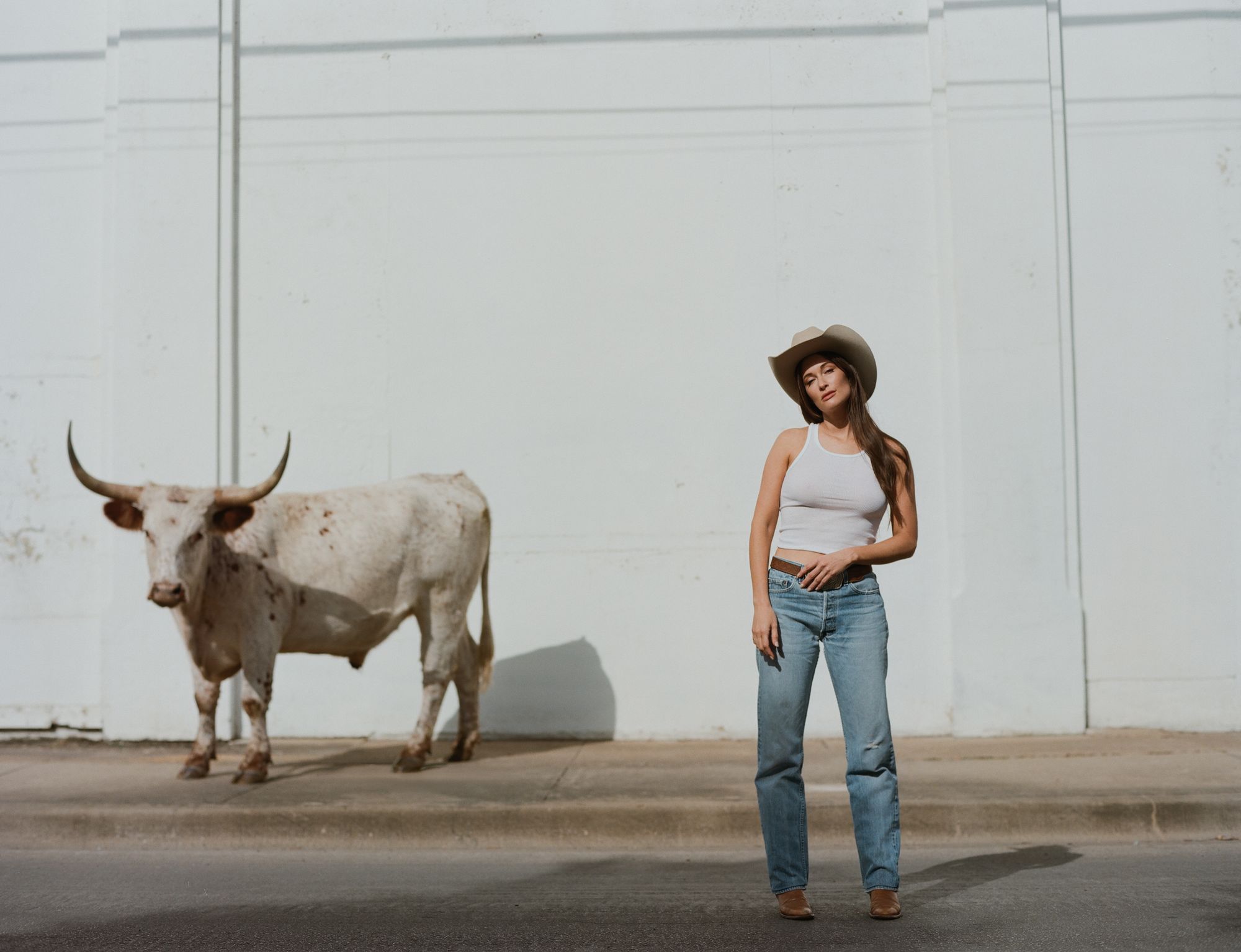
Her most recent boyfriend was the frustrating “last round” of repeating familiar unhealthy relationship dynamics, Musgraves says. She decided to give herself time alone, really alone, to inspect her decisions until she’d learnt not to fall into toxic situations anymore. “I really learned that being alone does not have to equal being lonely,” she says. “In fact, it can be extremely freeing and confidence-boosting to not be attached to someone else.”
Making that decision led to the longest period of being single in her adult life: “There’ve been so many times in my life when I feel like I’m the one in the relationship pulling them closer or doing the work, and never again.” She uses a fork to stab berries from a bowl she’s retrieved from a nearby food cart. “It has to be equal,” she continues. “I can’t be convincing you to be with me or like me. Why would I stand for that? The world is so chaotic and so crazy – the last place that you should be getting that chaos is at home. I put up with a lot of chaos for a long time.”

Enjoy unlimited access to 100 million ad-free songs and podcasts with Amazon Music
Sign up now for a 30-day free trial. Terms apply.
ADVERTISEMENT. If you sign up to this service we will earn commission. This revenue helps to fund journalism across The Independent.
Enjoy unlimited access to 100 million ad-free songs and podcasts with Amazon Music
Sign up now for a 30-day free trial. Terms apply.
ADVERTISEMENT. If you sign up to this service we will earn commission. This revenue helps to fund journalism across The Independent.
That clarity is a manifesto that runs through the album, at times played for laughs, at others, sadly examined. Kitschy lead single “Dry Spell” is a spaghetti western In Memoriam for her sex life: “It’s been a real long / Three-hundred and thirty-five days / And the last time / It wasn’t good anyway,” she mourns drily. “Loneliest Girl”, the catchiest song on the record, is a bright, understated report on her single status that plays like a Nineties alt-pop song with steel guitars. On the sombre “I Believe In Ghosts”, she remembers calling a lover to check whether he’d broken up with her.
“The title’s a double entendre because I definitely do believe in the supernatural, but also getting ghosted is a real thing in these modern times where accountability is optional for people,” she says with a sardonic smile. “I got ghosted before this record was being written and it was in the month of [Halloween], which I thought was ironic.” The lyrics make this scenario sound like the end of an actual relationship, rather than a casual encounter, I say. “Oh, it was. It was really messed up,” she shoots back.
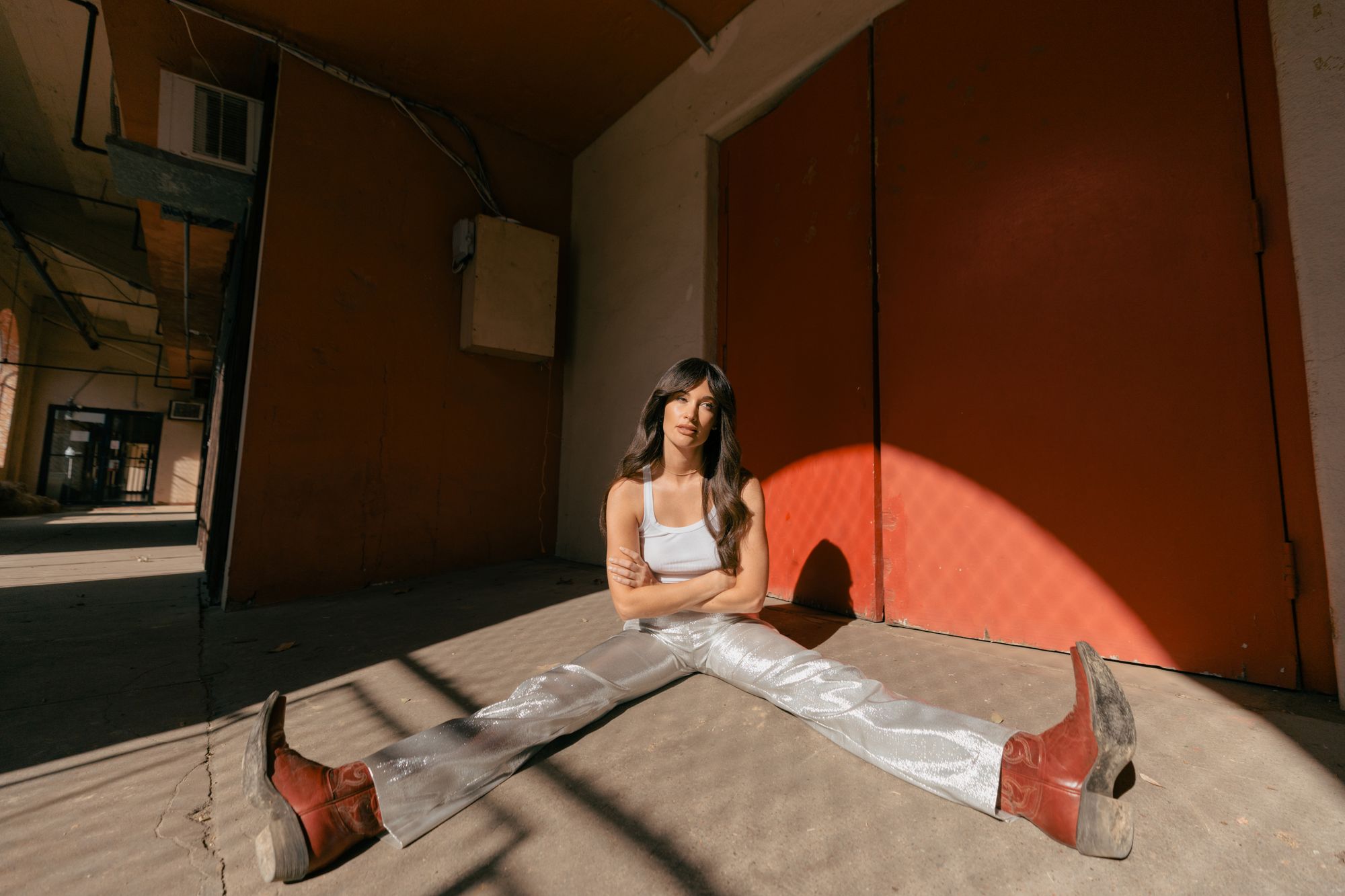
All that space for reflection led Musgraves to propose the irreverent duet “Horses and Divorces”. After seeing a video of fellow country queen Miranda Lambert out horseriding, she shrugged off their long-rumoured feud – sparked years earlier when a beloved song she co-wrote, “Mama’s Broken Heart”, was released by Lambert (without her blessing). “I thought, we’ve got two things in common: horses and divorces, and I was like, OK, that’s a song for sure.” The pair got into the studio and wrote it together as the album’s final addition. “When you get older, you have a lot less energy for negativity and the things that you once had more of an appetite for in your twenties or something,” Musgraves, who turns 38 this August, says. “You get perspective and think, do I really care anymore about this thing? It’s nice to let stuff go.”
That doesn’t mean she’s traded clarity for comfort, though. After that talk of there being enough chaos in the world, I say something about needing to feel optimistic about its future, if only for my own sanity. “What’s that like?” she jokes, adding: “I feel like for things to really change, darkness has to be exposed and there’s going to be an uncomfortable period where everyone is seeing what’s been under the surface for a long time. Otherwise what would motivate the change? But that uncomfortable period is so disturbing… just when you think it can’t get worse it does.”
I feel like for things to really change, darkness has to be exposed
For a long time, publicly, Musgraves was clear on one thing: she didn’t really want children. Lately a different feeling has taken hold. Becoming a mother feels like a whole new creative adventure. “I’ve gotten to do all these unbelievable things, have these adventures, really live for myself and explore all my creative ideas… and then sometimes, I’m like, what else is there? That can’t last forever,” she says wistfully. “Having a kid is a huge learning experience and it’s such a huge mirror for yourself.”
It’s been on her mind a lot, the thought of what comes next. Also, if she can have children and still enjoy the career she’s worked so hard for. “I see so many artists and powerhouse women creatives and CEOs and very driven women who are able to have both and that’s really inspiring,” she says. “I’m sure that it adds another layer of difficulty but maybe also appreciation for what you are able to do.” She’s so self-assured in her way of thinking, I tell her I find it hard to believe anything could stop her from doing what she wants. “But you can easily trick yourself into thinking that it would stifle everything about the life you currently know,” she responds.

Perhaps, with eight Grammys and seven albums to her name, it was inevitable that she’d begin thinking about legacy. “You wonder: what are you leaving everything behind for?” she says. On social media, fans tell her that they’re experiencing the same life events she sings about in her music: during the Golden Hour era they were falling in love, they got divorced when star-crossed was released; Deeper Well saw them through a time of healing.
“I feel like I’m going through this journey with all these people who listen to my music. It makes me feel less alone in my own trials and tribulations,” she says. Maybe it’s generational, that she attracts fans of her own age. She’s not sure. “But if that’s part of my ‘legacy’, then what a beautiful legacy to be able to connect with people on that level.” Whatever it is in life she feels late to, they make her feel like she’s right on time.
‘Middle of Nowhere’, the new album by Kacey Musgraves, is out now