








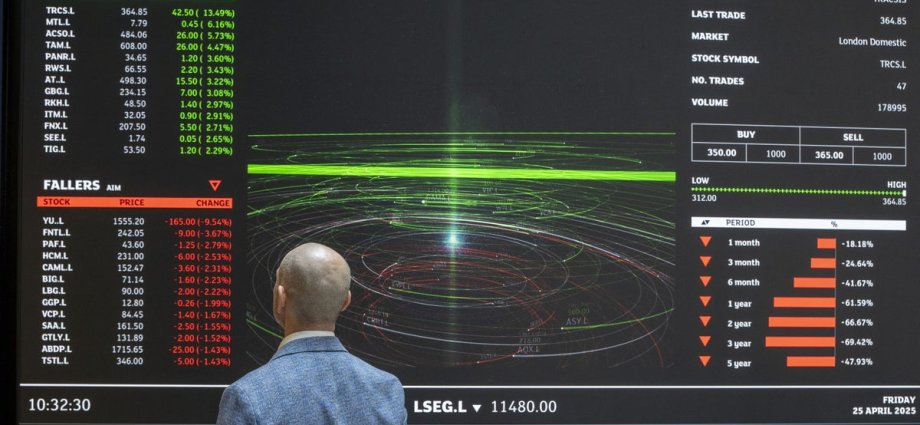
The FTSE 100 ended the week on a high on Friday, as Iran declared the Strait of Hormuz completely open, sending oil prices sharply lower.
“For stock and bond market bulls around the world, this is the perfect end to the week,” said Kathleen Brooks, research director at XTB.
The FTSE 100 closed up 77.64 points, 0.7%, at 10,667.63.
The FTSE 250 ended 426.42 points higher, 1.9%, at 23,205.92, and the Aim All-Share rose 12.25 points, 1.5%, to 810.11.
For the week, the FTSE 100 rose 0.6%, the FTSE 250 surged 3.8%, and the Aim All-Share jumped 3.9%.
Early Friday afternoon UK time, Iran’s foreign minister Abbas Araghchi said on X that “passage for all commercial vessels through Strait of Hormuz is declared completely open for the remaining period of ceasefire”.
The strategic waterway, through which one-fifth of the world’s crude oil normally flows, has been disrupted by Iran since the US-Israeli offensive began.
In addition, US President Donald Trump signalled that an Iran peace deal was all but done, flagging agreements on the Strait of Hormuz and Tehran’s nuclear programme.
Ms Brooks at XTB said this is the “biggest development so far during the ceasefire, and it gives hope that the war will end soon, and supply chains will return to some normality”.
“While it will take some time to relieve the backlog of tankers travelling through the Strait of Hormuz, and for Gulf commodity supplies to return to normal after damage caused by Iranian drones, this is undoubtedly good news, and it brightens the outlook for the global economy for the rest of this year,” she added.
In response, the price of oil plunged, while global stock markets made strong gains.
Brent oil traded lower at 89.15 dollars a barrel on Friday afternoon, compared to 98.39 dollars at the time of the equities close in London on Thursday.
The oil price slump saw London’s FTSE 100 underperform against European peers, as shares in BP and Shell fell heavily.
In European equities on Friday, the Cac 40 in Paris ended up 2.0%, and the Dax 40 in Frankfurt rose 2.3%.
France and the UK will lead a multinational mission to ensure freedom of navigation in the Strait of Hormuz as “soon as conditions allow”, Prime Minister Sir Keir Starmer said, after co-chairing a meeting on the issue with French President Emmanuel Macron.
“This will be strictly peaceful and defensive as a mission to reassure commercial shipping and support mine clearance,” said Sir Keir, adding that “over a dozen countries have already offered to contribute assets”.
Sir Keir hailed the announcement by Iran, but added: “We need to make sure that it is lasting and a workable proposal.”
In New York, markets were also higher.
The Dow Jones Industrial Average was up 1.9%, the S&P 500 was 1.2% higher, and the Nasdaq Composite advanced 1.6%.
Netflix missed out on the rally, as soft second-quarter guidance and the lack of an increase to its full-year outlook saw shares in the streaming service fall 9.7%.
For the second quarter, Netflix forecast revenue of 12.57 billion dollars and diluted EPS of 0.78 dollars, below Visible Alpha consensus of 12.80 billion dollars and EPS of 0.86 dollars.
The yield on the US 10-year Treasury ebbed to 4.24% on Friday compared to 4.29% on Thursday.
The yield on the US 30-year Treasury narrowed to 4.88% from 4.91%.
The yield on UK 10-year gilts fell to 4.68% on Friday from 4.84% on Thursday, but was still well above the levels of closer to 4.20% seen ahead of the Iran war.
Ms Brooks said reopening the Strait “dramatically improves the economic outlook for the UK, which is susceptible to energy price spikes and inflation threats”.
The pound firmed to 1.3556 dollars on Friday afternoon from 1.3532 dollars on Thursday.
Against the euro, sterling softened to 1.1481 euros from 1.1489 euros.
The euro traded higher against the greenback, rising to 1.1805 dollars from 1.1777 dollars.
Against the yen, the dollar was trading lower at 158.08 yen, down from 159.16 yen.
In London, oil and gas majors BP and Shell slid 7.4% and 5.6%, respectively, amid the weaker oil price.
Also in the red were electricity generator SSE, down 6.6%, and British Gas owner Centrica, which declined 5.0%.
Chancellor Rachel Reeves said she would be announcing changes to energy policy in the coming days, including on drilling in the North Sea and reforming the link between gas and electricity prices.
“We do need to delink gas and electricity prices,” Ms Reeves said.
“Because at the moment, on many occasions, electricity prices are based off the gas price, even though the costs of producing electricity, by and large, have not changed as a result of this conflict in the Middle East.”
Ms Reeves said she and Energy Secretary Ed Miliband would be making an announcement soon, both on that and on the next stage of extracting oil and gas in the North Sea.
Citi analyst Jenny Ping said the Government “appears to be stepping up intervention on the UK power market with the aim to curb power prices”.
She sees “most risk to earnings and valuation” at SSE in the UK, with some “marginal negative impact” to Centrica earnings, although she does not expect this to be “material”.
“In our view, SSE shares reflect very little of government intervention risk which is starting to materialise,” Ms Ping wrote.
While energy stocks suffered, travel firms flourished.
British Airways owner International Consolidated Airlines rose 6.2%, with budget airlines easyJet and Wizz Air up 6.1% and 7.6%, respectively.
Aerospace firms Rolls-Royce and Melrose climbed 4.8% and 4.9%, respectively, and Holiday Inn owner InterContinental Hotels Group advanced 5.3%.
Interest rate-sensitive housebuilders also took heart from the improved interest rate outlook, with Persimmon up 4.8% and Barratt Redrow up 4.0%.
Elsewhere, Workspace Group shed 6.2% after warning of a “substantial step down” in trading profit as it invests to become the “first-choice provider of space”.
The London-based flexible workspace provider blamed lower starting rents, the impact of disposals, higher debt costs, lower capitalised interest, and higher operating expenses and investment for the shortfall in the financial year to March 2027.
“Workspace expects the combined impact of these factors to result in a substantial step down in FY 2026/27 trading profit compared to FY 2025/26,” the firm said in a statement.
Chief executive Charlie Green, who joined Workspace in February, said that becoming the “first-choice provider of space” for the start-up, SME, and scale-up market will require investment in the portfolio.
“It will take time to deliver on our ambitions and, as we deliberately reposition the business, there will be a step down in profitability,” he added.
Gold traded at 4,869.13 dollars an ounce on Friday, up from 4,802.13 dollars at the same time on Thursday, pushing miner Fresnillo up 6.2%.
The biggest risers on the FTSE 100 were Fresnillo, up 229.0p at 3,782.0p, International Consolidated Airlines Group, up 23.9p at 410.1p, InterContinental Hotels, up 7.45p at 147.35p, Antofagasta, up 189.0p at 3,959.0p and Melrose Industries, up 26.6p at 567.2p.
The biggest fallers on the FTSE 100 were BP, down 43.0p at 541.0p, SSE, down 175.0p at 2,469.5p, Shell, down 188.5p at 3,196.0p, Centrica, down 10.3p at 197.4p and Glencore, down 10.8p at 547.1p.
Monday’s global economic calendar includes an overnight interest rate decision in China, along with Canadian CPI and German PPI figures.
Monday’s local corporate calendar has full-year results from advertising agency M&C Saatchi, and a trading statement from Workday partner and IT services provider Kainos Group.
– Contributed by Alliance News