









Want to bookmark your favourite articles and stories to read or reference later? Start your Independent Membership today.
Join today
Already a member?
Log in
A mysterious radio signal in space that pulses every eight minutes has been traced to a star system thousands of light-years from Earth.
The short bursts of radio waves are coming from an unusual pairing of stars, astronomers at Australia’s Curtin University and the International Centre for Radio Astronomy Research announced Friday.
The pair includes a white dwarf star – the dead core of an active star – that spins every eight minutes and a G-type star similar to our sun, often called a yellow dwarf.
This is the first time such pulses have been detected from these stars, the scientists said. Typically, pulses are detected in systems with smaller and cooler red dwarf stars: the smallest and coolest types of stars in space.
“This is the first time the pulses are clear enough to see the white dwarf moving in its orbit around its companion, so we know that the pulsations are coming from a region close to the white dwarf, or possibly even from the white dwarf itself,” Dr. Sam McSweeney, who made the discovery, said in a statement shared alongside new research.
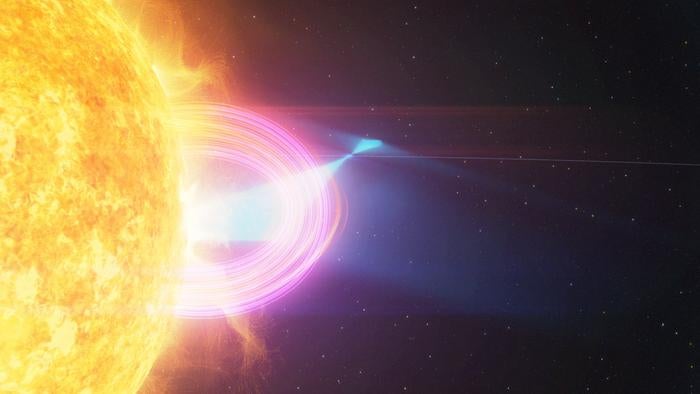
McSweeney and his team processed more than 100 hours of data at the Western Australia Pawsey Supercomputing Research Centre to confirm the white dwarf’s motion in the star system, which they call “GPM J071507−114153.”
Previously, researchers had discovered systems with objects similar to this – producing radio signals that switch on and off – but it was unclear which of the systems’ stars were generating the pulses.
Around a dozen star systems comparable to this system have been found since the first was discovered in 2021.
GPM J071507−114153 was detected using the Murchison Widefield Array telescope, also in Western Australia, to scan the Milky Way.
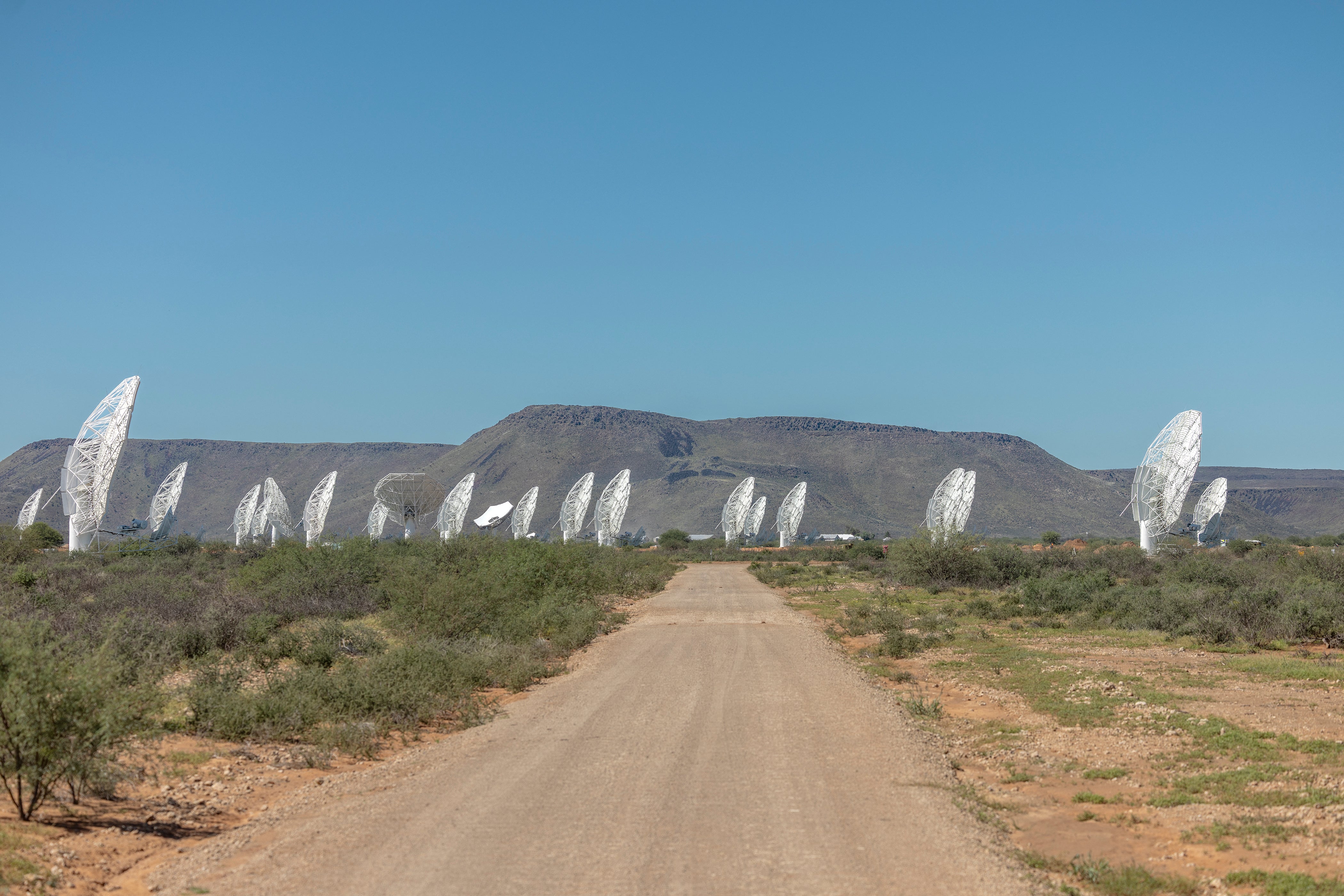
“We then used the MeerKAT radio telescope in South Africa to determine its precise position,” Natasha Hurley-Walker, an associate professor at Curtin, said.
The researchers also utilized Hawai’i’s W.M. Keck Observatory to confirm there was a G-type star.
But that wasn’t all they found, either.
The pulses allowed the scientists to detect stellar flares on the sun-like star similar to the flares that create auroras on Earth.
“It’s amazing that by using radio wavelengths we can detect the storms on a star over 5,000 light-years away,” said Hurley-Walker.