











Kimberly Levaco is not like other girls. This much is obvious from the first time we glimpse the hero of Kimberly Akimbo, lacing up her skates at a small-town New Jersey ice rink. She is on the cusp of her 16th birthday, but you wouldn’t know this by looking: she is played by 66-year-old stage veteran Maria Friedman. Kimberly, we quickly learn, is a teenager with a rare, one-in-fifty-million disease, a genetic disorder similar to the real-world condition progeria, in which her body ages four to five times quicker than it ought to.
As you might imagine, there is an inherent melancholy to David Lindsay-Abaire and Jeanine Tesori’s stage musical, making its UK debut at the Hampstead Theatre after an acclaimed, Tony-winning run stateside. From the very first scene, Kimberly is a sort of doomed figure, a woman coming to the end of her life at the point when it’s meant to be starting. (The life expectancy for people with her condition is 16 years old.) She is surrounded by teenagers wrapped up in the the frivolous concerns of adolescence, and adults – including Buddy (Peter Hannah), her deadbeat, booze-dipped dad, and Patty (Niamh Perry), her scatty, mercurial and heavily pregnant mother – who barely seem to have grown up themselves. Kimberly Akimbo mostly opts to keep things light, treating its premise with a kind of wry humour; if there’s such a thing as breezy morbidity, this show has it.
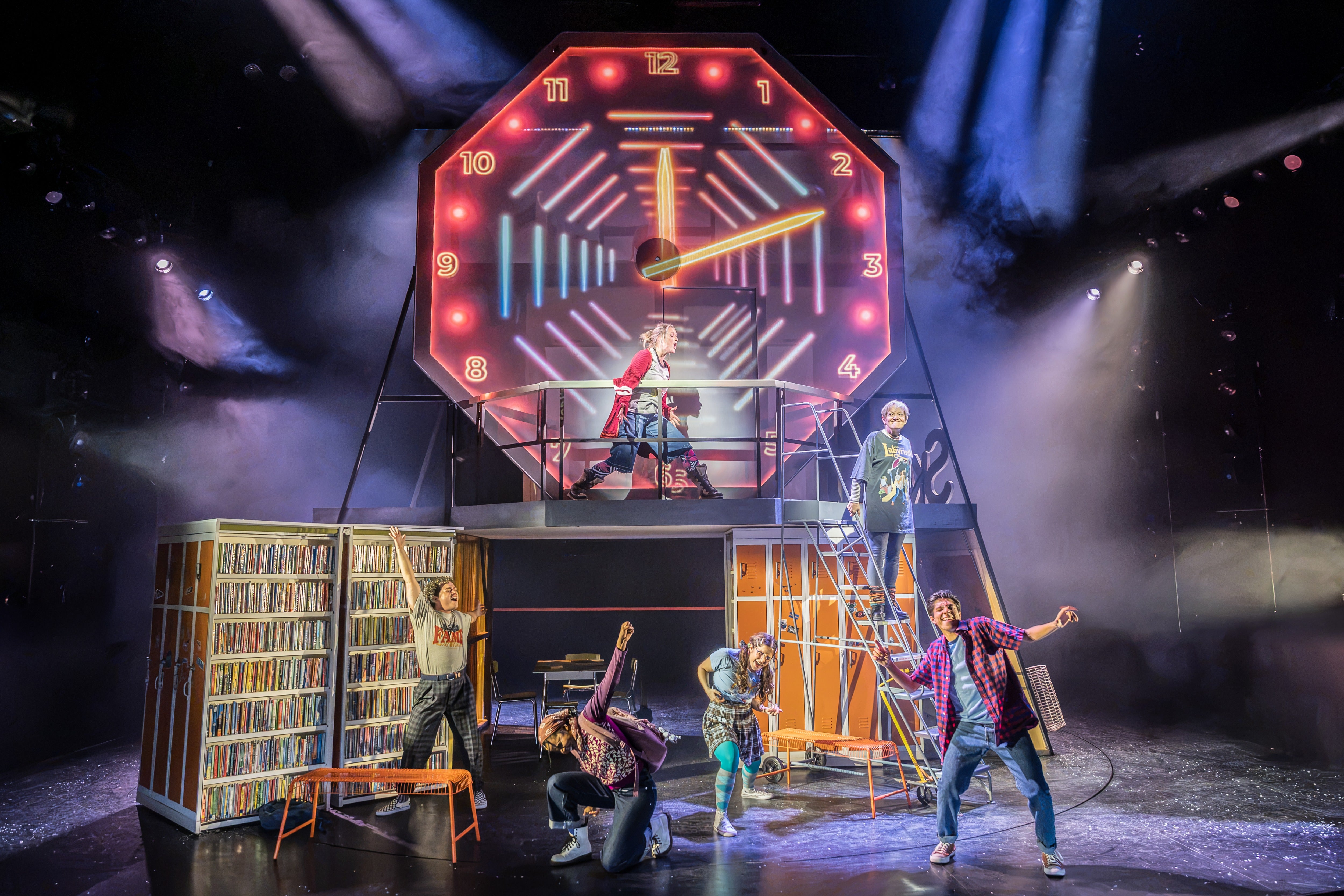
The parameters of Kimberly’s world are contained within one shapeshifting set, designed by Soutra Gilmour, which rotates 360 degrees to become an ice rink, a high school (evoked by a facade of hallway lockers), a library, and Levaco’s three-story house. A giant animated backdrop, mostly used to resemble a big clock, is the only thing remotely cheap-looking or superfluous; mostly, this is a robustly clever staging, and the scale feels just right in its depiction of a New Jersey town that people are itching to leave.
The cast are strong without exception – among them Gilli Jones as Kimberly’s tuba-playing, anagram-obsessed love interest, and Alice Fearn a tornado-like force as Kimberly’s chaotic criminal aunt, who rumbles into town partway through the first act with a harebrained get-rich-quick scheme. It’s Friedman, though, who’s most impressive, ably mimicking the physicality of a teenage girl with a sincerity that evades caricature; it’s the sort of role that is almost never available for older actors, and she makes it look natural. At 66, her voice remains a thing of power and clarity.
Shows like this often live and die by the music, and there is much to enjoy about Tesori’s score, and Lindsay-Abaire’s lyrics, which are never really intricate (beyond the odd internal rhyme) or profound, but consistently lively and well-judged. The music is a cut above most modern musicals, tempering the sort of bright, generically popish sound of its bigger numbers with more classical musical-theatre forms elsewhere.
The question, with imports like Kimberly Akimbo, is whether they will be able to charm British audiences in the same way they did Americans: will a joke about the ignominy of being a Bruce Springsteen hater in New Jersey carry over to North London? Ultimately, the show keeps things broad. This is not a musical about New Jersey at all, or about an ultra-rare genetic malfunction that only a handful of people will ever have to deal with. It is a show about aging, and about youth – those most thoroughly universal of experiences. And in this, it is a clear success.
‘Kimberly Akimbo’ is at the Hampstead Theatre until 7 November