










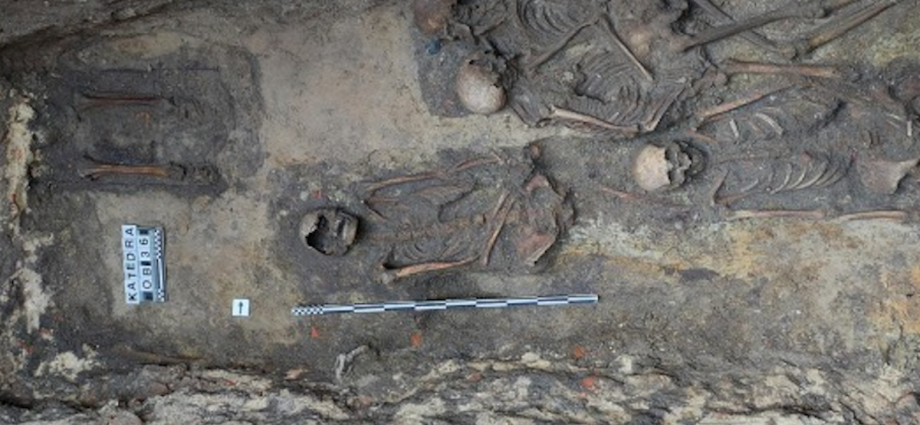
A strange pair of “hugging skeletons” unearthed next to a 13th-century Polish cathedral has been confirmed to be the country’s first medieval same-sex double burial, raising further questions about the lives of the mysterious women.
Double burials typically offer insights into the cultural practices and social structures of past societies, with the buried individuals often being connected through social ties or kinship.
A growing body of studies is applying genetic analysis methods to probe medieval burials across Europe for a better understanding of the relationship between the buried individuals.
Many medieval group burials have so far been found to be those of family members buried together, or those of men who died in battle buried side by side.
Now, scientists have assessed DNA from skeletons part of a double burial excavated at the Cathedral Church of the Exaltation of the Holy Cross in Opole, Poland, in which two adult individuals were buried in a “mutual embrace”.
Researchers found that both the buried individuals are genetically unrelated females.
This provides evidence of the first genetically confirmed same-sex double burial from medieval Poland, scientists write in the study published in the Journal of Archaeological Science: Reports.
However, any assumptions about the relationship between the two individuals based on their body position and physical sex estimation can be misleading, researchers warn.
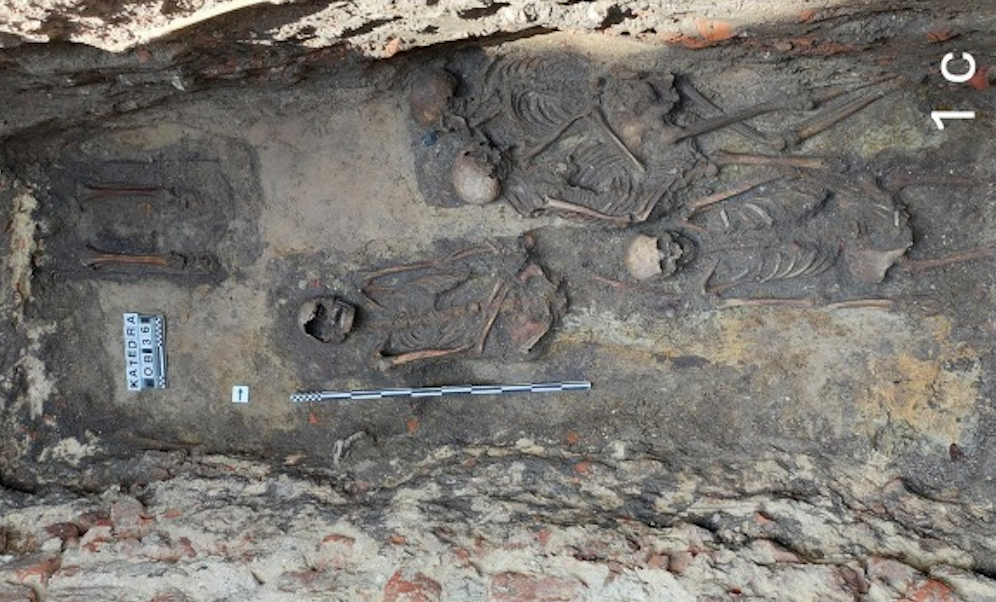
In the study, scientists assessed DNA from the two bones and reconstructed parts of the individuals’ genetic code.
They then used computational tools to reconstruct missing parts of their genetic code.
The analysis confirmed that both individuals were female and genetically unrelated.
But researchers are unsure why the two adult women were buried together in a mutual embrace.
The women were buried next to the cathedral’s walls, a position typically reserved for kings and nobles.
This suggests that the two were not marginalised by medieval society, researchers say.
Since same-sex partnerships were punished with execution in medieval times, if the two women had been suspected of being romantic partners, they may not have been buried in such a special grave, they say.
“The absence of close genetic kinship between the two women suggests that their association was grounded in social, institutional, or situational ties,” researchers wrote.
Scientists hope that future genetic analysis of other medieval graves in the area may provide clues to whether same-sex burials were part of a larger trend.