










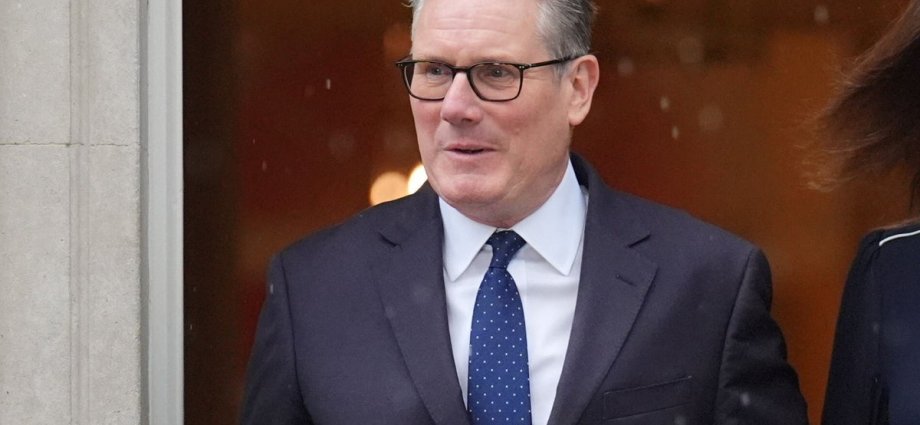
The FTSE 100 rallied on Wednesday, led by mining stocks, while gilts steadied as Prime Minister Sir Keir Starmer kept a precarious grip on power.
The FTSE 100 closed up 60.03 points, 0.6%, at 10,325.35. The FTSE 250 ended up 62.17 points, 0.3%, at 22,528.37, and the AIM All-Share rose 6.55 points, 0.8%, at 817.21.
In London, reports suggested Health Secretary Wes Streeting plans to step down and could mount a formal challenge to Sir Keir on Thursday.
Mr Streeting confronted his party leader over the crisis engulfing Labour as the pair met for crunch talks – which lasted less than 20 minutes – in Downing Street ahead of the King’s Speech.
According to various reports, Mr Streeting has told allies he is preparing to quit government on Thursday and run for the top job.
The pound nudged up to 1.3520 US dollars on Wednesday afternoon from 1.3505 dollars on Tuesday. Against the euro, sterling was higher at 1.1542 euros from 1.1517 euros on Tuesday.
The yield on UK 10-year gilts traded at 5.07%, cooling from 5.10% the day before.
Kathleen Brooks, research director at XTB, said markets “remain sensitive to all news out of Westminster, and it is hard to see how the Prime Minister can stop another coup against him”.
JPMorgan analyst Allan Monks said the political developments create significant uncertainty regarding the future leadership of the governing Labour Party, and hence the future path of fiscal policy.
“While the odds of a leadership change this year have increased, the precise path and outcome remain hard to judge. One observation relevant for the gilt market is the sheer length of time it could take to gain clarity over the fiscal outlook,” he said.
Mr Monks estimates the costs of higher borrowing since March, when the Middle East crisis flared, to be around £11 billion, knocking down the Government’s fiscal headroom to £13 billion.
Elsewhere, the fragile ceasefire in the Middle East held as US President Donald Trump headed to Beijing for talks with his counterpart Xi Jinping.
The International Energy Agency warned that countries were tapping into oil inventories and strategic reserves at a “record pace”, meaning further price volatility was likely.
Brent crude for July delivery was trading at 107.33 dollars a barrel on Wednesday, down compared to 108.07 dollars at the time of the equities close in London on Tuesday.
In Europe on Wednesday, the CAC 40 in Paris ended up 0.4%, and the DAX 40 in Frankfurt advanced 0.8%.
In New York, the Dow Jones Industrial Average was down 0.4%, the S&P 500 rose 0.2% while the Nasdaq Composite was 0.7% higher.
The yield on the US 10-year Treasury widened to 4.50% on Wednesday from 4.46% on Tuesday. The yield on the US 30-year Treasury stretched to 5.05% from 5.02%.
The euro traded lower against the US dollar, at 1.1715 dollars on Wednesday from 1.1729 dollars on Tuesday. Against the yen, the dollar was trading at 157.81 yen, higher than 157.73 yen.
Following Tuesday’s strong US consumer inflation figures, producer price data also surprised to the upside.
The Bureau of Labour Statistics said producer price inflation accelerated to 6.0% in April, from 4.3% in March, the latter revised up from 4.0%. The latest reading, the hottest in more than three years, topped the FXStreet cited consensus of 4.9%.
Mining stocks propped up the blue-chip FTSE 100 with Antofagasta up 8.7%, Metlen Energy & Metals up 7.2%, Anglo American up 4.5% and Rio Tinto up 4.4% as metals price rose.
Fresnillo, up 4.0%, benefited from a strong gold price with the yellow metal trading at 4,690.487 dollars an ounce on Wednesday, up from 4,663.87 dollars on Tuesday.
Intertek gained 5.3% as it backed the latest takeover tilt from suitor EQT Fund Management Sarl, after rebuffing three prior proposals.
EQT’s final proposal is worth £60 per share in cash, £61.077 including a final dividend. Together with the dividend, the tilt values Intertek at £9.40 billion.
Intertek said it “remains highly confident” in its standalone strategy and value creation plan. But it said the EQT offer would “deliver value in cash to Intertek shareholders”. As a result, it would be “minded to recommend” it, should a firm offer materialise.
Airtel Africa slumped 13% as Bharti Airtel confirmed it will raise its stake, but buy shares at a discount to the prior closing share price.
On Monday, shares had shot up 15% after Bharti Airtel – which has a 63% stake in the company – convened a meeting for Wednesday to consider a reorganisation of its subsidiaries’ shareholding structure, including Airtel Africa.
On the FTSE 250, Vistry was in the doldrums, down 12%, as it warned first-half profit will be “significantly lower than the prior year”.
JPMorgan analyst Zaim Beekawa said it “is a pretty disappointing update given the magnitude of downgrades implied and, particularly, given street numbers have already come down meaningfully”.
Elsewhere, recruiters PageGroup and Hays fell 5.6% and 7.4% respectively as Swiss peer Adecco plunged 17% after flagging weaker second-quarter margins.
While shareholders in Cordel were smiling as its share price doubled after accepting a £29 million bid worth 12.4 pence per share from Vossloh.
The biggest risers on the FTSE 100 were Antofagasta, up 345.00p at 4,299.00p, Metlen Energy & Metals, up 2.70p at 40.18p, Intertek Group, up 280.00p at 5,580.00p, Anglo American, up 177.00p at 4,075.00p and Rio Tinto, up 352.00p at 8,272.00p.
The biggest fallers on the FTSE 100 were Airtel Africa, down 54.20p at 359.60p, Relx, down 122.00p at 2,333.00p, Experian, down 123.00p at 2,526.00p, Sage Group, down 31.20p at 847.60p and Imperial Brands, down 76.00p at 2,756.00p.
Thursday’s global economic calendar has UK GDP data at 7am followed by US retail sales figures and the weekly initial jobless claims report.
Thursday’s local corporate calendar has first quarter results from insurer Aviva and full-year earnings from property investor Land Securities, luxury goods brand Burberry and electricity generator National Grid.
Contributed by Alliance News