









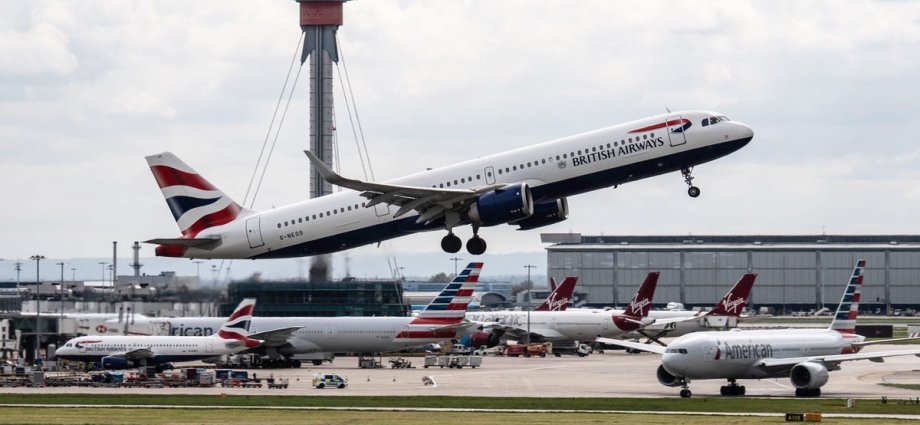
British Airways’ parent company warned its profits will be hit as it expects to spend about two billion euros (£1.72 billion) more than planned on fuel this year amid the Iran oil crisis.
International Airlines Group (IAG) chief executive Luis Gallego said it is “managing the uncertainty” caused by the fuel price increase by “taking the necessary action on yields, costs and capacity”.
He added: “Whilst the impact of the higher fuel price will inevitably lead to lower profit this year than we originally anticipated, we are confident in our business model and strategy.”
IAG shares fell by 4% in early trading on Friday after it said it expects its fuel cost to reach nine billion euros (£7.78 billion) this year, which will affect its full-year profit and free cash flow.
Iran continues to have a stranglehold on tankers passing through the Strait of Hormuz, leading to a surge in oil prices and concerns over jet fuel shortages.
Global figures released this week by aviation analytics company Cirium show 13,005 flights planned for May were cancelled between April 10 and April 21, equivalent to 1.5%.
On jet fuel supply, Mr Gallego said IAG does not believe there will be “any interruption for the summer”.
He acknowledged there is less jet fuel coming from the Middle East, but there are “other places with record supply” such as the US.
Mr Gallego said IAG has been “planning for situations like this for many years”, and has invested in its own jet fuel supply at its “main hubs”.
He added that “markets like Asia that were weaker” in terms of their fuel supplies are now “building up reserves”.
IAG said it has seen “strong demand across most of our markets” but “softer demand” in the eastern Mediterranean.
The company recorded a pre-tax profit of 422 million euros (£365 million) during the three months to the end of March.
That was a 76.6% increase from 239 million euros (£207 million) a year earlier.
Mr Gallego attributed the firm’s “strong first quarter” to “continued strong demand for our networks and airline brands”.
He went on: “IAG is uniquely positioned to navigate the current headwinds created by the Middle East conflict thanks to our leading positions across diverse markets, strong brands, structurally high margins and strong balance sheet, as well as a strong track record of execution.”
IAG said about 3% of its capacity was “exposed to the Gulf region” at the start of the war on February 28, mostly with British Airways flights.
A large part of this has been redeployed, including boosting capacity at destinations where there are now fewer flights by Middle East carriers such as Bangkok, Singapore and the Maldives.
British Airways has also announced additional flights this summer on routes with higher demand for direct flights, such as India and Nairobi.
IAG results come a day after Middle Eastern carrier Emirates said it remained “the world’s most profitable airline” after recording a pre-tax profit of 24.4 billion dirhams (£4.88 billion) in the year to the end of March, up 7% from the previous 12 months.