










Want to bookmark your favourite articles and stories to read or reference later? Start your Independent Membership today.
Join today
Already a member?
Log in
More than one billion years of Earth’s geological history has been missing for decades, in a longstanding conundrum pioneering 19th century U.S. explorer John Wesley Powell coined the “Great Unconformity.”
The mystery came with examining layers of rock. Typically, rocks are the youngest on the top, and the oldest on the bottom – but researchers have observed a massive, unexplained gap in time between sedimentary rocks and older crystalline rocks around the world.
Now, scientists in Australia say they think they know what happened.
The answer lies in the rise and fall of ancient continents due to hot currents deep beneath the Earth’s rocky crust, researchers at the University of Wollongong argue in a study published earlier this month.
Modeling these currents – which can lift huge areas of land – revealed land rise hundreds of millions of years ago, followed by a long period of sinking. The cores of the land gradually sank into the ocean and were buried by sediment, they wrote.
“Sometimes what is missing can tell us more about the story of Earth than what we can see. A single, long period of uplift followed by a long period of sinking would have been the ideal recipe for removing the rock and preserving the worn surface,” Associate Professor Nicolas Flament explained in a release.
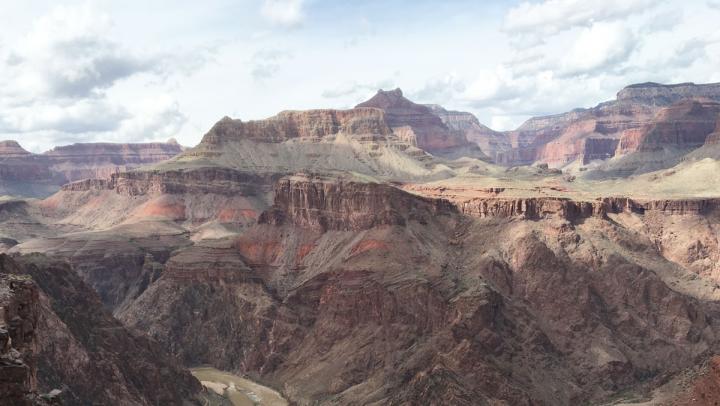
Rocks that show the signs of the Great Unconformity have been found in New Mexico and Arizona’s Grand Canyon, which was once part of the ancient continent known as Laurentia.
But proof of the gap has also been uncovered in Europe, Australia, Africa and Asia.
The evidence is best preserved and documented in North America, northern Europe and northern China, the researchers say.
The modeling showed that currents in those regions triggered the continents to rise during the Neoproterozoic Era, which spans between 541 million and 1 billion years ago.
This era ended with the Cambrian period, which brought an explosion of animal life on Earth, the university added.

However, more research needs to be done in other regions of the world to complement the work, the researchers said.
One recent theory for the cause of the Great Unconformity was that glaciers had removed rock around 635-720 million years ago, during a time known as “Snowball Earth.” The eroded material could have given the oceans nutrients needed to sustain life.
Yet, granite from Colorado showed that rock had been eroded above the granite between 1,000 and 720 million years ago, before the Snowball Earth, researchers from the University of California, Santa Barbara found in 2020.
The erosion lined up better with the period when the supercontinent Rodinia – which included Laurentia – formed and broke apart.
“The basic hypothesis is that this large-scale erosion was driven by the formation and separation of supercontinents,” geologist Francis Macdonald said.
Testing theories for the Great Unconformity has been a challenge, the Australian researchers wrote in The Conversation. That’s because “the primary evidence consists of missing rock.”
“As a result, we need to work from what we already know to fill in the gaps,” they said.