









Want to bookmark your favourite articles and stories to read or reference later? Start your Independent Membership today.
Join today
Already a member?
Log in
A test administered during sleep can help determine the risk of heart disease years in advance, scientists demonstrate in a new study.
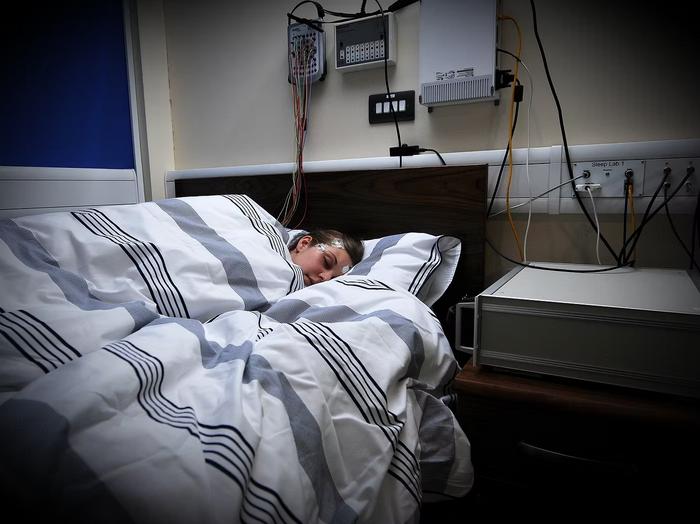
Polysomnography is a standard test conducted during sleep to diagnose disorders like insomnia and obstructive sleep apnea.
While ECGs are recorded during these tests, they are not often analysed deeply.
In the new study, scientists wanted to see if these recordings could be used to predict the 10-year risk of heart-related conditions such as irregular heartbeats, heart attack, and stroke.
Researchers used an artificial intelligence model to analyse patient ECG data from sleep studies.
The AI model learned from the dataset of more than 15,000 patients at the Massachusetts General Hospital in Boston, US.
“Deep learning applied to nocturnal ECGs with sleep stage information captures cardiac abnormalities,” scientists explained the methodology in the study published in the journal Sleep. “Integrating such prediction into polysomnography could enhance detection and support personalised clinical decision-making.”
The AI model then assessed two datasets that included over 9,800 patients from Emory University Hospital in Atlanta and more than 12,500 patients from Beth Israel Deaconess Medical Centre in Boston.
Scientists found the model could sort people into groups with different levels of long-term cardiovascular risk.
It retained its predictive value for heart attack and irregular heart rhythms in later life even after adjusting for other risk factors such as age, sex, BMI, diabetes, and hypertension.
Based on this, scientists say heart disease outcomes can be predicted from ECG data in sleep studies, making this a promising approach.
“Using large-scale sleep study data, the model predicts atrial fibrillation (irregular heart rhythm), stroke, myocardial infarction, heart failure, and death up to ten years after the sleep study,” scientists wrote.
“Given the close relationship between sleep disorders and cardiovascular disease, this work addresses a largely unexplored opportunity for risk prediction in sleep study populations.”
The method can predict heart disease by assessing just one night of sleep, making the approach highly accessible through simple, low-cost patches, researchers say.
“The score from our deep learning model improved prediction of cardiac outcomes beyond established risk factors,” said Gari Clifford, an author of the study from Emory University.
“Adding these scores into sleep studies has great potential for improving early detection of cardiovascular disease, determining who is most at risk, and being more proactive in patient care.”