








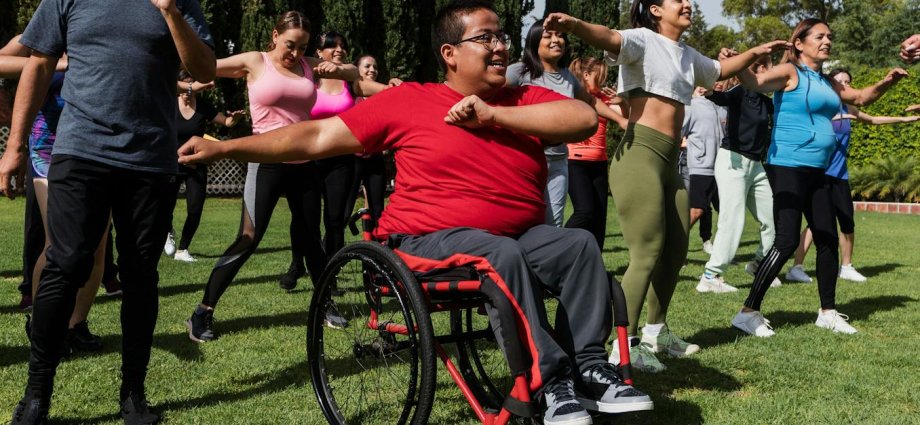
For some people with disabilities, going swimming or attending an exercise class comes with a worry that many others would never consider: could being seen to be physically active lead to their disability benefits being stopped?
This fear is known as the activity trap. A new report published by Disability Rights UK draws on research I led at Durham University and developed with disabled people and disability organisations. Of the disabled people we surveyed, 80% worried that being physically active could put their benefits at risk.
Only one in five participants who had applied for or were receiving benefits were happy with how much physical activity they did. Nearly three-quarters said they would be more likely to increase their activity if they knew their benefits would not be affected.
Disabled people already face barriers to physical activity, including high costs and facilities that are difficult to access. Nearly 40% of disabled adults in England do less than 30 minutes of moderate-intensity physical activity a week, according to Sport England. This means activity that makes someone breathe faster than usual, such as brisk walking. The proportion is almost twice that of non-disabled adults.
The activity trap was first highlighted in research published in 2018, when almost half of disabled respondents said they feared losing benefits if they were seen being active.
To explore how this fear affects people’s lives, we surveyed more than 200 disabled people and held group discussions with more than 30 participants. We also examined relevant laws and legal cases.
Participants described feeling encouraged to exercise to manage their health while worrying that being active could be taken as evidence that they no longer needed financial support. One participant said: “I would love to go to the gym, every day, but I don’t dare because I would be seen as being too physically fit.”
Others worried about being reported for benefit fraud if someone saw them enjoying an activity in public.
More than one-quarter of participants who had applied for or were receiving benefits reported having benefits or other financial support removed because of physical activity. These findings describe participants’ experiences; the survey alone cannot establish why individual benefit decisions were made.
How can physical activity affect benefits?
Much of our research focused on personal independence payment (PIP). This benefit helps with the extra costs of living with a disability or long-term health condition. People can receive it whether they work or not.
To decide who qualifies, officials assess how someone’s condition affects everyday activities, such as preparing food, washing and moving around. Going to the gym does not automatically mean someone will lose their benefits. But evidence of physical activity may be considered when deciding what someone can do.
Under existing PIP guidance, assessors must consider whether someone can carry out an activity safely, to a reasonable standard, as often as needed and without taking an unusually long time. They must also consider conditions that vary from day to day.
Yet participants told us that assessors sometimes appeared to place too much emphasis on isolated examples of physical activity, without adequately considering the pain, fatigue or other difficulties they experienced.
Our examination of legal cases revealed similar problems. In one 2024 upper tribunal case, a decision about a man’s entitlement to PIP had relied partly on observations of his ability to walk. However, the tribunal had failed to establish how far he could walk within a reasonable time, how frequently he needed to rest and whether he could repeat the activity. The upper tribunal ruled that the decision was legally flawed and ordered the case to be heard again.
The effects extended beyond physical activity. Of those who answered our survey question about the benefits application process, 84% said it had negatively affected their mental health. Some felt forced to concentrate on everything they could not do, while others said their own accounts or medical evidence were dismissed. The prospect of having to challenge a decision added to their anxiety.
What needs to change?
These findings come as the UK government reviews PIP. The Timms review has acknowledged that the current system can discourage physical activity and participation in community life.
Our report calls for better training for assessors, independent advice for people applying for benefits or challenging decisions, and greater involvement of disabled people and organisations led by them in designing the assessment system. These changes could help ensure decisions reflect the realities of living with a disability, including conditions that fluctuate.
A benefits system intended to support the independence of people with disabilities must recognise that occasionally being physically active does not mean someone no longer needs financial support. The challenge now is to ensure that this principle is reflected in how benefits decisions are made.

Toni Williams receives funding from Disability Rights UK. Toni Williams acknowledges the contribution of Sophia Kleanthous, of Disability Rights UK, to the research and the development of this article.