









Stock prices in London closed slightly lower on Monday, as rising oil prices fuelled inflation concerns, while investors also digested UK Chancellor John Healey’s pledge to control public spending ahead of next month’s Budget.
The FTSE 100 index closed down 8.96 points, 0.1%, at 10,822.13. The FTSE 250 ended down 78.03 points, 0.3%, at 24,506.68, and the AIM all-share closed down 0.41 points, 0.1%, at 799.50.
In European equities on Monday, the CAC 40 in Paris closed up 0.3%, while the DAX 40 in Frankfurt ended down 0.3%.
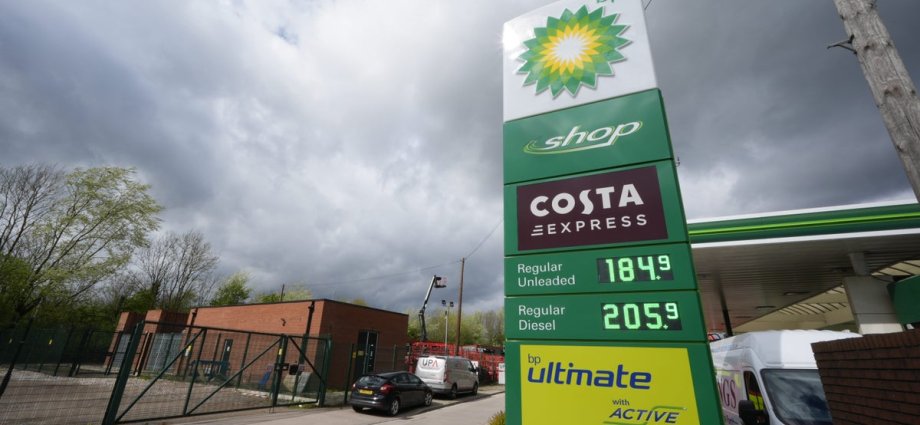
Oil prices rose following US attacks on Iranian ships.
A barrel of Brent surged to 97.89 dollars on Monday afternoon from 95.18 dollars at the time of the London equities close on Friday, following US attacks on Iranian tankers and the threat from Tehran of a new restricted zone outside the Strait of Hormuz.
London-listed oil majors, Shell and BP, rose 1.3% and 1.2%, respectively.
The US said it launched strikes on three Iranian oil tankers over the weekend, destroying one of them, in retaliation for attacks on US Navy warships. In response, Iran’s top security official said a new restricted zone outside the Strait of Hormuz will be declared in the coming days.
Dan Coatsworth, head of markets at AJ Bell, said: “Concern about inflationary risks is only exacerbated by the latest moves in energy markets, as Brent crude briefly ticked over 97 dollars per barrel. The US and Iran continue to exchange strikes as a resolution to the crisis in the Middle East remains elusive.”
In the UK, Chancellor John Healey said the economy was “turning a corner” as he pledged to keep government spending under control in next month’s budget.
In his first major speech since taking over at the Treasury, Mr Healey acknowledged the pressure from high government borrowing costs and pledged to tackle the growing burden on businesses, while striking an optimistic tone on the economic outlook despite global crises including the war in the Middle East and Russia’s invasion of Ukraine.
Speaking in Coventry ahead of the first budget since Prime Minister Andy Burnham entered 10 Downing Street, Mr Healey said: “The prime minister and I are in lockstep in our commitment to meeting the fiscal rules at the upcoming budget, to balancing the books with a buffer to protect against uncertainty.
“To controlling borrowing to bear down on inflation and reducing long-term pressures on our public finances.”
The pound was quoted at 1.3516 dollars at the time of the London equities close on Monday, down from 1.3522 dollars at the time of the London equities close on Friday. Against the euro, sterling was slightly higher at 1.1638 euro from 1.1636 euro.
Versus the dollar, the euro was higher at 1.1629 dollars from 1.1614 dollars. Against the yen, the dollar slumped to 154.33 yen from 156.03 yen.
Centrica led the FTSE 100, up 2.2%.
In second place, Standard Life rose 2.0% after reporting a stronger-than-expected half-year profit and saying it remains on track to deliver on its guidance.
The London-based retirement savings provider said its attributable pre-tax loss widened to £272 million in the first half of 2026 from £209 million a year earlier, although total income surged to £21.73 billion from £8.60 billion.
Next rose 1.1% after winning its appeal against a landmark equal pay ruling in the UK, which the retailer had said would threaten the viability of a number of its stores.
On the FTSE 250, Hollywood Bowl Group was the worst performer, losing 6.0% after Deutsche Bank cut its price target for shares of the tenpin bowling operator to 358p from 376p, while retaining its “buy” rating.
At the other end of the mid-cap index, Oxford BioMedica rose 5.8%, while B&M European Value Retail gained 3.4% after RBC raised its price target to 275p from 240p, maintaining an “outperform” rating.
Among smaller caps, Kropz plunged 33% after the phosphate producer and developer launched an “urgent operational review” of its Elandsfontein asset.
Kropz said the asset has been unable to achieve operating profitability due to lower realised sales prices and rising costs, which it blamed on the US-Iran war.
“These conditions have necessitated an urgent operational review and the implementation of a restructuring process. This operational review and restructuring process will result in a reduction of revenue generated from phosphate rock,” Kropz said.
United Oil & Gas jumped 24% after naming Donal Meehan, who has upstream experience at Exxon Mobil, as its new operating chief.
IQE rose 3.0% as it celebrated a “strong first half”, with revenue jumping 43% and its loss narrowing. The semiconductor wafer products manufacturer also reported a surge in adjusted earnings, with trading ahead of internal expectations and reinforcing its confidence for the full year.
IQE shares also benefited from a broader technology rally that tracked gains across Asia-Pacific tech stocks amid optimism that OpenAI’s newest artificial intelligence model could spur increased demand for memory chips.
ChatGPT-maker OpenAI said last week it will begin rolling out its latest AI model, GPT-6, also known as Astra, to selected customers. OpenAI sees the model as a key part of its push towards artificial general intelligence, while saying it has built in safeguards aimed at mitigating security risks.
AJ Bell’s Mr Coatsworth said: “Many of the headlines from the dominant AI theme remain positive, and that supported gains for South Korean stocks, but investors are having to contend with the potential for an interest rate hike at the US Federal Reserve’s meeting later this month.”
Ahead of the European Central Bank’s interest rate decision on Thursday, figures on Monday showed the eurozone economy expanded more strongly than previously thought in the second quarter of 2026.
Seasonally adjusted gross domestic product grew 0.6% in the second quarter from the first, accelerating from no growth in the first quarter. The reading was revised higher from a previous estimate of 0.4% published in mid-August.
Across the wider EU, GDP increased 0.7% quarter-on-quarter, revised up from 0.5%, following growth of 0.1% in the first quarter.
Gold traded at 4,412.10 dollars an ounce late on Monday afternoon, down from 4,439.40 dollars on Friday.
Financial markets in New York were closed on Monday for the Labour Day holiday.
Average diesel prices in the US climbed to a record on Monday as damage to Gulf refineries during the war against Iran disrupted supplies.
The average price of diesel, which is widely used in road haulage, agriculture and construction, hit 5.9015 dollars a gallon, according to motorists’ association AAA, around 30 cents higher than a week earlier.
The biggest risers on the FTSE 100 were Centrica, up 3.3p at 153.1p; Standard Life, up 19p at 951.5p; Smiths Group, up 34p at 2,601p; Shell, up 45.5p at 3,482.5p; and Admiral Group, up 50p at 3,866p.
The biggest fallers on the FTSE 100 were Entain, down 15.8p at 512p; Haleon, down 9.5p at 343.3p; InterContinental Hotels Group, down 365p at 15,615p; St James’s Place, down 26p at 1,134p; and Fresnillo, down 67p at 3,079p.
Looking ahead to Tuesday’s economic calendar, the British Retail Consortium releases retail sales for August.
Elsewhere, there are Japanese gross domestic product figures; Chinese, German and French trade balance data; the US NFIB business optimism index; and US consumer inflation expectations.
On the UK corporate calendar, Dunelm Group reports full-year results.
Contributed by Alliance News.