









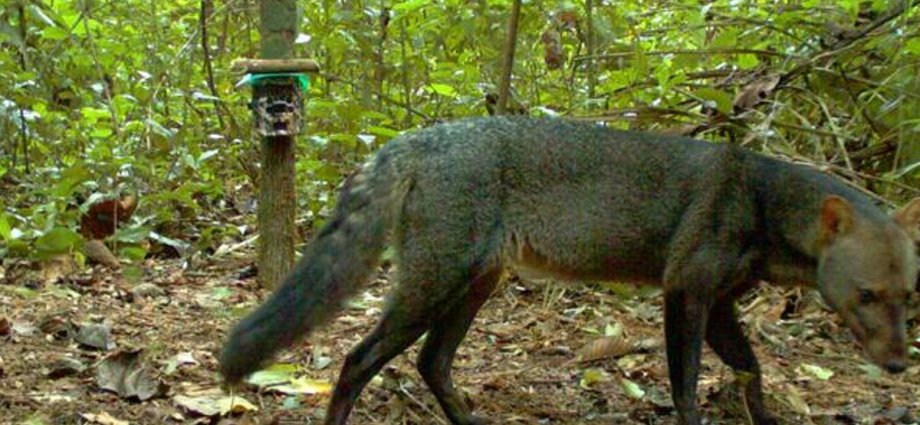
The elusive short-eared dog, one of the world’s least known canids, has been secretly thriving deep in the Amazon forest areas of Bolivia and Peru, a new study reveals.
Due to its acute hearing, strong sense of smell, and secretive nature, very few direct sightings of the dog have been made in the wild.
The cryptic animal has been an “almost mythical beast”, earning the moniker of “ghost dog”, researchers say.
Now, a new study offers fresh insights into the life of this enigmatic Amazonian predator thanks to intensive camera traps set across the jungles of Bolivia and Peru.
Photos reveal that the dog has a dark, dense coat ranging from blackish grey to reddish-brown, a large head with very small and rounded ears, short legs, and a long, bushy tail.
The species even has partially webbed paws, completely unique among dogs of the Amazon.
“The most surprising aspect of the results was that despite being an almost mythical beast, short-eared dogs are much more abundant than we had imagined,” scientists wrote in the study published in the journal Neotropical Biology and Conservation.
Over 25 years, researchers systematised 500 records of the dog across Bolivia, and conducted 34 intensive camera-trap surveys.
The camera-traps were mainly set to capture movements of the mythical beast in the Greater Madidi-Tambopata and Llanos de Moxos Biocultural Landscapes.
With over 594 photographs, the study represents the largest collection of confirmed short-eared dog records anywhere within the species’ distribution.
The research, according to scientists, is a “wonderful example of how conservation technology and remote sensing – in this case the intensive use of camera traps – can provide substantial data on one of the least known species of the Amazonian rainforests”.
Camera trap data also reveal the dog is not as rare as scientists once feared, living deep within forests with a density of 15 individuals per 100 square kilometers.
This suggests that the short-eared dogs are more abundant than larger carnivores like jaguars, but less so than medium-sized carnivores like ocelots.
The latest sightings also suggest that the dog is mainly active during the day, with their activity peaking between 6am and 12pm.
They seem to be specialised to live in upland forests, away from rivers – one main reason they have been away from visibility to humans.
This also means that their conservation depends heavily on the creation and effective management of protected areas.
“The most important management strategy is the protection of Amazonian forest canopy for which the creation and effective management of protected areas is the most important element, in combination with the sustainable management of Indigenous territories,” scientists wrote.