










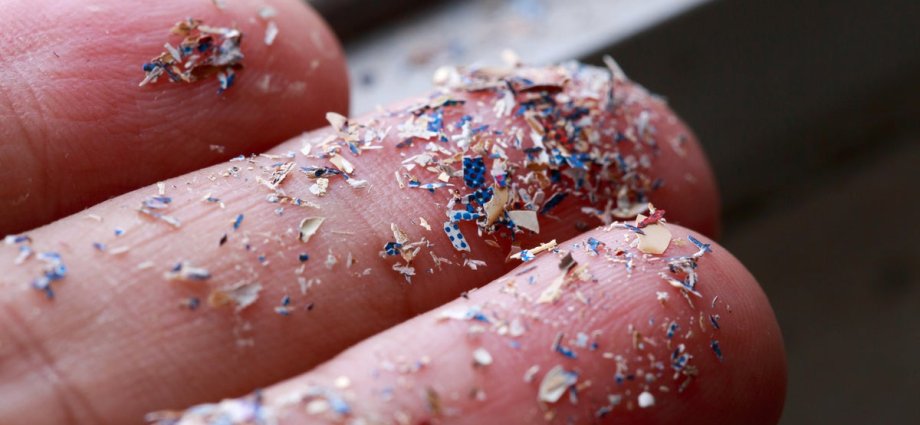
Microplastics used in coffee cups and plastic bags have been detected by scientists using a laser light to map the build-up of the tiny particles in the body.
Plastic particles have been found in fish, ocean trenches, the air we breathe, and our clothes. But detecting just how much of these microplastics end up in the human body was previously only possible through dissection.
Now a breakthrough test uses photoacoustic imaging, where pulses of laser light are directed into tissue and absorbed by microplastics. Tiny high-frequency soundwaves are created when the light is absorbed, allowing scientists to create a detailed map showing where microplastics are located within the body.
The technique means scientists are able to map microplastics without the need for surgery or taking tissue samples, and can study the impact microplastics have on human health.
Dr Stephen Patrick from University College London (UCL) Medicine, the lead author of the study, said: “Everyone on earth is exposed to microplastics – they are found everywhere: in our food, drink, clothing and home furnishings.
.jpg)
“There is growing concern over their effects on human health, which until now has been difficult to study inside living tissue. Most existing methods rely on biopsies or analysis of tissue after dissection, which limits what researchers can observe over time.
“We expect our new approach to detecting microplastics will open up new avenues of research into where these particles accumulate in the body, how long they persist, and whether they contribute to diseases affecting the brain, blood vessels and other organs.”
The study, published in the journal Advanced Science, shows that this non-invasive method can be used to detect microplastics deep in the living tissue of mice.
In the experiment, mice were given about half a milligram of microplastics – the equivalent to half a grain of salt – using an injection. Researchers then tracked how the plastic moved through the body.
As with humans, the animals were also likely to already have low background levels of microplastics from food and drinking water.
Researchers from UCL, Kingston University and the University of Birmingham detected common microplastics such as polypropylene (used in food containers and coffee cups) and polyethylene (used in single-use plastic bags).
Until now, researchers have generally needed to chemically label microplastics before tracking them inside animals, a process that can change how the particles behave and limits how realistically they can be studied.
The new method allows researchers to non-invasively map and track microplastics deep inside living tissue over months and it may even help study how other medical equipment reacts in the body.
Dr Joseph Bear, first author on the study and senior lecturer in inorganic chemistry at Kingston University London, said: “The versatility of the technique allows us to shed light on the behaviour of other plastics in the body.
“Surgical implants such as hernia meshes are a particular focus due to their frequent mechanical failure, side effects, and need for replacement. We are following this up with further research that aims to improve patient outcomes and the safety of these devices.”