











In any other profession, kissing your co-worker hundreds of times a day would be an HR issue – but in the world of acting, it’s often a job requirement.
Actors have been kissing one another on stage for centuries, and most have kept it strictly professional, but many famously haven’t. Brad Pitt and Angelina Jolie fell in love while playing a married couple in Mr & Mrs Smith; Elizabeth Taylor’s head was turned by future husband Richard Burton on the set of Cleopatra. What exactly happens if that onstage chemistry turns into a full-blown affair?
That’s the question behind Sarah Ruhl’s Stage Kiss – the latest production to arrive at London’s Hampstead Theatre. Starring The Witcher’s MyAnna Buring and Dept Q’s Patrick Kennedy, the play follows two actors with a shared romantic past as they’re cast in a production that eerily mirrors their real-life relationship history. Named “He” and “She”, the pair quickly struggle to distinguish between reality and the play’s love story as they’re swept up in the kiss-heavy script.
-MyAnna-Buring-(She)-and-Patrick-Kennedy-(He)-Stage-Kiss_credit-Helen-Murray_19.jpg)
Its stars admit that the messy, romantic relationship that unfolds in Stage Kiss can easily happen in real life within the acting profession.
“It’s really truthful,’ Kennedy tells The Independent. “It’s a very precise script, and it’s just got every note of what it is to be an actor. All the absurdity and heartbreak. There’s even the money pressures – everything’s in there.”
“Everyone’s had that first love – that really major relationship that fell apart,” Buring says, adding that while some don’t necessarily meet up with their ex later in life to have an affair, they’re left with “unresolved love”.
Kennedy and Buring are keeping things strictly business in Stage Kiss – but Kennedy admits having found himself in a similar scenario earlier in his career.
“I mean, that has happened to me,” he says. As for whether Stage Kiss brought up any raw feelings about his past situation, he adds: “I can’t say I’ve felt it in any sort of deep way, because the play is so technical that it’s hard to go into it feeling deep emotion about it. I just haven’t got there yet, and maybe that’s the problem – maybe I should.”
While many in their profession are required to perform kissing scenes at some point during their career, neither Buring nor Kennedy – who both attended Lamda – received any professional training for those moments. Indeed, it’s not uncommon for actors to be left to work it out for themselves.
-and-Patrick-Kennedy-(He)-in-Stage-Kiss_credit-Helen-Murray_66.jpg)
“I had to kiss Sam West on my first job,” smiles Kennedy – the 48-year-old starred opposite West in BBC Two’s Cambridge Spies in 2003. “It was actually fine, because I didn’t care what he thought.”
“Did you slip him the tongue?” Buring teases. “He slipped me the tongue, I think,” Kennedy jokes.
But it’s not always a pleasant experience – something to which Buring can attest. “I’m definitely not going to name and shame, but there’s a very clear example where I was like, ‘Crikey, I should have won an award for that if it looked like there was any intimacy going on,’” she laughs.
For some actors, kissing is a step too far. Industry’s Myha’la revealed in January that she no longer performs kissing scenes since marrying her husband, as the act feels “sacred”. However, that wasn’t an option for Buring and Kennedy, who knew what they were walking into because, well, the clue is in the play’s title. They were, however, assisted by an intimacy coordinator.
“You can’t say yes to this play and be like, ‘I’d rather not do kisses’,” Buring says. “But I think the way that we did it and approached it with [director Blanche McIntyre] and our intimacy coordinator Yarit [Dor] was just all really pragmatic, which is useful and clear and caring.
“It’s like stage fighting in a way, because you’re doing something physical with your body, and there are different movements, intentions, eye contact, where hands go or don’t go. That all affects it. Then you can rehearse it quite intensely without going home and saying, ‘Oh God, I just snogged somebody for nine hours today.’ It’s more of an exercise when you do it.”
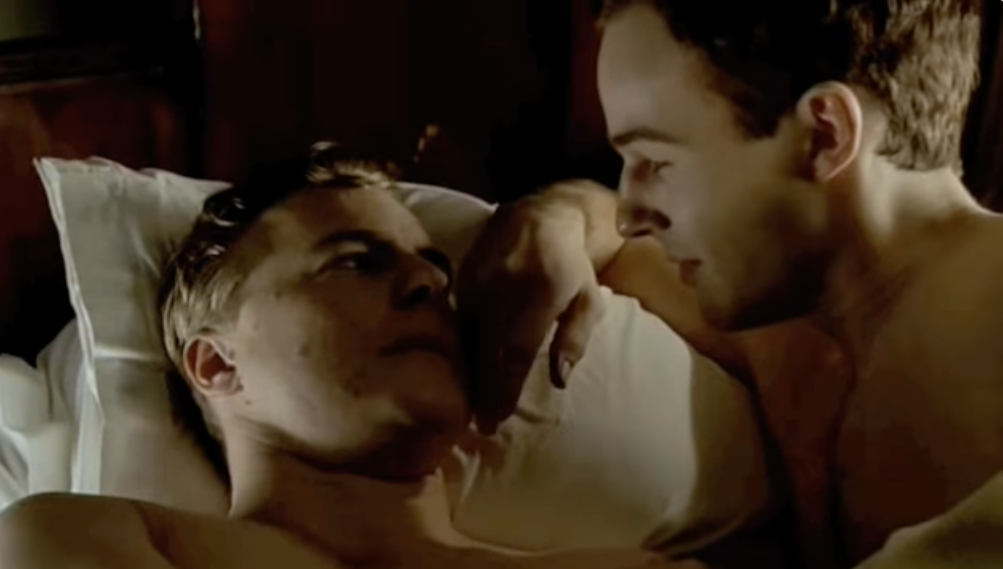
In fact, intimacy coordinators – the people who choreograph intimate scenes in film, TV and theatre and ensure the actors’ safety and consent – have changed everything for actors since becoming a set staple almost 10 years ago, prompted by the #MeToo movement. In Stage Kiss, the characters themselves don’t have the opportunity to work with an intimacy coordinator – the play was written in 2011, before the role became commonplace.
“That would be unheard of now, which is amazing,” Buring says. “That’s a real move forward. Ten years ago, there wasn’t the language for it, whereas now this kind of language trips off our tongues really easily. It’s easier to come into work and be like, ‘I’ve woken up feeling quite sensitive. Can we just not do the kisses today?’
“Knowing you have that option there, I think it’s really important – especially for younger actors, because I feel that often they’re the ones put in the most precarious situations within our industry, in terms of kissing, sex scenes, anything that’s to do with physical touch. I think the language, and the fact that intimacy coordinators exist, is really useful.”
Kennedy adds, “For me, it’s not about personal boundaries. It’s just about choreography. It’s having someone else help you talk through it very early on.”
Stage kissing still comes with its risks, though – namely the prospect of spreading germs. “If one of us goes down, we’re all going down,” warns Buring, who kisses almost everyone else in the seven-person cast during the play.
“We said that quite early on. It’s hayfever season as well, so we had quite a lot of streaming eyes and noses. We’ve been like, ‘Is this a cold or is it hayfever?’”
But Buring is adamant that no one in the cast need worry. “It is hayfever.”
‘Stage Kiss’ is at the Hampstead Theatre until 13 June