







When Sir David Attenborough was born in 1926, George V was on the throne, Stanley Baldwin was in Downing Street, and the BBC, the institution where he would spend many productive decades, was, itself, still in nappies.
Over the years, Attenborough has become the face and voice of natural history the world over. From chasing animals through jungles and deserts, to observing the myriad changes to our ecosystem in his near century on planet earth, Attenborough has been a guide through the wild citizens and untouched places of our world.
Here, ahead of his 100th birthday this week, we look at some of the moments from his televisual oeuvre that have defined Attenborough for generation after generation.
Attenborough and the puffins, Wild Isles
As the years have gone by, Attenborough’s forays in front of the camera have become increasingly rare. Appearing in 2023’s domestic-focused Wild Isles, Attenborough sits amid a colony of Pembrokeshire puffins. “Never has there been a more important time,” he implores the audience, “to invest in our own wildlife.” In its accessibility and urgency, it shows a man still, somehow, in his prime.
Attenborough and the leatherback, Blue Planet II
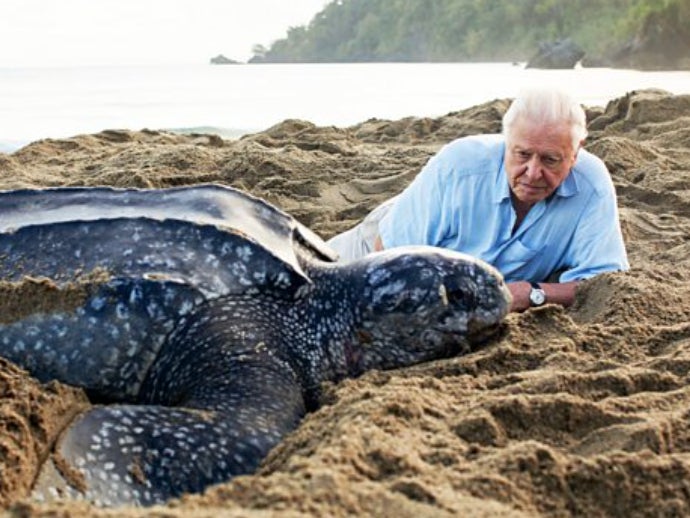
At the ripe age of 91 years old, Attenborough could’ve been forgiven for reclining on a beach in the Caribbean. That he would do so, back in 2017, in the moonlit company of leatherback turtles is typical of the man. “Whoops,” he exclaims, with a half-chuckle, as a giant leatherback turtle prepares to lay her eggs. All that’s missing from the scene is a striped beach towel and pina colada.
Attenborough vs curling at the Winter Olympics, Radio 1
Attenborough’s voice and intonation make him ripe for parody, a fact he made light of when appearing on Greg James’s Radio 1 show back in 2014. Lending his dulcet tones to the women’s curling event at the Winter Olympics, he narrated proceedings in trademark fashion. “The frisking is frantic,” he said, as the stone slid down the Sochi ice, “and often futile.” The seriousness of his voice paired with the lack of self-importance has been key to his success (both as a sports commentator and, more often, a wildlife presenter).
Attenborough on Raine Island, Planet Earth III x Zoo Quest
“As far as I know,” Attenborough told viewers, during 2023’s Planet Earth III, “I was one of the first people to film on Raine Island, back in 1957.” It was 66 years ago when Attenborough first set foot on this coral cay in the Great Barrier Reef to witness the world’s largest population of green turtles for an episode of his show Zoo Quest. Reflecting on this so many decades later, with the same issues at stake, is a remarkable feat of both zoological and televisual longevity.
Attenborough and sloth, The Life of Mammals
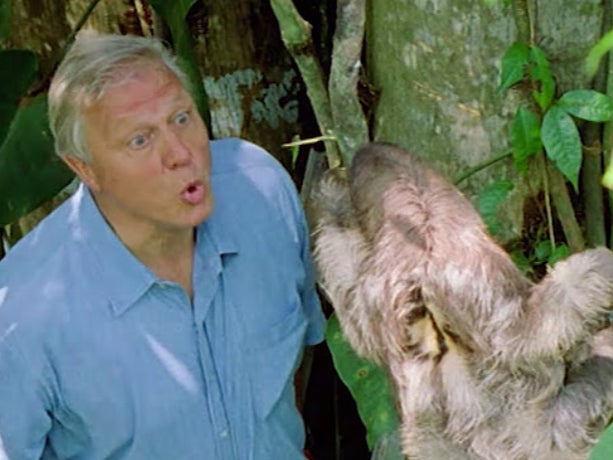
In 2002, Attenborough was back to his roots as a hands-on zoologist for this 10-part series about earth’s dominant animal class. But it was an intimate interaction shared with a sloth (“the most extraordinary plant predator”) that captured viewers’ imaginations. “Boo!” he says to the sloth, with somewhat uncharacteristic playfulness. The central American herbivore looks back at the naturalist, stretching its head out in measured curiosity, and for a beautiful moment it’s ambiguous as to who is scientist and who is subject.
Attenborough vs python, Zoo Quest
Back in the 1950s – long before bravura herpetologists had turned snake wrangling into a TV artform – a young Attenborough found himself in Indonesia, face to face with an enormous python. Not much older than 30, Attenborough already possessed that recognisable voice of his – but what is utterly unrecognisable is the figure nimbly scuttling up a tree, khaki shirt unbuttoned to reveal a rippling torso. The conscientious tone that would come to typify Attenborough’s later narration is entirely absent as he stuffs the python’s head into a burlap sack and grins for the camera in his moment of triumph.
Attenborough at Glastonbury 2019

Watch Apple TV+ free for 7 day
New subscribers only. £9.99/mo. after free trial. Plan auto-renews until cancelled.
ADVERTISEMENT. If you sign up to this service we will earn commission. This revenue helps to fund journalism across The Independent.
Watch Apple TV+ free for 7 day
New subscribers only. £9.99/mo. after free trial. Plan auto-renews until cancelled.
ADVERTISEMENT. If you sign up to this service we will earn commission. This revenue helps to fund journalism across The Independent.
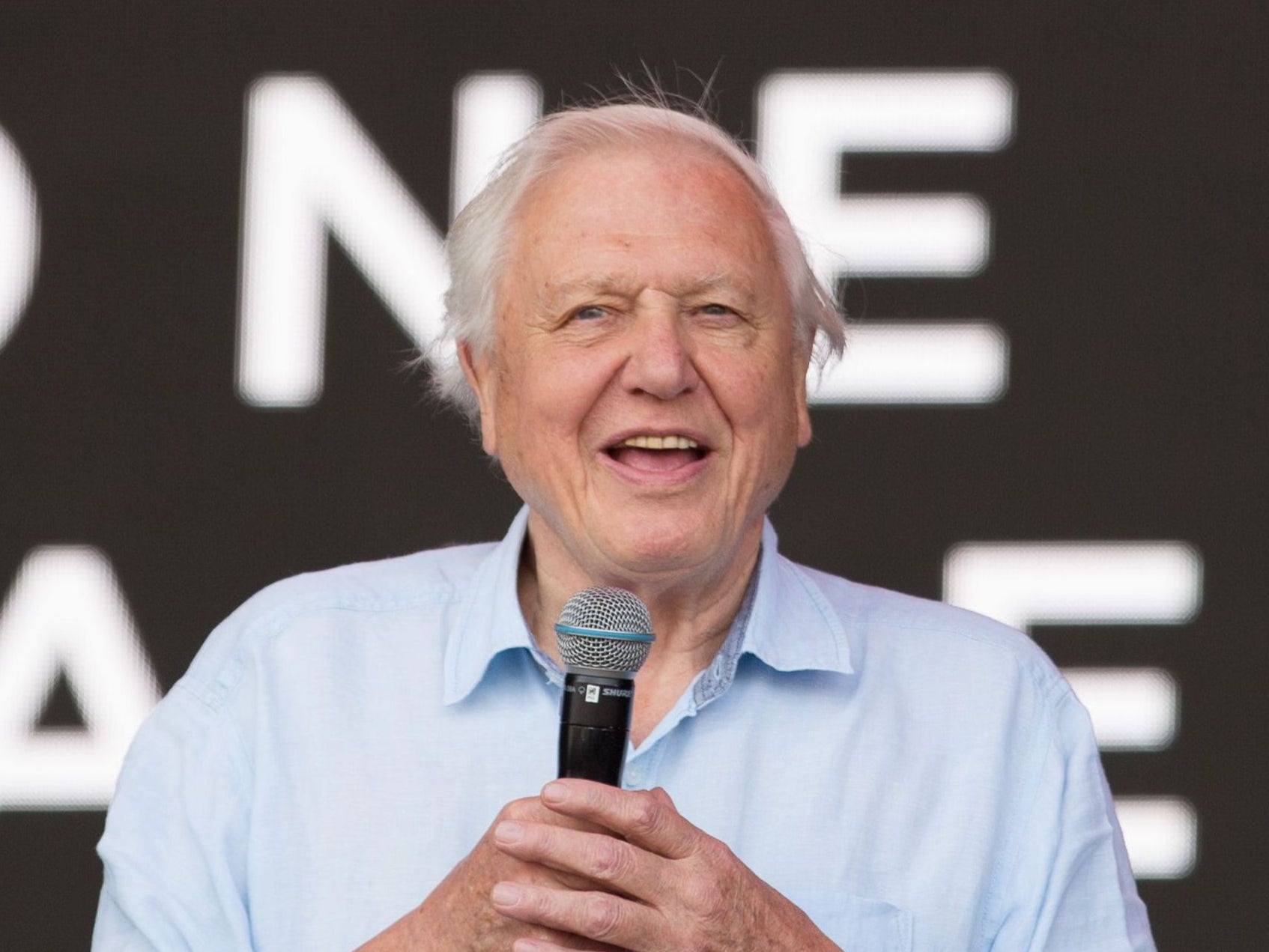
Bob Dylan, Radiohead, Jay-Z: all the biggest acts in the world have played the Pyramid Stage at Glastonbury. So, it was oddly fitting when, in 2019, this titan of the natural world took prime position at Worthy Farm to give a rousing speech about the festival’s accomplishments in divesting itself of plastic. “This great festival has gone plastic-free,” he told the enormous crowd. “That is more than a million bottles of water that have not been drunk by you in plastic bottles.” The roar that greeted the nonagenarian’s rather banal appearance was the sort usually reserved for teen idols or ageing rock superstars.
Attenborough and the Cargo Cult, The People of Paradise
It’s not unfair to say that David Attenborough walked so that men like Bruce Parry and Anthony Bourdain could run. In 1960’s The People of Paradise, a youthful Attenborough deviated from his zoological background for a sojourn in the cultural anthropology arena. His episode amongst the Cargo Cult of Vanuatu, who worship a mystic figure called “John Frum” is particularly excellent. Watching it in 2023 is a good reminder of how much smaller the world seemed when Attenborough first began broadcasting.
The clever killer whales, Frozen Planet II
One of Attenborough’s key skills as a narrator is his ability to read meaning into animal behaviours, parsing them for a lay (read: human) audience. One of the most striking examples came during 2022’s Frozen Planet II. A pod of killer whales swim in formation to create waves that displace a delicious, succulent seal skulking safely on an ice floe. “It’s an ingenious solution,” he says, with almost grandfatherly pride, as the whales rip the seal to smithereens and sup on its exquisite blubber.
Lizard vs snakes, Planet Earth II
There’s nothing audiences love more than the rare moments when the animal kingdom pits one species against another. The best example of this, in recent years, comes from 2016’s Planet Earth II. A death match is waged between a lizard – sprinting through the desert as though it’s in Mad Max – and countless deadly snakes. This was one of the first clips from an Attenborough documentary to go viral on social media, aided by a legendary slot on Channel 4’s Gogglebox.
Attenborough and the Queen, The Queen’s Green Planet
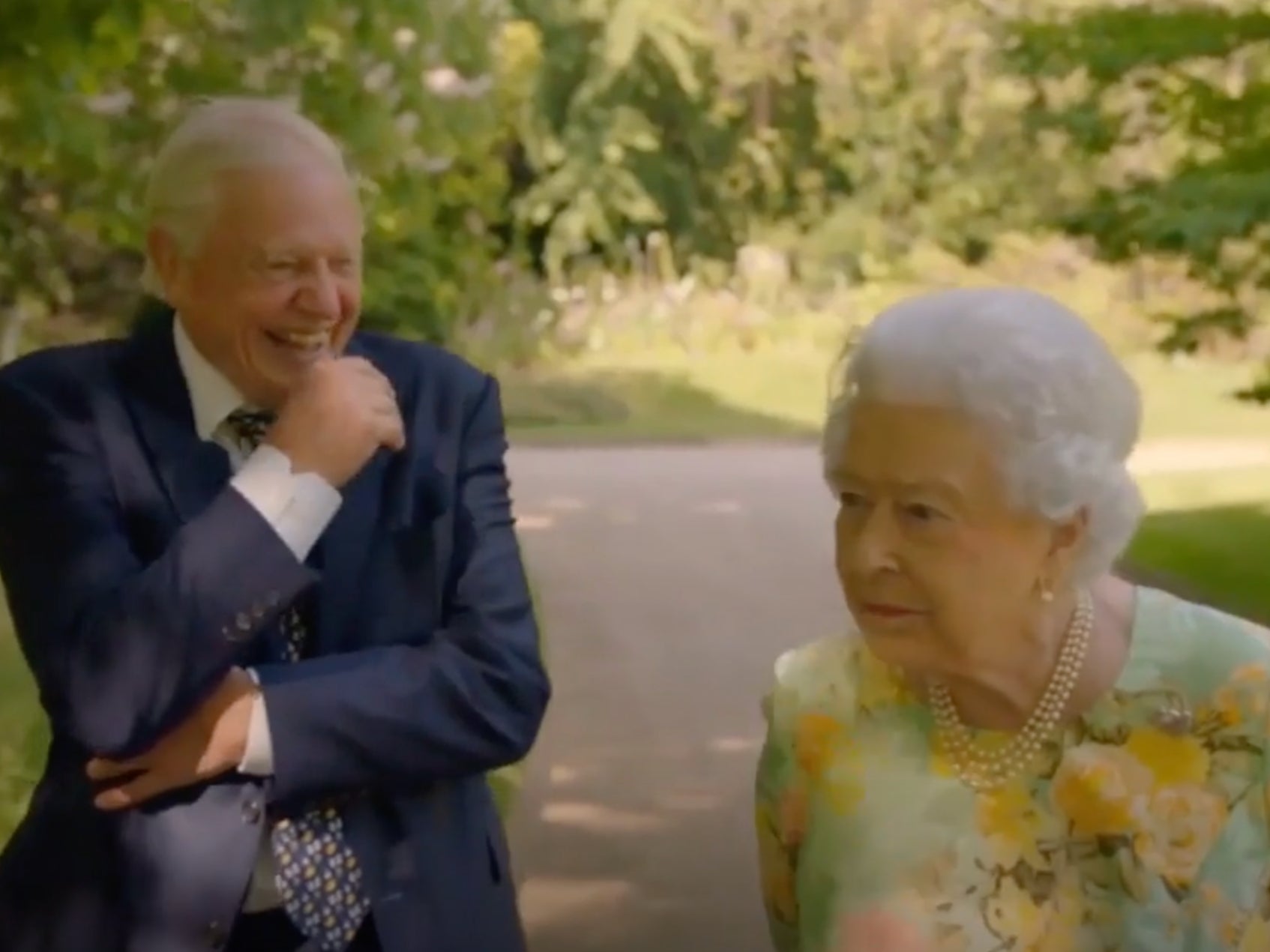
ITV really bagged the big guns for its 2018 documentary, The Queen’s Green Planet. David and Elizabeth, the nonagenarians, who were born just a couple of weeks apart in 1926, were filmed going for a pleasant stroll in the gardens of Buckingham Palace. The conversation itself isn’t exactly scintillating – the Queen compares a variety of trees to her awful children – but there’s something pleasing about the sight of these two figures, both of whom had acquired living (at the time) legend status, pottering around the garden.
Attenborough and Obama, 2015
In his later years, Attenborough began to transition from naturalist to campaigner. In 2015 he sat down in the Oval Office with then-President Barack Obama to discuss life on our “blue marble”. The two discuss the renewable energy transition, population urbanisation and educating children about the natural world. But what’s most striking, perhaps, is that both these men look infinitely more statesmanlike than those politicians now convening at COP after COP to talk about these same issues.
Attenborough and Lonesome George, Galapagos 3D
“This is the rarest living animal in the world,” whispered Attenborough, as Lonesome George, the last Pinta Island tortoise, crawled beside him. Attenborough’s 2013 series Galapagos 3D – made during the short-lived 3D fad – saw him get up close and personal with a creature who, having been born in 1910, made the silver-haired presenter look like a spring chicken. Even more remarkably, the tortoise died a fortnight later at the age of 102, making it his last on-camera interview. Attenborough was not, to my knowledge, questioned in connection with the tortoise’s death.
Attenborough and the mountain gorillas, Life on Earth
Probably the most instantly recognisable on-camera sequence from Attenborough’s decades at the BBC, this 1979 encounter with mountain gorillas at Dian Fossey’s sanctuary in Rwanda is a remarkably tactile piece of broadcasting. These huge apes – who could comfortably rip his face off and use it as a banana dish – start to tussle with the presenter in the foliage. Rather than run for his life, Attenborough submits, even grinning broadly as two baby gorillas remove his shoes. For a man best known to a whole generation as a disembodied voice, it is a wonderfully corporeal moment.
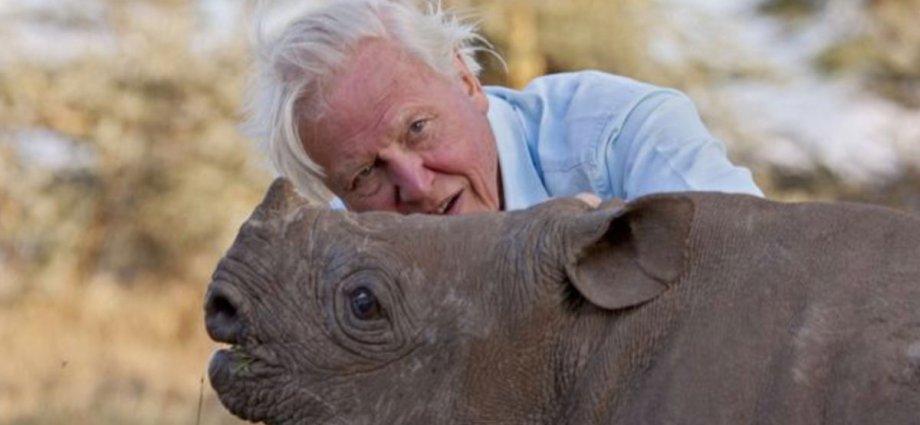
Attenborough and the baby rhino, Africa
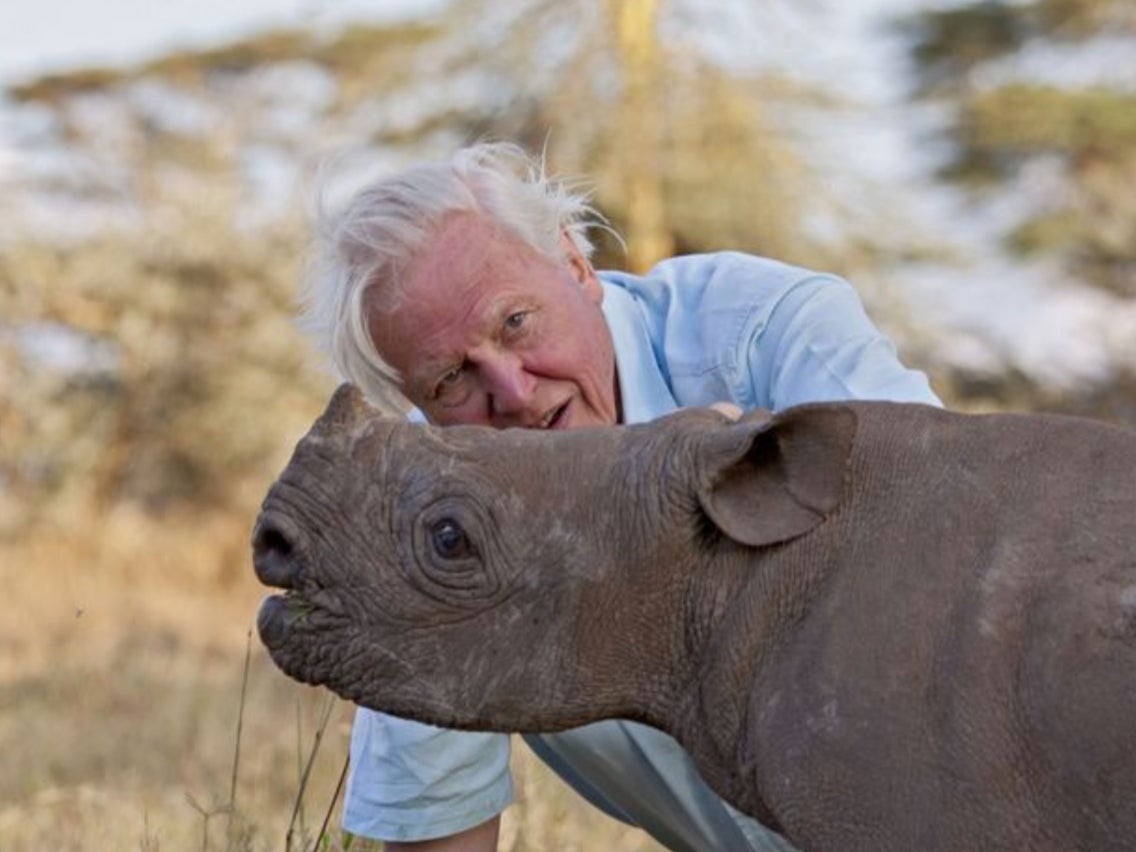
What’s better than a full-sized rhino? A baby one, of course! On all-fours in the African savannah, Attenborough comes face to face with a pint-sized rhinoceros. They squeak at one another, the older man replicating the younger mammal’s juvenile calls. “Enchanting creature,” Attenborough muses afterwards, but that shot of them locking eyes – one gnarled and wrinkled by evolution, the other craggy and lined with age – remains iconic. It is a moment not of enchantment, but of fraternity.
Attenborough’s butterfly, Micro Monsters
Big cats, giant snakes, great apes: these showstopping animals might take the headlines, but Attenborough is as adept working on a far smaller canvas. There is no more poignant example of this than a scene from 2013’s Micro Monsters, in which a butterfly lands on the presenter’s index finger. The insect seems to hold its poise while Attenborough delivers his trademark narration, his eyes staring inquiringly at the patterned wings just a few inches from his face.
Attenborough’s orangutan, Zoo Quest
Zoo Quest, the show that made Attenborough’s career as a presenter, was based on a premise that now seems wildly dated: the staff of London Zoo, and the BBC, travel the world to capture animals for the site’s permanent collection. All the same, the show introduced the British public to far-flung locales and their equally eye-catching denizens. The highlight is, perhaps, the search through Indonesia for an orangutan. Tracking discarded fruit on the floor, Attenborough spots their distinctive orange fur through the foliage. The ape proceeds to hang there “screaming and breaking off branches to throw down at [Attenborough]”. Fair enough – anything to avoid a trip to 1950s London.
Attenborough at COP26 2021
With Britain hosting COP26, the global climate change summit, it was natural that the organisers would turn to the nation’s most respected voice on issues of the natural world. Opening the summit in Glasgow, Attenborough delivered a rousing speech against a backdrop of dramatic images of planet earth – together with illustrations of humanity’s impact on it. “If working apart we are a force powerful enough to destabilize our planet,” he told attendees of the conference, “surely working together we are powerful enough to save it.” At a conference famous for half-measures and backroom deals, it was a spine tingling moment of public performance.
Dancing with the capercaillie, The Life of Birds
The capercaillie – the horse of the wood – is the world’s largest grouse. Up in Scotland, Attenborough gets up close with the local alpha male. “He is so charged up,” Attenborough observes wryly, as the bird, tail feathers standing erect, bears down on him. Moments later, the capercaillie has, somewhat over-dramatically, knocked the long-in-the-tooth presenter to the ground. “Now, now!” he exclaims, with a chuckle, as the beak of the capercaillie rattles with indignation.
Attenborough, tortoise and Graham Norton, The Graham Norton Show
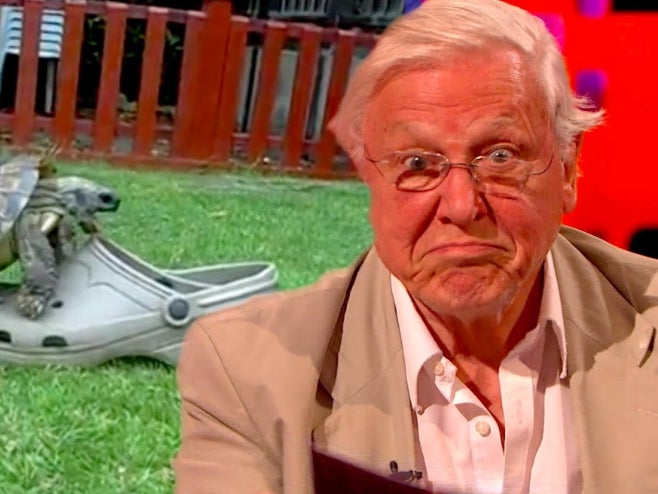
Attenborough has a long association with animals mating. “Does it get to the point where you just feel like an old perv?” asked Graham Norton when the esteemed knight of the realm sat on his red couch in 2012. Attenborough was a fixture of talk shows, from Parkinson to Friday Night with Jonathan Ross, and a very good sport. Following his cheeky enquiry, Norton made Attenborough provide his trademark narration to grainy video footage of a tortoise attempting to have its way with a rubber Croc. “The humble tortoise gently mounts his chosen mate,” Attenborough says soberly, “in a dance as old as time itself.”
Evil shoebills, Africa
Attenborough’s reassuring voice was often utilised to good effect in heart-warming stories of survival against the odds, but it could also run counter to that grain. There’s no better example than in 2013’s Africa, when two shoebill chicks start to fight in their mother’s absence. “This is more than scrap between two siblings,” Attenborough growls, as the comically grotesque shoebill bites at its runty brother’s neck. “It reveals a dark side.”
Lions vs elephant, Planet Earth
The BBC’s Natural History unit has always been at the cutting edge of technological developments. Underwater photography, drones and infrared are now staples of their broadcasts. Back in 2006, for the first series of Planet Earth, the team caught an extremely rare natural event using what was then considered state of the art technology: night vision. “They’re specialist elephant hunters,” Attenborough says of a pack of lions chasing their next meal, using narration sparingly as audiences bear witness to the elephant being dragged to the ground. He concludes, with trademark pragmatism, that “this elephant will feed the whole pride for at least a week”.