










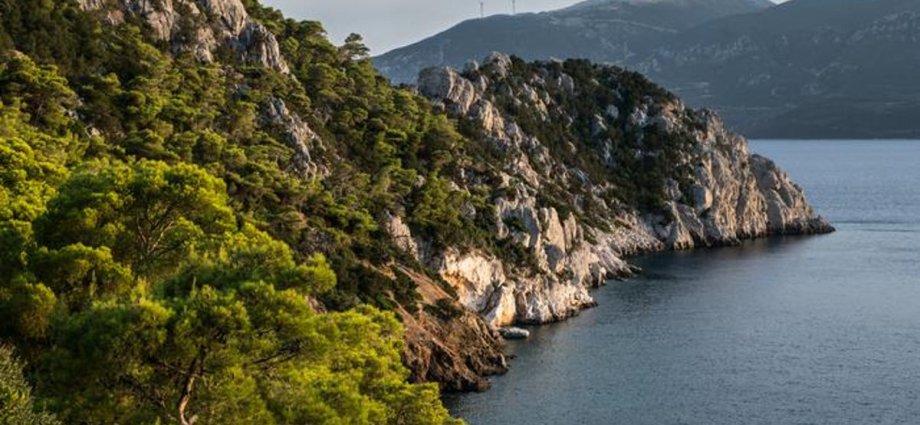
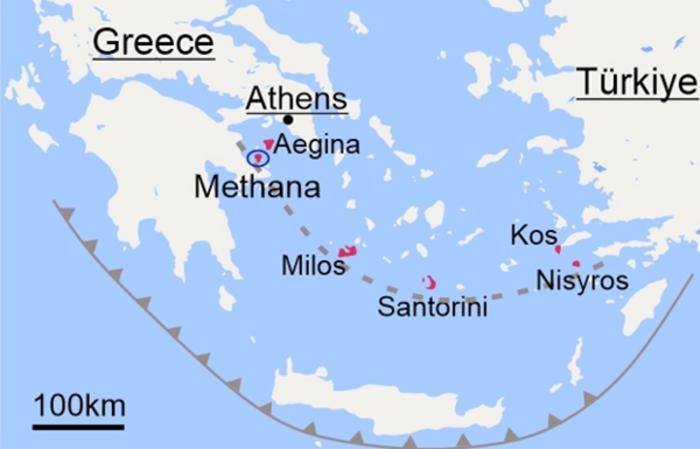
The Methana volcano in Greece, thought to be dormant for hundreds of thousands of years, has been found accumulating enormous amounts of magma underneath.
For more than 100,000 years, the volcano situated 50km southwest of Athens has appeared dormant without spewing lava or any explosions or ash clouds.
Researchers have now found that while it appears extinct, it has been steadily accumulating enormous amounts of magma deep within its magma chambers, prompting a rethink of the threat posed by silent volcanoes.
“This highlights the importance of monitoring dormant volcanoes, even in the absence of recent eruptions,” they write in the study published in the journal Science Advances.
Scientists assessed tiny zircon crystals that form inside magma reservoirs in the Earth’s crust as they cool.
These crystals act like natural time capsules, preserving information about when and under what conditions they grew.
“We can think of zircon crystals as tiny flight recorders. By dating more than 1,250 of them across 700,000 years of volcanic history, we’ve reconstructed the volcano’s inner life with precision,” volcanologist Olivier Bachmann from ETH Zurich explains.
“What we learned is that volcanoes can ‘breathe’ underground for millennia without ever breaking the surface,” he said.
The analysis revealed that magma was produced almost continuously beneath Methana, despite the volcano having an exceptionally long quiet period of more than 100,000 years.
“For volcano hazard authorities, for example, in Greece, Italy, Indonesia, the Philippines, South and North America, Japan, etc, this means re-evaluating the threat level of volcanoes that have been quiet for tens of thousands of years but show periodic signs of magmatic unrest,” Dr Backmann says.
-flowing-into-the-sea.jpeg)
During the 100,000-year timeline, researchers say zircon growth peaked underneath the volcano, showing clear evidence of intense magma activity.
The magma supplying Methana’s upper chamber was found to be very water-rich, far more so than they expected.
Scientists found that this could be due to the mantle beneath Methana being strongly influenced by ocean-floor sediments and substantial amounts of water.
This process, they say, “hydrates” the mantle, triggers crystallisation, and also makes magma production more efficient.
Such rapid crystallisation of water-rich magma may lead to fewer eruptions, researchers say, but caution that more such cases need to be studied.
“We actually believe that many subduction zone volcanoes might be periodically fed by particularly wet primitive magma, something that the scientific community has not yet fully recognised,” said Răzvan-Gabriel Popa, another author of the study.
The findings indicate that a prolonged period of volcanic silence does not mean a volcano is extinct.
On the contrary, it could signal the buildup of a large and potentially more dangerous magma system, with “major implications” for volcanic risk assessment, scientists say.
Such seemingly dormant volcanoes can remain quiet for millennia while quietly storing energy and transition into highly hazardous systems, they warn.