










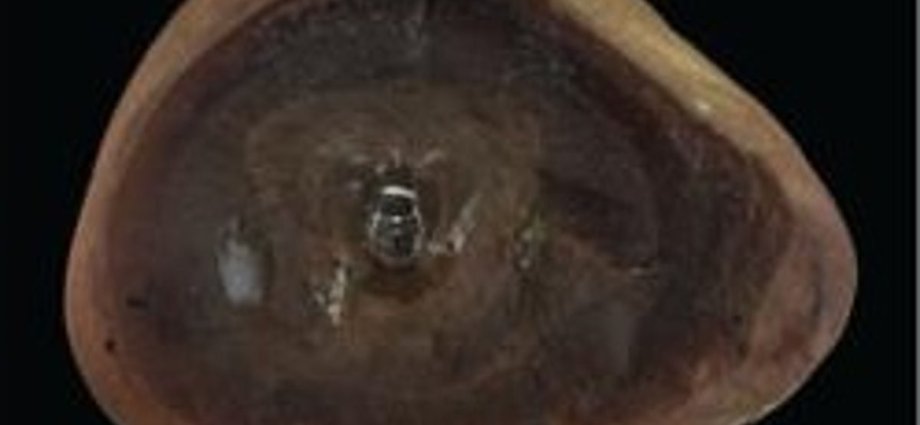
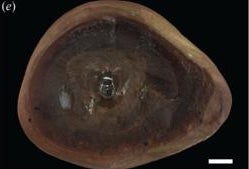
A famous 300-million-year-old fossil previously believed to be the world’s oldest octopus actually may be a different animal entirely, new scans have revealed.
The Pohlsepia mazonensis fossil was found in Illinois in the US in 2000, and first identified as an octopus 25 years ago. It has since been widely lauded as the oldest of its kind ever found – even featuring in the Guinness Book of Records.
But scientists at the University of Reading used new technology to reveal previously unseen tiny teeth in the fossil, proving it is actually an entirely different animal related to a modern Nautilus – a multi-tentacled animal with an external shell.
Published in the journal Proceedings of the Royal Society B , the “exciting” findings help give scientists a clearer picture of when octopuses actually first appeared on the planet.
Dr Thomas Clements, lead author and Lecturer in Invertebrate Zoology at the University of Reading, said: “It turns out the world’s most famous octopus fossil was never an octopus at all. It was a nautilus relative that had been decomposing for weeks before it became buried and later preserved in rock, and that decomposition is what made it look so convincingly octopus-like.
“Scientists identified Pohlsepia as an octopus 25 years ago, but using modern techniques showed us what was beneath the surface to the rock, which finally cracked the case. We now have the oldest soft tissue evidence of a nautiloid ever found, and a much clearer picture of when octopuses actually first appeared on Earth.
.jpeg)
“Sometimes, reexamining controversial fossils with new techniques reveals tiny clues that lead to really exciting discoveries.”
In the 26 years since its discovery, the Pohlsepia mazonensis fossil has been used in studies exploring the evolution of octopuses and their relatives. Scientists thought the fossil showed eight arms, fins, and other features typical of an octopus, pushing back the known history of octopuses by around 150 million years.
.jpeg)
While some doubt has been cast on the true species of the fossil for years, researchers have been unable to put their concerns to the test until recently.
The team behind the paper used modern synchrotron imaging – a technique that uses beams of light brighter than the sun – to scan for structures invisible to the eye beneath the surface.
Scans revealed something called a radula, a ribbon-like feeding structure with rows of teeth only found in molluscs. The imaging showed at least 11 tooth-like elements per row, while octopuses only have seven or nine – meaning the fossil cannot possibly be an octopus.
Instead, they matched it to a fossil nautiloid called Paleocadmus pohli. The researchers concluded the animal had partially rotted before fossilisation, causing it to look very different from its true self.
The new findings suggest octopuses did not appear until the Jurassic period, much later than previously thought.
Dr Clements said: “It’s amazing to think a row of tiny hidden teeth, hidden in the rock for 300 million years, have fundamentally changed what we know about when and how octopuses evolved.”