










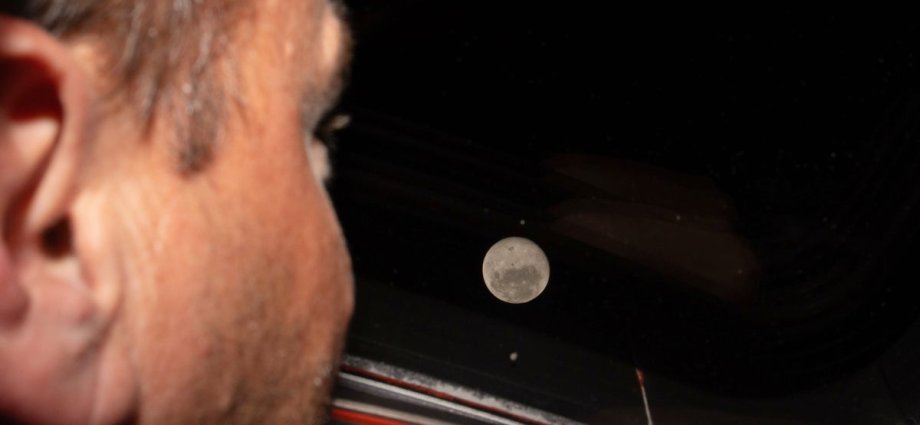
The crew of Nasa’s Artemis II mission have started the journey home after creating history on their pass behind the Moon,
The four astronauts on the first manned Moon mission in more than 50 years reached 252,756 miles (406,771 kilometres) from Earth.
The record was achieved during a seven-hour lunar flyby which included a 40-minute communication blackout as they passed around the far side of the Moon from Earth.
Apollo 13’s previous record was 248,655 miles (400,171 kilometres) from Earth in April 1970.
During the blackout, the crew reached their closest point to the Moon at 4,067 miles (6,545 kilometres).
Before the flyby, Canadian astronaut Jeremy Hansen said: “It is blowing my mind what you can see with the naked eye from the Moon right now. It is just unbelievable”.
The astronauts asked Nasa if they could name two newly observed lunar craters Integrity, after the capsule of their Orion spacecraft, and Carroll in honour of the late wife of Commander Reid Wiseman. She died of cancer in 2020.
Pilot Victor Glover and Christina Koch complete the four-strong crew, who experienced a total solar eclipse from their vantage point behind the moon early on Tuesday.
Nasa administrator Jared Isaacman said on X: “Before they left, they said they hoped this mission would be forgotten, but it will be remembered as the moment people started to believe that America can once again do the near-impossible and change the world.
“This mission isn’t over until they’re under safe parachutes, splashing down into the Pacific.”
The astronauts aboard the Orion spacecraft were woken on the sixth day of the mission with a recorded message from late Apollo 8 and 13 astronaut Jim Lovell.
The former commander, who died last year aged 97, said: “Welcome to my old neighbourhood.
“It’s a historic day, and I know how busy you’ll be, but don’t forget to enjoy the view… good luck and Godspeed.”
During the flyby, the crew used professional cameras to take detailed photos of the moon’s surface, usually hidden from view, and enjoy the rare sight of their distant home planet.
Artemis II is using the same manoeuvre that Apollo 13 did after its famous “Houston, we’ve had a problem” incident, when an oxygen tank explosion ended hope of a moon landing and became a fight for survival.
Using the Moon’s gravity for a “free” return journey, it will take the crew four days to get back, with a splashdown in the Pacific on Friday.
The Goonhilly Earth Station, near Helston, in Cornwall, has been helping track the flight.
While the astronauts will not touch down on the Moon, the mission paves the way for a future lunar landing and also lays the foundation to send a crew to Mars.
The launch previously had to be postponed by two months because of hydrogen fuel leaks and clogged helium lines.
The last time Nasa sent astronauts to the Moon was as part of the Apollo 17 mission in 1972.
The agency is seeking to return a crew to the lunar surface by 2028, before China does in about 2030.