










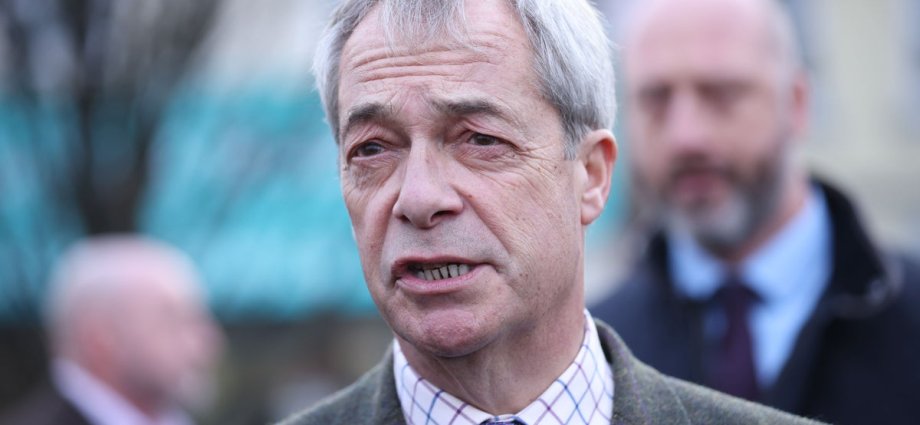
Slashing net migration to zero would shrink the economy and require a swathe of tax rises or an increase in borrowing in order to plug a £37bn funding shortfall, a leading economic think tank has warned, in what is a major blow to Reform UK’s immigration plans.
The National Institute of Economic and Social Research (NIESR) said such a scenario would “put pressure on the public finances” in its latest economic outlook report, saying that “any net zero migration scenario would not be fiscally sustainable for the UK unless there were significant tax rises”.
Ahead of the 2024 general election, Nigel Farage declared that net migration to the UK should be zero – meaning that the number of people leaving Britain would be equal to those arriving.
Meanwhile, after a number of government measures to clamp down on legal migration, the latest official figures showed that net migration dropped to 204,000 in the year to June, down 69 per cent year-on-year, and raising the possibility of Britain reaching net zero before the end of the decade, according to some forecasters.
Labour has declined to put a hard cap on the number of people arriving in Britain, but have unveiled a number of measures – including increasing the amount of time migrants have to wait before they can apply for indefinite leave to remain – to reduce legal migration.
The Tories have proposed a “binding, legal cap” on net migration but they have not specified at what level this cap should be set.
NIESR, a research institute which is independent of party-political interests, said net zero migration would slow down employment growth and lead to a smaller proportion of working-age people, therefore resulting in lower tax revenues.
This would leave the government needing to raise taxes to plug a growing funding gap in the long tun.
Reduced tax revenues could also be met through higher borrowing, which would increase the budget deficit by around 0.8 per cent of gross domestic product (GDP), equivalent to around £37bn in today’s prices, by 2040, according to the analysis.
But if net migration stayed positive, a larger working-age population would broaden the tax base and help stabilise the debt to GDP ratio, NIESR said.
While the think tank predicted that GDP growth per capita would be higher under a net zero migration scenario, they predicted that overall GDP growth would be lower, reflecting slower employment growth and a smaller workforce.
Cumulatively, NIESR predicts that net zero migration would leave the economy 3.6 per cent smaller by 2040, equivalent to reducing the UK’s trend GDP growth rate by around 0.2 percentage points.
Stephen Millard, NIESR’s deputy director for macroeconomics, said: “Our analysis clearly shows that net zero migration would put pressure on the public finances and worsen the public debt outlook.
“Unlike Japan, the United Kingdom lacks the institutional and financial conditions to support a substantially higher debt ratio.
“We therefore recommend the government makes a concerted effort to get public debt down, so it has room to respond to a sharp fall in migration or any other negative shock happening to the UK economy.”
Elsewhere in the latest report, NIESR lowered its outlook for UK economic growth in 2025.
It now expects GDP to be 1.4 per cent for the year, down from the 1.5 per cent it forecast in November.
The think tank predicts that the economy will slow to 1.3 per cent in 2027 and 1.1 per cent in 2028 as taxes rise and government spending growth falls.
It is also forecasting the rate of unemployment to rise to a peak of 5.5 per cent in the second half of 2026, before gradually declining.
Meanwhile, NIESR said it was forecasting two cuts to interest rates this year, bringing them down to 3.25 per cent by the end of 2026 as inflation falls.
Reform UK has been contacted for comment.