











The most deprived areas of England will see rates of crime and unemployment rise before the end of this parliament unless further action is taken by government, a report has found.
In a study published on Wednesday, the Independent Commission on Neighbourhoods (ICON) forecasted that England’s 613 most-deprived neighbourhoods may see crime rates rise by 27 per cent from 2021 levels, to around 313 per 1000 people in 2030, if long-standing trends persist.
Meanwhile, it found that the proportion of people who are economically inactive due to long-term sickness or disability, is three times higher (12 per cent) in these neighbourhoods than it is nationally. Overall, economic inactivity could rise to 46.1 per cent in these areas by 2023, the report said.
The 613 neighbourhoods are those which were declared ‘mission critical’ by ICON in a 2025 report. It identified those areas, which are home to around 1m people, as those which are furthest away from contributing to the government’s five missions, saying they have many people isolated from the workforce, see higher levels of welfare spending and have health outcomes which mirror those of developing nations.
Despite these neighbourhoods making up just 2 per cent of England’s population, they account for half of the areas where life expectancy is below 70.
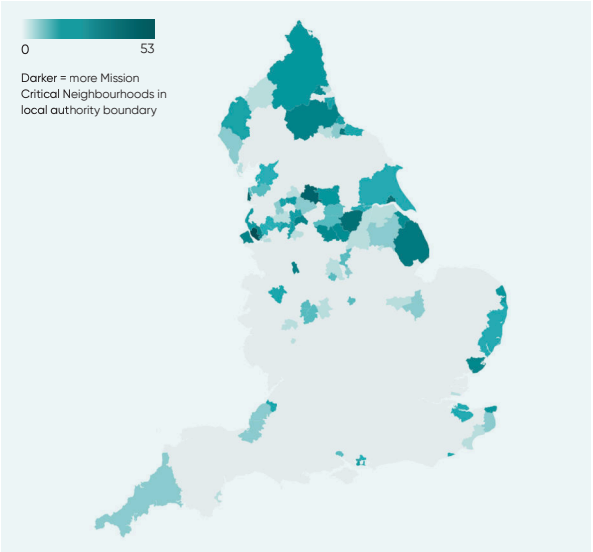
Three-quarters of these 613 neighbourhoods are found in the North of England. The highest number – 53 of them – are within the Liverpool City Council area, making up 18 per cent of the local authority.

35 neighbourhoods are in Bradford, 34 are in Blackpool (36 per cent of its local authority), 24 are in Doncaster and 23 are in the City of Kingston upon Hull.
ICON said these areas are disproportionately concentrated in coastal communities, post-industrial towns and on the peripheries of the North’s cities. They have typically lower levels of home ownership, high rates of social housing occupancy have many working-age people who are economically inactive.
The report’s author and ICON’s head of research analysis Ross Mudie, said that the outcomes outlined in the report would be the consequence of entrenched divides and show what the price of inaction would be.
Mr Mudie wrote: “Without stronger intervention, crime is set to rise fastest in the most disadvantaged neighbourhoods, reinforcing insecurity and weakening social order.
“Economic inactivity looks set to remain persistently higher in these areas, leaving too many households without the stability and routine that steady work provides.
“Health shows the greatest promise, but improvements are likely to be modest, and the gap between the healthiest and least healthy places may narrow only slightly.
“The implication is clear: left unchecked, these trajectories will deepen divides.
“Government initiatives such as the Neighbourhood Policing Guarantee and the Neighbourhood Health Service offer opportunities to bend the curve, but they will need to be ambitious in scope and targeted where disadvantage is most entrenched.”
The report notes that the government’s Pride of Place funding, called for by ICON in 2025, could make a difference and improve matters, but it said the funding must be backed up by wider programmes in order to improve the forecasts it lays out.
The Pride in Place programme will see nearly 250 areas sharing funding of around £5bn for local regeneration over 10 years. These communities, largely found in Labour’s traditional electoral heartlands, are likely to be targeted by Reform UK in coming elections.

When announcing the funding last year, Sir Keir Starmer said: “We’re investing in the UK’s future, by backing the true patriots that build our communities up in neighbourhoods across every corner of the country. Because it’s people who bring pride, hope and life to our communities.
“This is a huge investment, but what matters most is who decides how it’s spent: the neighbours, volunteers and parents who know their communities best – the people with real skin in the game.”
In a separate study published on Wednesday, ICON said that existing government initiatives “are nowhere near enough to meet the need that we know that exists.”
It recommends that the government creates a ‘Neighbourhood Recovery Pipeline’ laying out a clear timetable for support for the most disadvantaged neighbourhoods, which should be backed by investment worth £2-2.5bn a year over the next twenty years.
A government spokesperson said:“Through Pride in Place we’re investing £5 billion across 244 communities to tackle deprivation and improve peoples’ lives and the places in which they live.
“This will help fix decades of underinvestment and give local people who know their areas best the power to shape their futures so we can boost opportunity across the country.”