










Nearly half of federal health surveillance databases either stopped or delayed routine updates last year, with potentially dire consequences to public health, according to researchers.
A newly-released audit of nearly 1,400 public records from the Centers for Disease Control and Prevention revealed that 38 of the agency’s 82 databases that were normally updated monthly had unexplained pauses starting last spring.
More than a third of the 38 paused databases had stops lasting for more than half a year, and only one was updated by the second of December, researchers at Vanderbilt University, the University of North Carolina at Chapel Hill and the Boston University School of Law said.
Nearly 90 percent of the paused databases reported vaccination topics, while others covered respiratory diseases and drug overdose deaths.
The pause on these topics could stymie critical information about respiratory illnesses and other health-related threats, potentially leading to eroded public trust, the researchers said.
“The evidence is damning: The administration’s antivaccine stance has interrupted the reliable flow of the data we need to keep Americans safe from preventable infections,” Dr. Jeanne Marrazzo, the former director of the National Institute of Allergy and Infectious Diseases, who is suing the administration over public health warnings and did not contribute to the research, asserted in an accompanying editorial.
“The consequences will be dire.”
Marrazzo added that failing to provide accurate and timely data to public health leaders and providers would undermine the ability to recognize disease outbreaks and respond to them, also noting that the findings were consistent with actions taken by the administration to undermine trust around vaccines.
The study did not determine reasons for the pauses, but she said she believed whether or not the data interruptions reported were due to intentional disregard for sharing data on immunizations or to workforce shortages due to the agency’s reduction in force likely did not matter.
“Either causative pathway demonstrates a profound disregard for human life, scientific progress, and the dedication of the public health workforce that has provided a bulwark against the advance of emerging, and reemerging infectious diseases,” she said.
The Independent’s request for comment from the Department of Health and Human Services was not immediately returned.
Andrew Nixon, a spokesperson for the department, told NBC News that the CDC reports Covid and Respiratory syncytial virus activity through its respiratory virus surveillance systems and weekly flu activity through a database called FluView.
“Changes to individual dashboards or update schedules reflect routine data quality and system management decisions, not political direction,” he said. “Under this administration, public health data reporting is driven by scientific integrity, transparency, and accuracy.”
‘Flying blind’
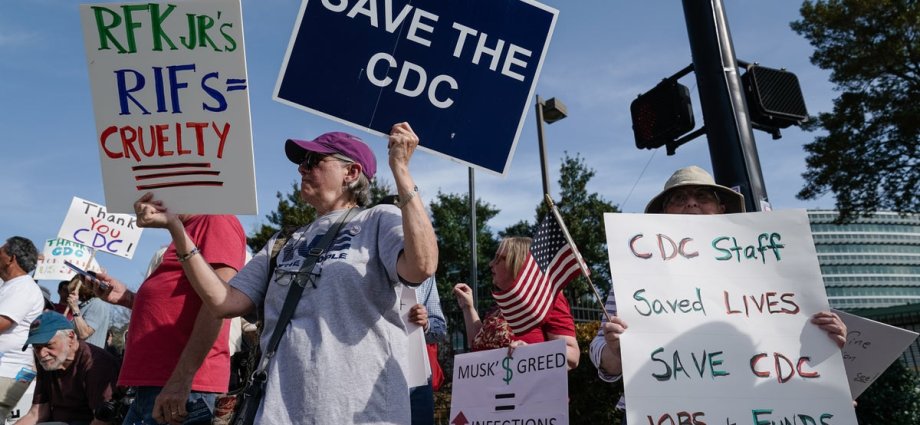
The audit builds upon previous research showing that staff cuts last year had eliminated more than a dozen data-gathering programs that track death and disease, including some related to pregnancy, abortions, job-related injuries, sexual violence and lead poisonings.
And, it’s not just the data reporting that stopped. Pages of public data were erased from the CDC’s website, departments were shuttered and newsletters stopped going out.
“Missing that expertise and that connection between laboratory information and outbreak investigation means we are flying blind,” Scott Becker, the CEO of the Association of Public Health Laboratories, told POLITICO in April. “The critical services that they provide to public health labs in the country that are really not replicated anywhere else.”
Health Secretary Robert F. Kennedy, Jr. said in April that he was “slashing unhealthy fat” at the CDC, and that some of the agency’s work would be moved to a new Administration for a Healthy America.
Earlier this month, the department told NPR that efforts to create the administration are still in the works – but any timeline for that remains unclear.
A historic problem
All of this comes amid what has become a historic public health crisis, in which vaccination plays a key role.
The U.S. is experiencing the worst outbreak of the measles virus in more than 30 years and a continuous rise of vaccine hesitancy, including at the HHS.
Scientists are waiting to see if America will lose its longstanding measles elimination status and CDC data updated on Friday shows 416 cases reported so far this year in 14 states.
But measles is vaccine-preventable, and two doses of the measles-mumps-rubella vaccine are 97 percent effective against the highly contagious illness.
The outbreak comes as Americans also have to contend with a surge of whooping cough, along with a nasty and severe flu season.
These threats are why keeping databases updated is crucial, according to Marrazzo.
“Crafting a rapid response to these types of events requires that we know about them in the first place,” she said.