










What if ChatGPT had the power to kill people? Mercy conjures up this horrifying scenario, then ponders whether it’d really be all that bad. What if your AI judge, jury, and executioner looked and talked like the sublimely charming Rebecca Ferguson, say? Wouldn’t that be a calming sight while your last breath departed your body? And all because an algorithm that scrapes information from the digital world decided you were guilty and no longer worthy of life?
Director Timur Bekmambetov’s latest is a baffling piece of work that happily swipes the mood and aesthetics of Hollywood’s police state dystopias (Minority Report, RoboCop, Blade Runner etc), while presenting such horrors as an agreeable norm. It opens with a voiceover so menacingly chipper you’d naturally assume it to be satirical (it’s not): there’s a crime epidemic in Los Angeles being squarely blamed on civil unrest and homelessness, leading to the creation of the Mercy court.
The accused are strapped to a chair in front of AI Judge Maddox (Ferguson), who is equipped with a touchscreen tablet containing unfettered access to people’s data. The accused are also assumed to be guilty, and have 90 minutes to essentially google their way into innocence – otherwise they’re terminated on the spot.
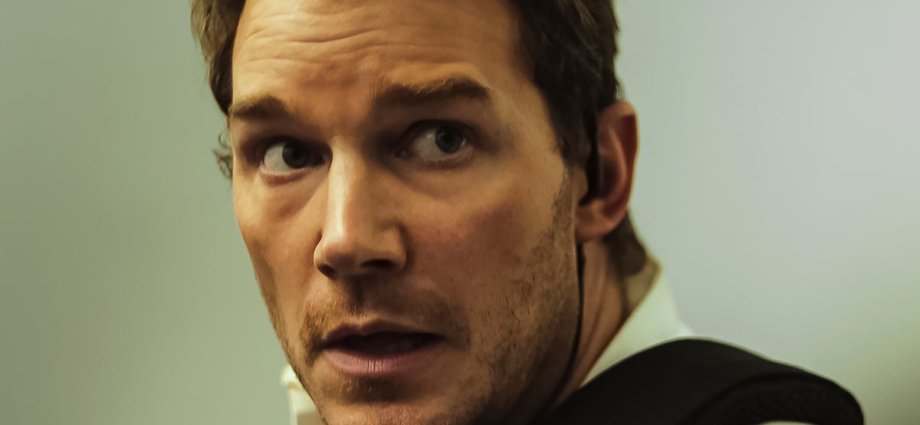
Chris Pratt, here interchangeable with any other famous Hollywood Chris, plays Chris Raven, the cop who arrested the very first man processed by the Mercy court. Now he wakes up in the chair, though, accused of murdering his wife (Annabelle Wallis) and hungover with no memory of the day. So he starts commanding Maddox to pull up phone records, Instagram accounts and emails, which all fly out on screens towards him and at us (especially if you choose to see the film in 3D). The aim is to immerse us as much as possible.
Bekmambetov was instrumental in popularising the “screenlife” film, in which events are captured entirely within the digital realm via phone or computer, having produced early hits Unfriended (2015) and Searching (2018), as well as last year’s notorious Ice Cube-led War of the Worlds. It’s an arresting gimmick, though it’s yet to really prove itself as much more than a gimmick, and Mercy barely qualifies since the camera cuts back so frequently to Pratt’s pained expressions.
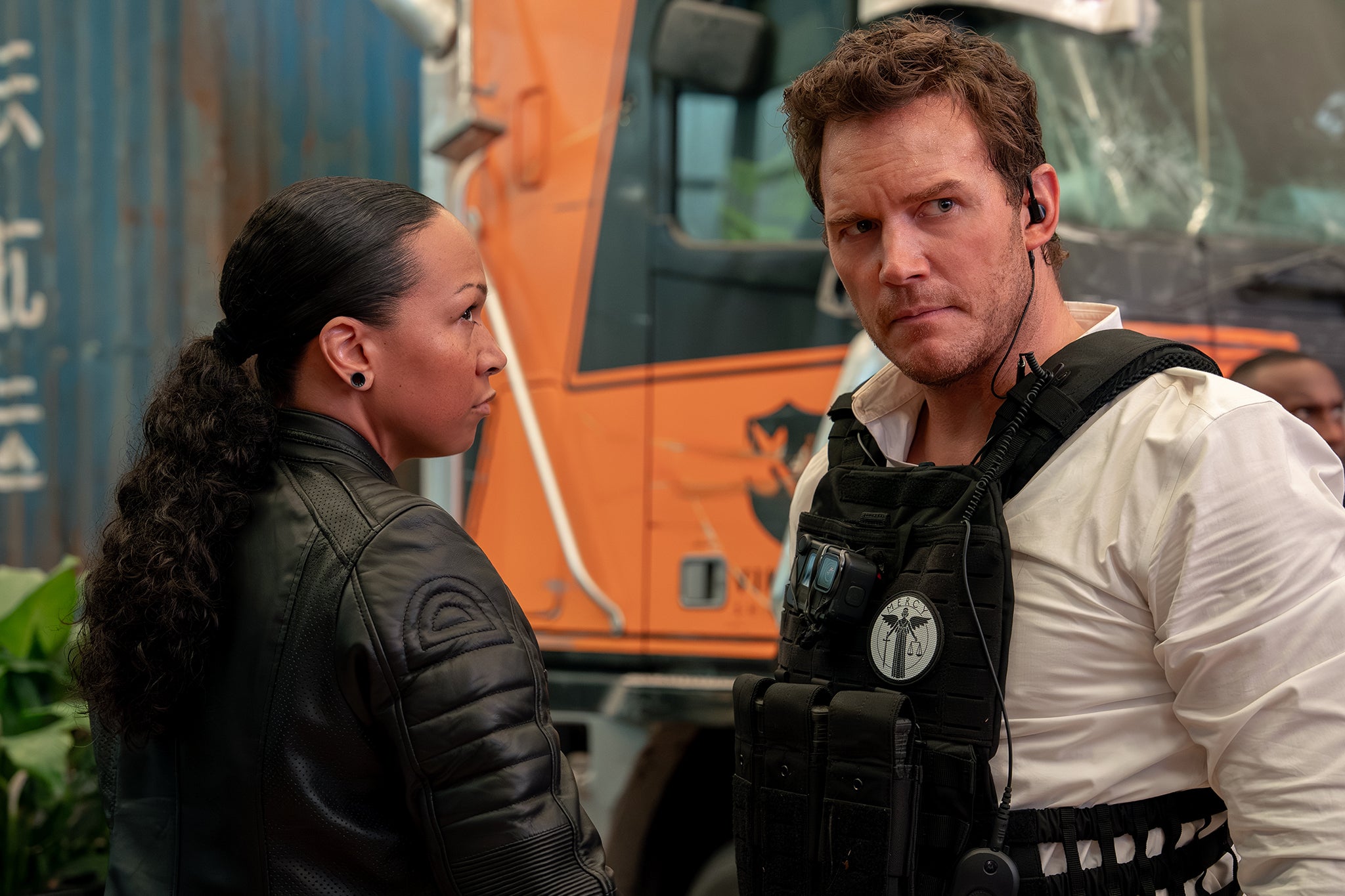
Yet any effort to force us to identify with Chris comes to naught. Any promising idea leads to a dead end. It’s a maddening watch. Chris, it’s revealed, has a violent temper. Perhaps Mercy will ask us to question the true meaning of justice by having us root for an unlikeable but ultimately innocent protagonist? No, that goes nowhere. What about the violation of privacy in the pursuit of justice? Is it ever ethical? His daughter (Kylie Rogers) confronts him about the fact that he’s snooped on her phone. He agrees it’s not right, then continues to snoop. Surely, Mercy will at least question whether Judge Maddox can be trusted with a human life?
It’s a no to that as well, and, despite Ferguson’s skilfully artificial performance, Marco van Belle’s script either doesn’t address the fact Maddox is slowly gaining sentience or fundamentally doesn’t understand how AI works. After a few pointless twists and turns, Mercy eventually reaches the conclusion that its chosen dystopia – where segregated, militarised red zones are constructed around undesirable chunks of the city and police brutality is rampant – would actually be fine with some minor improvements. We’re left with the observation that “human or AI, we all make mistakes and we learn”. It’s quite the conclusion to come to for a film about capital punishment.
Dir: Timur Bekmambetov. Starring: Chris Pratt, Rebecca Ferguson, Kali Reis, Annabelle Wallis, Chris Sullivan, Kylie Rogers. Cert 12A, 100 minutes.
‘Mercy’ is in cinemas from 23 January