










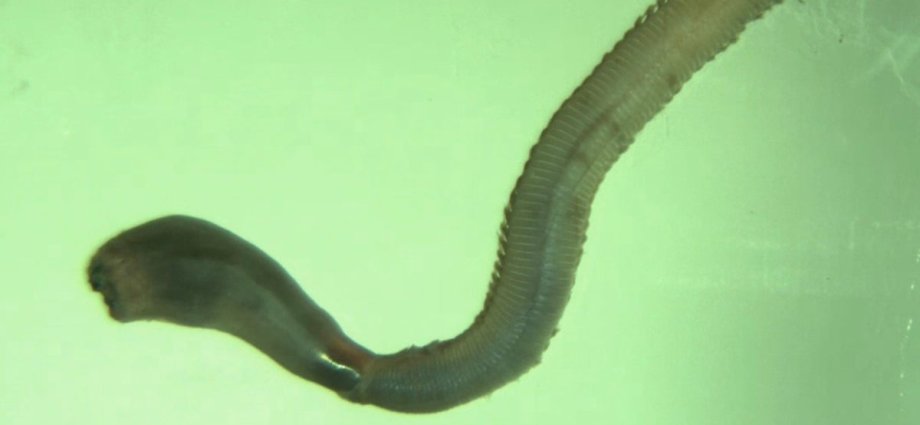
Scientists have given us another reason to fear – or marvel at – ruddy-hued marine bloodworms.
The haunting, copper-fanged invertebrates that may grow to over a foot long can do something remarkable with their long flexible mouth, known scientifically as a “proboscis.”
In the event of an attack or the need to burrow, the venomous Glycera dibranchiata bloodworms can “explosively” turn their appendage, which normally remains concealed within their bodies, inside out. Now, researchers say they know how it happens.
The process has been likened to fictional biology portrayed in the 1979 scifi horror film Alien, with aliens that have mouths that shoot out and retract.
The key lies within the “very disagreeable” worms’ translucent wrinkly folds, Georgia Institute of Technology researchers said in a bioRxiv preprint published earlier this month.

The bloodworms store their organs when not in use, with their mouth tube and intestine “buckled” in size. Their retractor muscles display “pronounced wrinkles and folds, potentially functioning as a form of self-organized origami,” the team wrote.
“These natural strategies may provide insights into repeatable retraction,” they said.
They found this out by testing the bloodworms’ biomechanics, in both air and seawater-infused gelatin that simulated the mudflats where the bloodworms burrow.
The researchers filmed the creatures turning themselves inside out and used ultrasound imaging tech – also used to check on fetuses during human pregnancies – to see the worms’ internal processes.
The worms were held in a 3D-printed plastic “open-casket worm ‘coffin’” to ensure they would not wriggle, as is their nature.
The researchers also tested the worms’ internal fluid pressure to better understand the conditions in which the proboscis inverts.
Ultimately, the Georgia researchers found that the process is similar to blowing up a balloon, inflating as fluid is pumped inside of the proboscis in a matter of fewer than two seconds. The proboscis is able to stretch out up to three times its size without breaking.
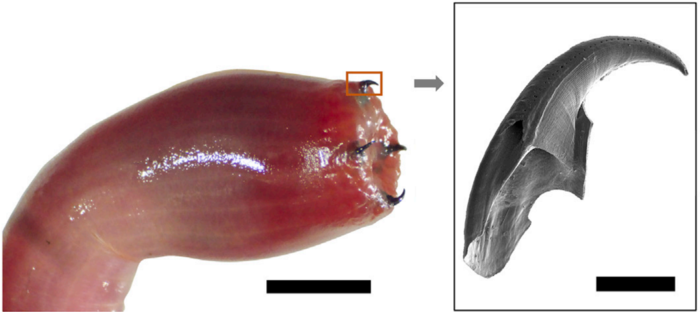
“Its maximum strain of ϵmax = 2.9 is comparable to one of the most extensible soft tissues in nature, the body of the leech Hirudo nipponia with a max strain of 3.6. In comparison, human tendons fail at a strain of 0.098,” the authors wrote.
Retracting the proboscis takes around eight seconds, but it’s still pretty darn fast.
“It’s similar to seeing the ‘behind the scenes’ of the magic trick,” David Hu, a mechanical engineer at the Georgia Institute of Technology, told Science. “We could see the deflated proboscis waiting for action.”
Hu said understanding how these bloodworms work could help inform future technology for soft-bodied robots. Most soft-bodied robots use polyurethane films that aren’t as stretchy as a bloodworm’s proboscis.