










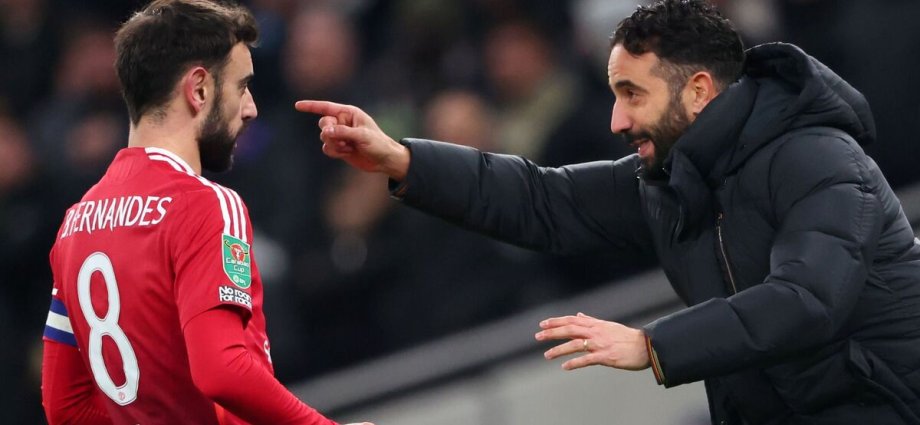
Ruben Amorim has a Bruno Fernandes problem that he can’t afford to keep overlooking (Image: Getty Images)
For a fleeting moment, it appeared Manchester United might finally be steadying the ship. Three consecutive wins – a first streak of its kind in almost two years – sparked talk of progress, momentum and Ruben Amorim beginning to find his rhythm. However, Saturday’s 2-2 draw with relegation-threatened Nottingham Forest – which, without Amad Diallo’s late wonder strike, would have been a bitter defeat – served as a stark reminder that United’s problems run far deeper than a few recent results.
The team still struggles to control games for long stretches. They remain fragile when under pressure – and despite the buzz around Amorim’s fresh tactics and renewed energy, United continue to feel like a work in progress – a side caught between transition and tradition. The draw at Forest didn’t just stop their momentum, it highlighted the uneasy balance in Amorim’s developing 3-4-3. The system can look sharp when United dominate possession, but it quickly unravels when they are forced to fight, press and defend in numbers. At the centre of this sits Bruno Fernandes – captain, talisman and perhaps, unintentionally, one of United’s trickiest tactical dilemmas. With that in mind, here are three observations from United’s concerning weekend.
The Fernandes problem
Fernandes has been moderately effective in Amorim’s 3-4-3, operating as one of the two central midfielders. When United control the ball, his vision and rapid passing are valuable. But in tougher away fixtures – like Forest – his role becomes a potential weakness.
He lacks the mobility to cover space or the discipline to maintain structure, leaving United’s midfield vulnerable. It’s reminiscent of Cesc Fabregas under Antonio Conte at Chelsea – a talented player, but too lightweight for the intensity and organisation required in a two-man midfield. Conte’s choice to prioritise N’Golo Kante and Nemanja Matic brought Chelsea balance – and, ultimately, a Premier League title.
United may get away with Fernandes in that role for now, particularly against weaker opponents. But if Amorim truly aims to build a team capable of contending for major trophies, he might need to take the bold step of pushing Fernandes further forward – or even leaving him out entirely.

Bruno Fernandes has been playing well, but he doesn’t really suit a two-man midfield (Image: CameraSport via Getty Images)
The challenge is that advancing him risks displacing Matheus Cunha and Bryan Mbeumo, both of whom seem far more natural as inside forwards in this formation. There’s also the reality that Fernandes, despite his tactical drawbacks, remains a talismanic, goal-scoring fan favourite and one of the few United players with consistent form during turbulent seasons.
Still, if Amorim persists, so will his 3-4-3 – and within it, Fernandes increasingly feels like a square peg in a round hole. Some will insist he is too valuable to drop and worth forcing into the side – but shoehorning him into an unsuitable role could ultimately hurt United when it counts most.
It’s a difficult puzzle to solve, but if the Red Devils genuinely want to return to the top, they must be prepared to exclude even their biggest stars if it means the team functions better as a whole.

Amorim has rarely deviated from his Casemiro-Fernandes partnership in midfield this season (Image: Getty Images)
Mainoo is a must
For United’s midfield to operate effectively, one player is indispensable: Kobbie Mainoo. The 20-year-old offers a rare mix of composure, mobility and football intelligence that United desperately need. He can glide past presses, advance the ball purposefully and still retain the discipline to shield the defence.
A 3-4-3 demands balance, control and energy. Mainoo provides all three – and pairing him with a true holding midfielder, whether Casemiro, Manuel Ugarte, or a summer signing like Carlos Baleba, makes perfect sense.
Amorim’s choice to sideline him has puzzled many. In games where United struggle to control tempo, Mainoo could be transformative. Where someone like Fernandes introduces risk, Mainoo provides rhythm – a calming influence that allows others to play freely. If Amorim wants a midfield that dictates matches rather than merely reacts, reinstating the youngster should be a priority.

Mainoo has spent most of the season warming the bench (Image: NurPhoto, NurPhoto via Getty Images)
Two-man midfields need not only discipline and structure but also energy – the ability to cover space, press intelligently and recover rapidly in transition. Amorim seems intent on pairing Casemiro and Fernandes, but that duo lacks the mobility and intensity the system requires against elite opposition.
Casemiro no longer has the legs to cover large areas alone, while Fernandes excels in creativity and chance creation rather than defensive duties or ball recovery. Without a more dynamic partner like Mainoo, United’s midfield risks being outpaced – solid on paper, sluggish in practice.
Wing backs needed
The other glaring weakness lies on the flanks. Amorim’s 3-4-3 depends heavily on wing backs who can stretch the pitch and defend intelligently. Currently, United have neither.
Patrick Dorgu is the only natural option but has been inconsistent. Amad is being misused at right wing back, while Diogo Dalot continues to cover the left despite being right-footed. It’s an awkward arrangement that leaves United vulnerable defensively and blunt offensively.

United need to sign proper wing-backs, which will allow players like Amad to be used better (Image: Ben Roberts – Danehouse, Getty Images)
If United are serious about making this formation effective, the January window – and next summer – must prioritise proper wing backs. Players who can surge forward, deliver quality and recover quickly. They spent over £200million last summer on forwards, yet leaving £50-100m of that sum aside to sign two top-class wing backs would have been far smarter.
Now, they are linked with pricey midfielders like Baleba and Elliot Anderson. But until the problems in wide areas are fixed, the structure will continue to collapse. The formation relies on balance and without reliable wing backs, it’ll be like trying to build a house without walls.