









Perfidious Albion, in modern terms, means when it comes to international affairs, Britain is seen as treacherous and unreliable – and has turned mendacity into an art.
Students of imperial history will recall the hundreds of treaties signed with local chiefs, kings and leaders that were waved aside in the interests of the empire.
The French call their deep distrust of the Les Ango-Saxons the “Fashoda Syndrome” – named after a sordid episode of British duplicity which delivered an obscure bit of southern Sudan to the UK in the 19th century – and triggered the enduring distrust of our closest neighbour up to this day.
Now we have the Kabul Cockup. It will inevitably serve to undermine Britain’s woeful and feeble international reputation – and drive some of those who have been betrayed into the arms of our enemies.
The disastrous accidental release of 100,000 names and numbers of Afghans seeking safety in the UK, a noble but feeble effort to save some of them, and the desperate cover up using the courts to ensure that the British public knew nothing of the whole farrago, can only be reported today, two years after it was uncovered.
The official reason for a superinjunction to hide the mess was to protect Afghans who wanted to get out of Afghanistan, before the Taliban found and killed them. But their numbers, emails, and names were already in the public domain after the leak.
The Taliban are not illiterate morons. They beat the Soviets, they beat Nato and the US at war. They would have got hold of the list within moments of a clumsy British Ministry of Defence official hitting the “send” button on an email containing all those sensitive details to sources in, or near, Afghanistan.
Rather than take the lead and act on principle to protect human lives, the British government did what it always does and went into overdrive to protect its own embarrassment and to avoid making the case for, not against, immigration to this country.
Ministers could have stood up and admitted to the leak. They could, and should, have defended the right and need for people who had literally risked their lives to settle into the UK because they believed this is a country of decency as a first principle.
But because British politicians of the two mainstream parties live in fear of Reform, they had already embarked on betraying the soldiers who had given most to the UK in its hopeless war in Afghanistan.
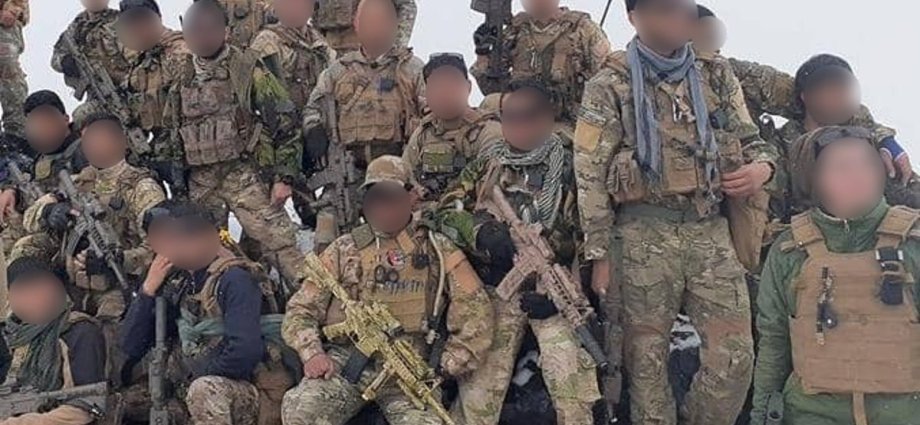
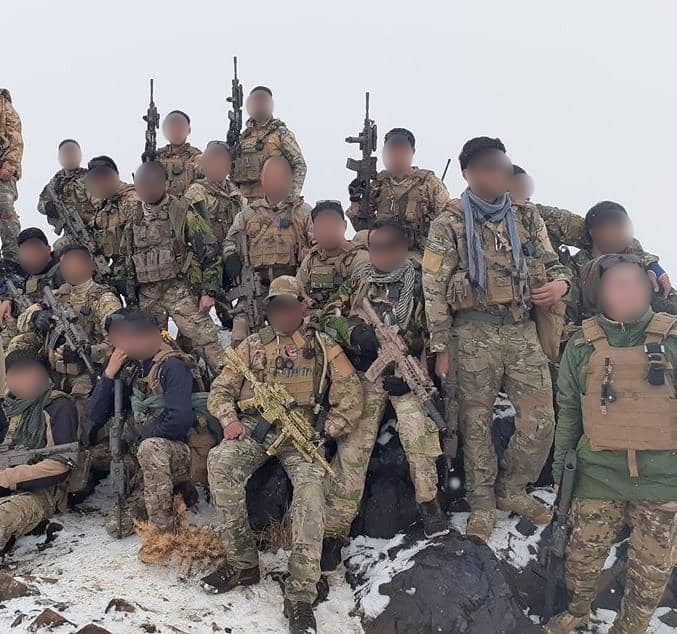
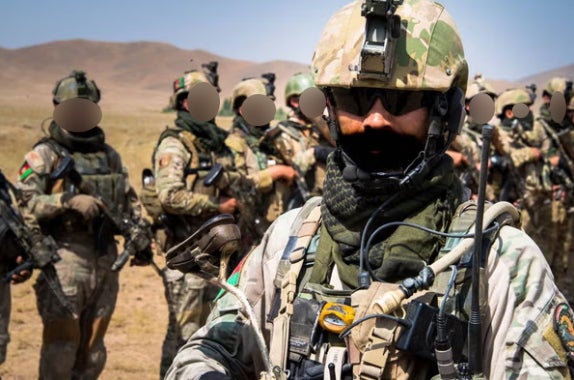
As The Independent has previously reported, Afghan Special Forces teams from task forces 333 and 444 – paid and trained by the UK, who fought alongside the SBS and the SAS for years – were ditched when the Taliban took over Kabul in mid 2021.
Very senior British officers, who knew the capabilities and the loyalty of these men, formally suggested they could be brought to the UK and used as Tier Two special forces operators in the British army. They were sneered away.
Some of those Afghan special forces operators, intelligence sources have told The Independent, are now living in Iran. Imagine their skills put to work for a regime that is planning revenge for the Israeli and US attacks on it recently.
Some have been relocated to the UK after a campaign by this newspaper. But many others were abandoned.
So, when the massive leak of names was reported to the British government, it did set about trying to help some of the potential victims. But it kept most in the dark to hide a British snafu, not to save the lives of loyal servants to the Crown who did not know that the Taliban probably knew who they were.
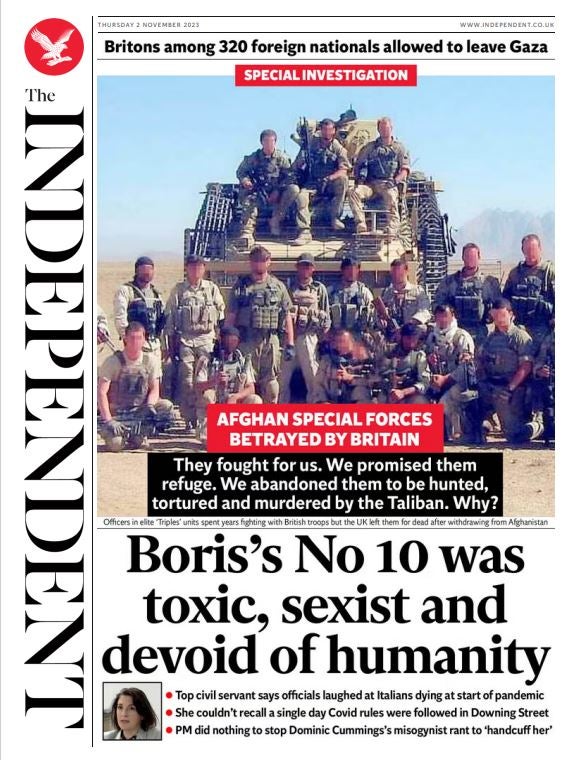
The Independent’s Holly Bancroft uncovered the story in the autumn of 2023, but was unable to report it because of the ongoing evacuation operation.
“In total, 23,900 Afghans linked to the breach have been offered relocation to the UK, with more than 16,000 already in the UK. The MoD says 6,900 of those are people who would not have otherwise been brought to Britain,” she wrote, now that the superinjunction has been lifted.
Why not? Why were these 6,900 Afghans – originally deemed ineligible – suddenly given access to the UK? Could it be because politicians had been reluctant to make the case, moral or economic, for immigration?
It’s feeble enough that this government, like the last, continues to campaign against immigration while businesses, led by the Confederation of British Industry, are crying out for skilled and unskilled labour to fuel growth.
It’s just as feeble that no matter that although the economic case for rejoining the European common market is overwhelming, no senior politician in government is making the case.
So, if there is no effort to show leadership in areas of clear national self-interest, one should not be surprised that ministers hide in the mob which clings to irrational beliefs fomented by disinformation and extremist populism.
They’d rather just abandon battlefield allies, hide the fact they’ve been accidentally endangered, and gag anyone talking about it. The first instinct is perfidy and obfuscation, not leadership.
“Plus ça change, plus c’est la même chose,” as they’d say next door.