










Want to bookmark your favourite articles and stories to read or reference later? Start your Independent Membership today.
Join today
Already a member?
Log in
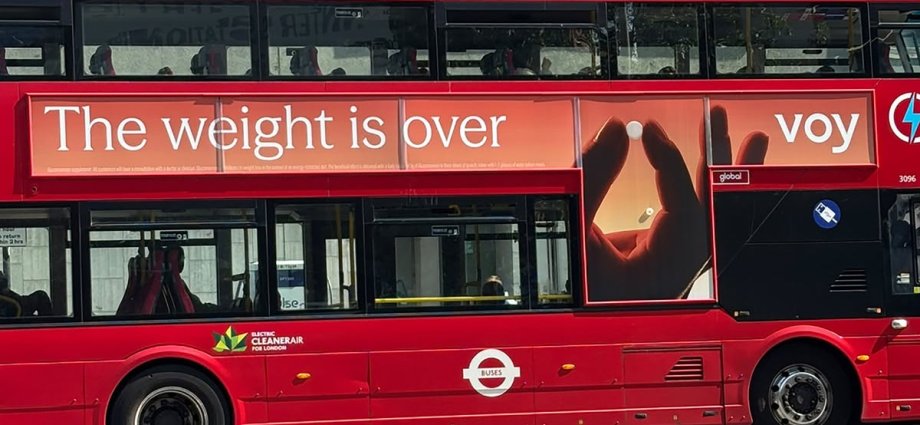
Two adverts from Voy’s “The weight is over” campaign” are among four advertisements which have been banned for promoting prescription-only weight loss to the public.
One ad for Voy, seen on the side of a bus in July, highlighted a hand holding a white tablet underneath the headline ‘The weight is over… Voy’.
The other of Voy’s banned ads, which was broadcast on video on-demand services back in August, shows a pill next to wording reading ‘Oral weight support’, and ‘It’s kind of a small deal’.
The first GLP-1 tablet for weight loss was licenses to be sold as a medicine available only via prescriptions in June. Prescription-only medicines cannot be advertised to the public.
The Advertising Standards Authority (ASA) said the imagery and wording in both ads were likely to lead people to understand they were advertising the newly available oral Wegovy tablets, rather than a food supplement.
It said references in the small-print to glucomannan were not enough to change that impression, while the video-on-demand ad also directed people to a website featuring prescription-only weight-loss medicines.

The watchdog also banned ads by Juniper and MedExpress for promoting oral weight-loss prescription-only medicines despite not naming them directly.
A YouTube ad for Juniper stated: “The weight loss pill is here”, while an Instagram ad for MedExpress promoted “New weight loss tablets”, “No needles” and invited people to “Join the waitlist”.
Last month, ads for oral weight loss medicines become the first to be banned for promoting unlicensed and prescription-only products to the public.
Simple Online Pharmacy and Pharmacy Online advertised oral GLP-1 treatments through social media ads and on their websites, including by inviting people to join waiting lists, register their interest and pre-order treatment.
Catherine Drewett, investigations manager at the ASA, said: “Today’s rulings make clear that advertisers need to consider the overall impression their ads create.
“A medicine doesn’t need to be named for an ad to be understood as promoting a prescription-only medicine and references to a non-medicinal product in small print won’t necessarily change that impression.

“Using our AI monitoring, we have this sector under ongoing review, and we won’t hesitate to take action against ads that break the rules”.
Julian Beach, executive director of operations at the Medicines and Healthcare products Regulatory Agency (MHRA), said: “The MHRA’s Advertising Standards team works closely with the ASA to support action against inappropriate advertising of medicines, and we welcome these latest rulings.
“Prescription medicines are not consumer goods, and promoting them can have serious impacts on public health. These safeguards are there to protect people and support appropriate treatment decisions between patients and their healthcare professionals.”
Voy chief medical officer Dr Earim Chaudry said: “Every patient decision at Voy is clinician-led and these campaigns were developed to align with UK advertising standards. We keep all our advertising under continual review to ensure it meets any updated guidance.
“We actioned withdrawal of the advert while the investigation was under way and will not run it again. We cooperated fully with the ASA throughout and acted promptly on its feedback.”