








Want to bookmark your favourite articles and stories to read or reference later? Start your Independent Membership today.
Join today
Already a member?
Log in
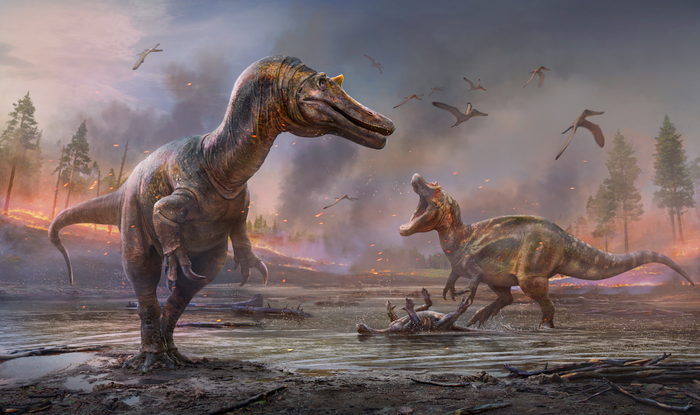
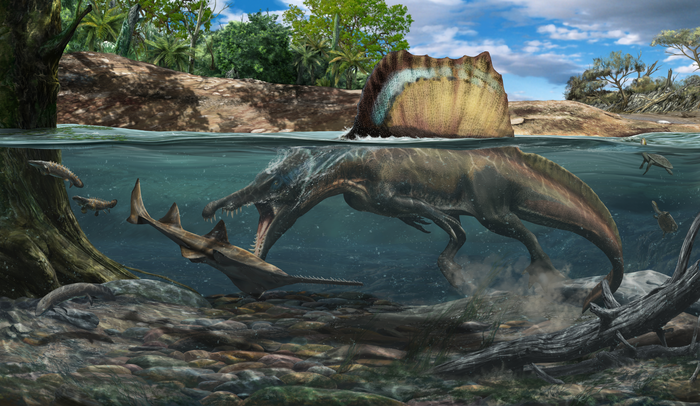
Spinosaurus, the iconic dinosaur featured as the main antagonist of 2001’s Jurassic Park III, spent most of its life underwater, according to a new study.
Although many animals evolved from living in the ocean to life on land, the journey was not always unidirectional.
Studies have shown that many animal groups, including mammals and reptiles, eventually returned to the water, developing new adaptations that allowed them to thrive in aquatic environments.
Now, a new study using artificial intelligence analysed thousands of fossil measurements to uncover surprising clues about which prehistoric creatures truly became aquatic.
“These secondarily aquatic groups adapted in strikingly similar ways to their new aquatic home, evolving flippers and a suite of other features that made them better swimmers,” said Caleb Gordon, an author of the new study published in the journal Current Biology.
The findings reveal that spinosaurus spent most of its life underwater, while some ancient marine reptiles previously thought to be fully aquatic actually spent considerable time on land.
In the study, researchers examined hundreds of fossil and modern specimens housed at the Yale Peabody Museum and dozens of other institutions worldwide.
They assessed extensive data, including more than 11,000 measurements, photographs, and CT X ray scans.
Scientists have disagreed for decades about how and when particular groups of prehistoric animals became fully adapted to life underwater.
This is because fossil records do not offer complete clues, and sometimes even provide conflicting clues, making it difficult to determine whether an extinct species predominantly lived on land, in water, or in both environments.
While some fossil features may indicate an aquatic lifestyle, others can suggest that the same animal remained capable of moving and feeding on land, leading researchers to different conclusions about how the species behaved.
“In these cases, paleontologists are often stuck, as different lines of evidence disagree about what the ancient animal was like,” Dr Gordon said.
The new AI model identified relationships between skeletal proportions and known lifestyles to estimate how extinct species used aquatic environments.
Researchers could use the model to predict tissue adaptations in such fossil species, including swimming structures that rarely get preserved over time.
The AI model revealed striking insights about spinosaurus, a giant prehistoric dinosaur whose relationship has long been a topic of debate.
These dinosaurs are known to have lived in what is now northern Africa about 113 million to 94 million years ago.
While previous studies have pointed to its association with aquatic environments, exactly how it moved, hunted, and spent its time remains a subject of debate.
Some earlier research suggested that the prehistoric reptile may have frequently submerged itself and pursued prey underwater like modern-day seals or penguins.
But others suggest they may have had a lifestyle similar to that of modern herons, with spinosaurus walking and searching for food along shorelines and in shallow water.
The latest study provides new support for the more aquatic interpretation.
“Our results shed new light on how much time spinosaurus spent submerged, which could support the underwater hunting view,” Dr Gordon said.
“We confidently recovered highly aquatic habits for spinosaurus, indicating that it spent the vast majority of its time submerged in the water,” he said.
Researchers also made deductions about mesosaurs, which were marine reptiles that lived between 290 million and 274 million years ago in regions now forming parts of South Africa and eastern South America.
Scientists previously thought that mesosaurs most likely had a fully aquatic existence as they gave birth to live young.
But the new analysis suggests that their limbs were not adapted for a life spent entirely in water.
Mesosaurs regularly moved between aquatic and terrestrial environments, according to the latest study.
“They spent a lot of time on land, like a modern-day alligator or platypus does. Mesosaurs didn’t completely leave the land behind,” Dr Gordon said.
The research also points to a broader pattern among the earliest marine reptiles.
It suggests all marine reptiles seemed to return to land regularly some time before the dinosaurs disappeared.
This seems to have been the case with even the most water adapted species remaining amphibious, researchers say.