









Want to bookmark your favourite articles and stories to read or reference later? Start your Independent Membership today.
Join today
Already a member?
Log in
A newly discovered fossil of a crow-sized bird that inhabited China around 150 million years ago features surprisingly small wings, indicating it was better suited for running than flying — a finding that paints a considerably more complex picture of early avian evolution.
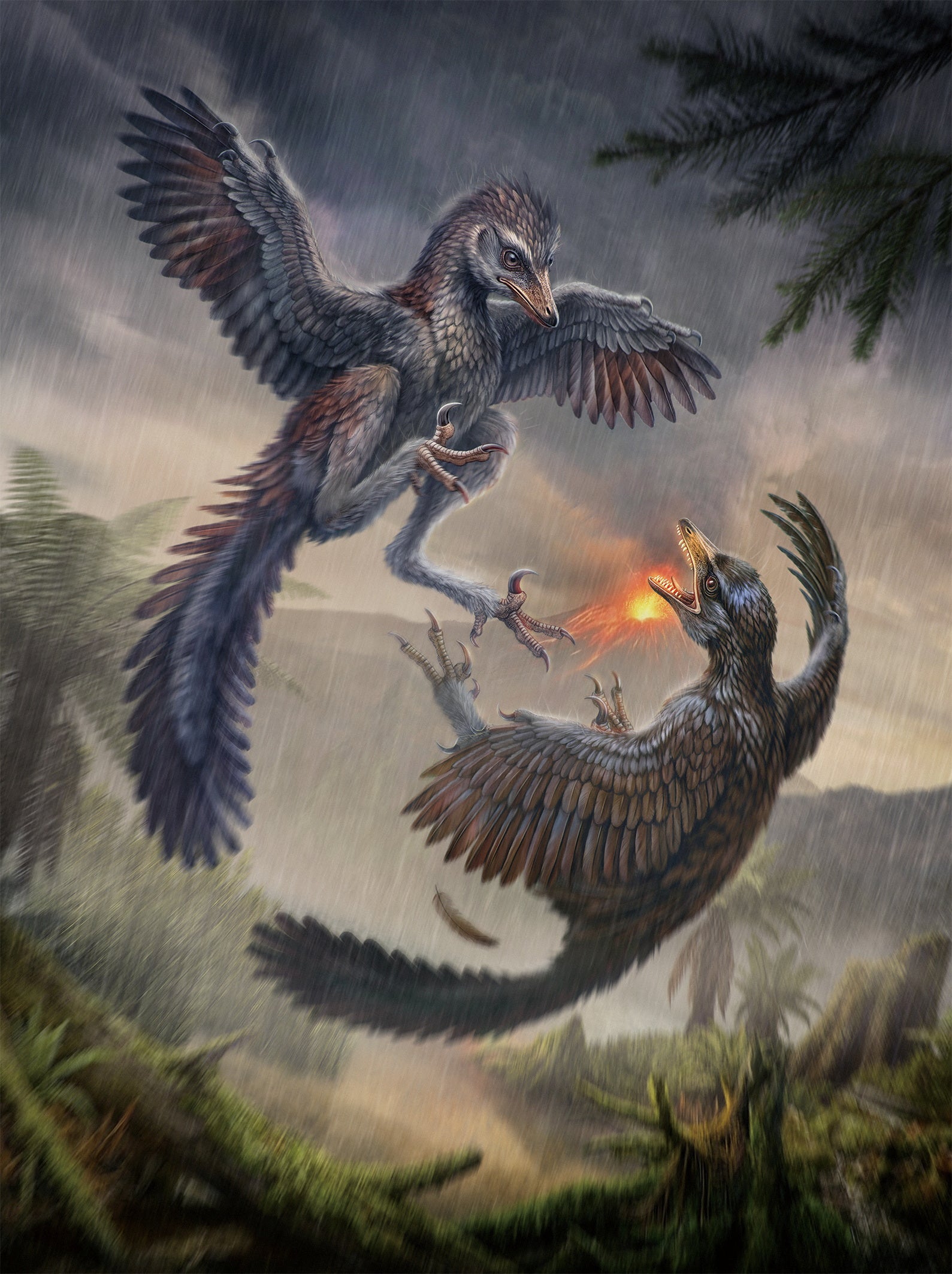
Dating back to the Jurassic Period, the new species has been named Yuezhuornis yangyuanensis and stands alongside Europe’s famous Archaeopteryx as one of the earliest-known birds. Curiously, Yuezhuornis appears to have already diminished its flight capability in favor of ground running, mirroring a roadrunner — a fast sprinter that rarely takes to the air.
“Yuezhuornis challenges the traditional paradigm that the avian body plan evolved almost exclusively under the selective pressures of flight,” said paleontologist Min Wang of the Institute of Vertebrate Paleontology and Paleoanthropology, part of the Chinese Academy of Sciences, who co-led the study published on Wednesday in Nature.
“So this new fossil just changes our assumption about what a Jurassic bird looks like,” Wang said.
Asked if Yuezhuornis may have lived like a roadrunner by mostly running but flying in short bursts when necessary, Wang confirmed, “Yes, that is likely.”
The nearly complete fossil specimen was unearthed in Fujian Province, located in southeastern China.
Birds evolved during the Jurassic from small feathered dinosaurs, but fossils showing precisely when this occurred and how it unfolded remain lacking. Archaeopteryx was long considered the oldest-known bird, but a small number of others of similar age like Yuezhuornis have now been discovered.
MOSAIC OF ANATOMICAL TRAITS
Yuezhuornis, which weighed an estimated 1.8 pounds (800 grams), presented a mosaic of anatomical traits combining avian and dinosaurian characteristics. Its forelimbs were fully developed wings, though they were too small compared to the rest of the body to have allowed for robust flying. It also had the slender cranial bones of a bird and a bird-like pelvis.
On the other hand, Yuezhuornis had a sickle-shaped claw on its flexible second toe similar to that of meat-eating dinosaurs like Deinonychus, Velociraptor and Troodon — a dangerous weapon useful for a terrestrial hunter. In fact, Wang said, Yuezhuornis may have competed for prey with small non-bird dinosaurs.
It had relatively large, closely packed and serrated teeth lining its jaws, typically present in certain carnivorous dinosaurs but not birds. In addition, it had a long and bony dinosaurian tail, as all the earliest-known birds did.
Archaeopteryx combined avian and dinosaurian traits, too, but its well-proportioned wings showed it was built for flying. The wings of Yuezhuornis, by contrast, were a third shorter than its legs. Comparisons with 377 extant bird species showed that the limb proportions of Yuezhuornis most resembled those of ground-dwelling avian species like pheasants.
Yuezhuornis is believed to have shared with Archaeopteryx a common ancestor that lived earlier in the Jurassic, Wang said. It also is possible that Yuezhuornis represents an evolutionary experiment that emerged separately from the main avian evolutionary lineage, Wang said.
Wang said he did not expect to see a species so close to the evolutionary origins of birds that appears to have possessed limited or perhaps no ability to fly.
“It surprises us,” Wang said.
University of Edinburgh paleontologist Steve Brusatte, an expert in dinosaurs and birds who was not involved in the study, said, “Yuezhuornis is one of those discoveries that throws up more questions than it gives answers.”
Brusatte, who authored the recent book “The Story of Birds” exploring avian evolution, said Yuezhuornis appears to be an actual member of the bird evolutionary lineage.
“That would make it both one of the oldest birds in the fossil record and one of the most primitive birds on the family tree. Yet this is a weird bird. Its skeleton looks like a Frankenstein monster mashup,” Brusatte said, of avian and dinosaurian traits.
“It’s obviously an important new species because it shows that early birds and their closest relatives were more diverse and more variable in their anatomical features and body plans. But it also hints that some of the first birds were not particularly good fliers, maybe even that some of them had evolved from flying ancestors but reverted back to living on the ground, rarely if ever taking to the skies,” Brusatte said.