









Want to bookmark your favourite articles and stories to read or reference later? Start your Independent Premium subscription today.
Subscribe
`;
document.body.appendChild(modal);
modal.addEventListener(‘click’, () => {
document.cookie=”mos-plan-select=; Max-Age=0; path=/; expires=Thu, 01 Jan 1970 00:00:00 UTC;”;
});
modal.querySelector(‘.subscribe-link’)?.addEventListener(‘click’, (e) => {
e.preventDefault();
document.cookie=”mos-plan-select=; Max-Age=0; path=/; expires=Thu, 01 Jan 1970 00:00:00 UTC;”;
setTimeout(() => {
window.location.href=”https://www.independent.co.uk/subscribe/app”;
}, 500);
});
});
Perhaps you have started eyeing your thermostat, thinking about inching the heating up. Possibly you’ve seen the green of tree leaves becoming tinged with brown. Maybe you’ve noticed Halloween decorations in Tesco or seasonal favourites returning to Starbucks. Or, among all these perennial harbingers of autumn’s return, it’s conceivable that it is the reappearance of Slow Horses, Apple’s beloved adaptation of Mick Herron’s spy novels, that tells you that summer is over.
Remember Struan Loy (Paul Higgins), the sad sack agent who was fired by Jackson Lamb (Gary Oldman) in the show’s first series? Returning – briefly – at the start of the sixth season, Loy meets his maker in a manmade inferno that raises a few questions. “It seems somebody is killing Slow Horses,” observes Catherine Standish (Saskia Reeves). What have these off-the-books misfits done to attract the attention of two Russian assassins? And why does it seem like Diana Taverner (Kristin Scott Thomas) has scrubbed all trace of their existence from the records? They face a race, against both time and foreign powers, to save their former agents and uncover the truth.
There’s a lot going on in this season of Slow Horses, which is adapted from two novels: Joe Country (from which they draw the main “kill list” plot) and Slough House, which has meatier geopolitical themes for Taverner to deal with. The narrative also reunites River Cartwright (Bond contender Jack Lowden), who is grieving the death of his grandfather, with Sid Baker (Olivia Cooke), who is resurrected and drawn into the intrigue (this isn’t a spoiler: her return has been heavily teased in the promotional material). They bumble flirtatiously away from the pursuing contract killers, while Standish is paired again, to comedic effect, with Joanna Scanlon’s fastidious Moira. After six seasons, Slow Horses can be forgiven for re-running its greatest hits. After all, much of the show’s appeal still rests upon Gary Oldman’s willingness to play Lamb as a greasy savant, utterly incapable of character growth or development. Similarly, there will be much scrutiny of Lowden’s performance given he is on the rumoured shortlist to play 007, yet the show contrives to give him another plot to demonstrate Cartwright’s signature dashing incompetence.
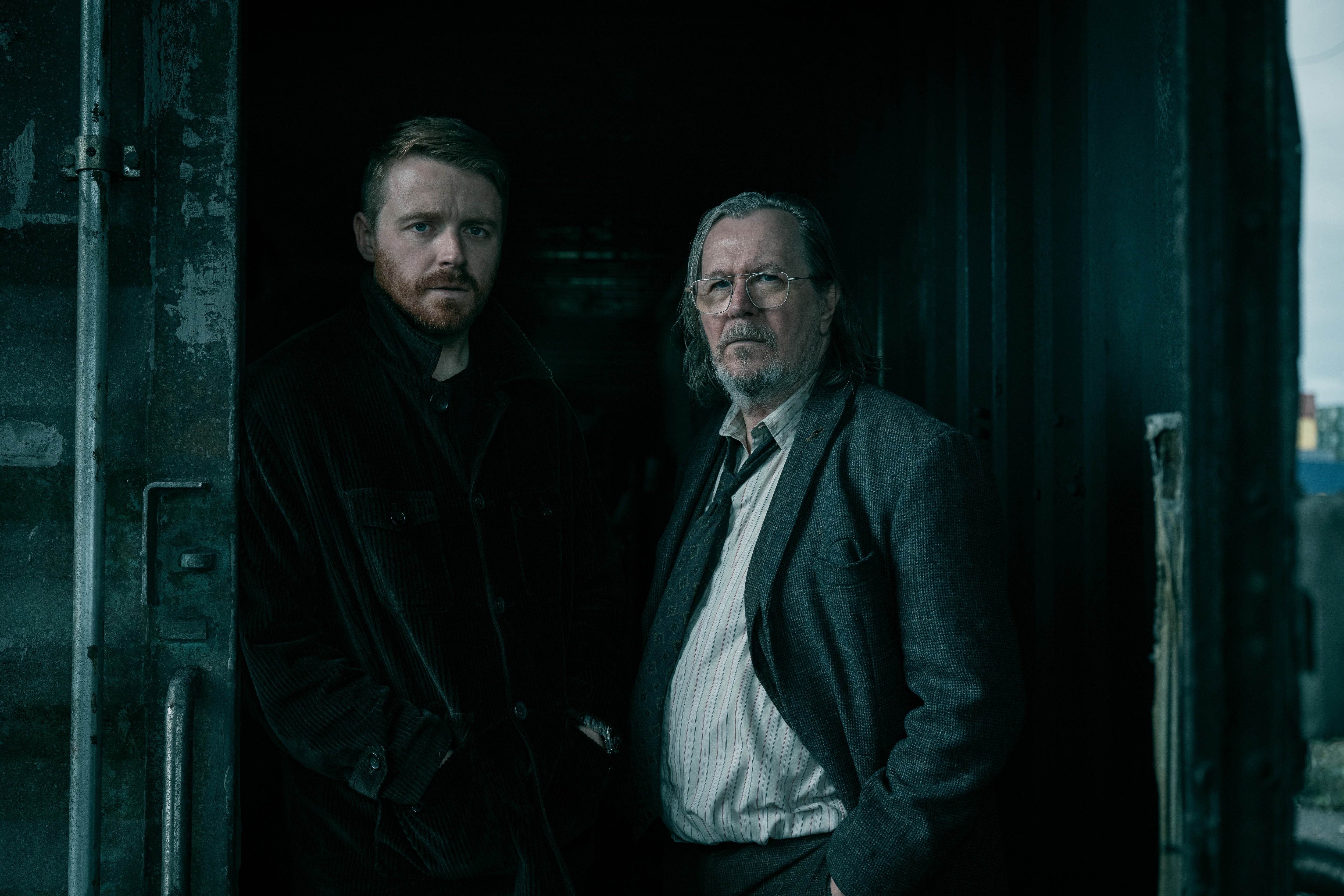
With critically acclaimed oddball hits like Severance and Widow’s Bay and long-running audience favourites like Silo and Ted Lasso, Apple TV has quietly become the world’s most reliable streaming service. And there’s nothing as consistent as Slow Horses. In fact, it’s consistent almost to a fault: each new chapter feels like a continuation of a single saga. That has necessitated changes from the books, as the showrunner, Will Smith, seeks to ensure audiences get a healthy dollop of Oldman’s Lamb (a role for which he has three Emmy nominations and counting). His badinage with Scott Thomas’s Taverner, the head of MI5, was the show’s original pitch to viewers. “He paraded you around like you’re in a bikini at Butlins,” Lamb rebukes his boss after she gives a national TV interview. These exchanges have a warm familiarity, like a sitcom catchphrase or a pumpkin spiced latte.
It does, however, rather raise the question of whether Slow Horses is evolving in interesting directions. Each season follows a similar formula: strange external forces put Slough House in jeopardy, Lamb tussles with the Park (head office), and one of his agents is dramatically murdered. Ultimately, however, his brand of pragmatic spycraft wins out. The capacity of the show to shock has been significantly reduced over the seasons (I recall the death of Min Harper in season two as a real sucker punch; a similar exit this time round carries far less weight). This is the price that the show pays for being extremely reliable: it has become predictable. Just as James Bond ultimately foils the evil plot, the Avengers banish some alien back into the cosmos, and seemingly ill-suited romcom lovers end up in a beautiful clinch, so too will Slow Horses always conclude with Lamb’s mob fighting for survival like rats in a bag. The show’s devotees will eat this up, but less invested viewers might find that, after a few seasons, they crave something a bit different.
Still, Slow Horses is one of the simplest pleasures in modern TV. It has the soap operatic quality of Spooks, just with Oscar-worthy lead actors and Apple’s deep-pocketed budgets. The show is beautifully shot, the action sequences well choreographed, and the tension executed with aplomb. It might not be much interested in reinvention or evolution, but this is prestige entertainment at its absolute sturdiest.