










Want to bookmark your favourite articles and stories to read or reference later? Start your Independent Premium subscription today.
Subscribe
`;
document.body.appendChild(modal);
modal.addEventListener(‘click’, () => {
document.cookie=”mos-plan-select=; Max-Age=0; path=/; expires=Thu, 01 Jan 1970 00:00:00 UTC;”;
});
modal.querySelector(‘.subscribe-link’)?.addEventListener(‘click’, (e) => {
e.preventDefault();
document.cookie=”mos-plan-select=; Max-Age=0; path=/; expires=Thu, 01 Jan 1970 00:00:00 UTC;”;
setTimeout(() => {
window.location.href=”https://www.independent.co.uk/subscribe/app”;
}, 500);
});
});
A complete fossil of the iconic Diplodocus has been discovered in Europe for the first time, upending our understanding of dinosaur distribution during the Late Jurassic period.
The long-necked sauropod had previously been found only in the Morrison Formation paleontological site in western US.
But a recent dig excavated 14 tail vertebrae and many exceptionally preserved bones of the iconic dinosaur at the La Tejería site in eastern Spain’s Teruel.
The fossil was dated 150 million years ago, providing compelling evidence that dinosaurs migrated between North America and Europe during during the Late Jurassic Period.
Dinosaurs likely crossed temporary land bridges that emerged as the proto-North Atlantic Ocean underwent regressive phases.
Researchers said the findings also helped them better understand the diversity of sauropod dinosaurs that inhabited the European Jurassic.
“The outcome of the dig is some of the strongest paleontological evidence for episodes of dispersal and faunal exchange between the two continents across the proto-Atlantic Ocean during the Late Jurassic,” Sergio Sánchez Fenollosa, an author of a study detailing the new discovery in the Journal of Vertebrate Paleontology.
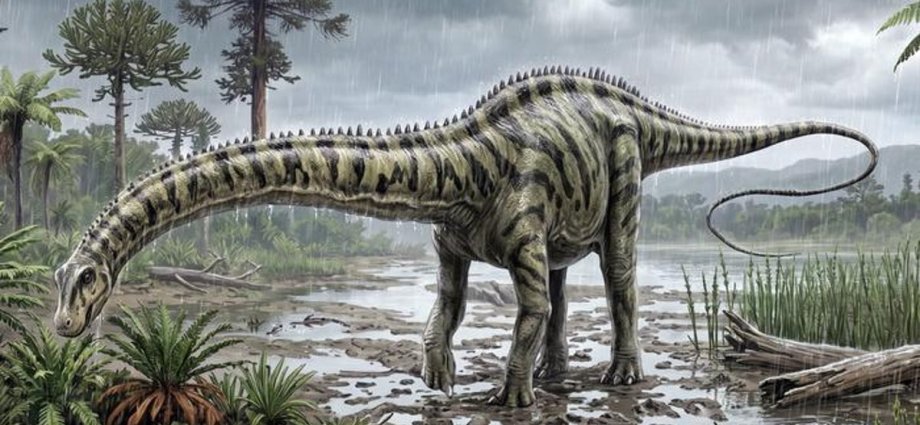
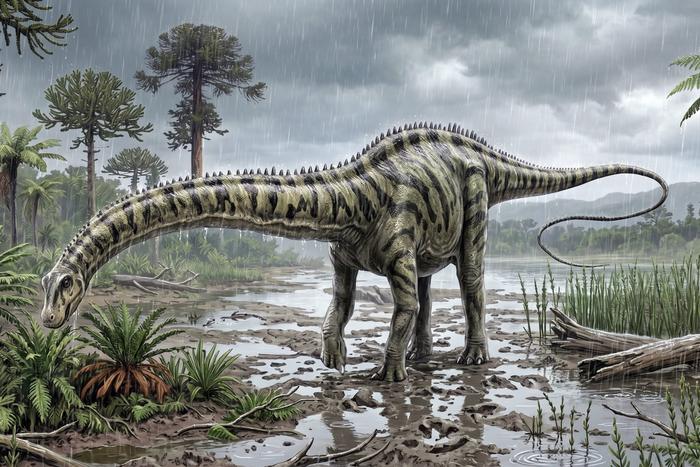
Diplodocus is one of the most recognisable dinosaurs, with its long neck, whip-like tail and relatively small head.
Researchers estimated the fossil Diplodocus unearthed in Spain was about 25m long, comparable in size to its North American relatives.
Thanks to the exceptional state of the fossil’s preservation, researchers could identify distinctive anatomical features characteristic of Diplodocus.
They found the dinosaur had large air-filled cavities in its vertebrae, special grooves on the underside of the tail bones, and distinct Y-shaped bones on the underside of the tail.
-together-with-a-figure-indicating.jpeg)
Comparing the Spanish fossil’s features with those of other sauropods, researchers placed the specimen within the Diplodocus genus, specifically as a close relative of Diplodocus hallorum.
“As we looked more closely at the anatomy, we began to identify a combination of features characteristic of Diplodocus species,” Mr Sánchez Fenollosa said.
“Then, as we carried out different evolutionary analyses, they kept pointing in the same direction. With each new result, the picture became clearer: we were looking at a Diplodocus.”
Researchers have also found other sauropod dinosaurs at Teruel, like Turiasaurus and Losillasauru.
“The fossils of all these dinosaurs, including those of the new Diplodocus specimen, make Teruel a reference place for understanding this great diversity,” said Alberto Cobos, another author of the study.
The Diplodocus fossil is on display in the dinosaur hall of the Museo Aragonés de Paleontología at Dinópolis in Teruel.