










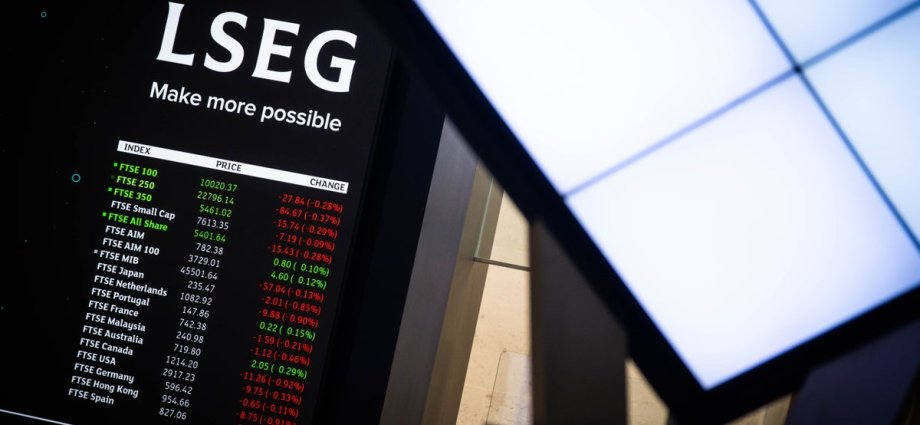
The FTSE 100 outperformed European peers on Tuesday, with oil stocks on the up amid rising prices, and bond market concerns adding to the cautious mood.
The FTSE 100 index closed up 7.74 points, or 0.1%, at 10,728.04. The FTSE 250 ended down 142.97 points, 0.6%, at 24,561.43, and the AIM All-Share closed down 6.50 points, 0.8%, at 794.25.
Oil prices crossed 90 US dollars once more as hopes fade for an imminent reopening of the Strait of Hormuz.
US President Donald Trump said on Tuesday that no US talks with Iran are under way or planned and insisted the blockade of its ports remains in force.
“There are no talks or conversations going on, or scheduled, with the Islamic Republic of Iran. The Naval Blockade remains in full force and effect. The Hormuz Strait is open and operating. All water mines have been removed or detonated,” Mr Trump wrote on Truth Social.
In response, Brent oil for October delivery traded at 91.17 dollars a barrel on Tuesday afternoon, up from 89.07 dollars late on Monday.
Dan Coatsworth, head of markets at AJ Bell explained the oil price moves are both a “pain and a gain for UK investors”.
It is “bad for businesses and consumers, but good for the FTSE 100’s oil heavyweights BP and Shell who propped up the UK blue-chip index amid a broader European market pullback,” he noted.
BP rose 2.7%, while Shell gained 1.8%. On the FTSE 250, Harbour Energy was up 1.5%.
“Efforts to bring an end to the war have not been successful, and reports suggest Iran will now become more aggressive,” Mr Coatsworth said.
“That raises the risk of further disruption to oil supplies out of the Middle East, hence why inflation fears and potential interest rate hikes are front of mind for investors. This scenario is negative for equities as it can dampen risk appetite.”
In European equities on Tuesday, the CAC 40 in Paris closed down 0.8%, while the DAX 40 in Frankfurt fell 0.8%.
Stocks in New York were lower. The Dow Jones Industrial Average was down 0.3%, the S&P 500 index was 0.6% lower, while the Nasdaq Composite fell 1.3%.
Bond markets were also a source of worry.
Mr Coatsworth noted in the US the 30-year Treasury yield reached a 19-year high of 5.33%, while in the UK the 30-year gilt traded at 5.85% – the highest level since May this year.
“Rising long-dated bond yields are not driven solely by expectations of higher interest rates and inflation fears. They can also reflect concerns around high levels of government borrowing and investors demanding greater compensation for the risks of holding long-dated government bonds,” he said.
The yield on the US 10-year Treasury stretched to 4.72% on Tuesday from 4.71% on Monday. The yield on the US 30-year Treasury widened to 5.30% from 5.29%.
In London, investors weighed jobs and average earnings data, ahead of Wednesday’s inflation report.
Figures from the Office for National Statistics showed the UK unemployment rate was steady at 4.9% in the three months to June, unchanged from the three months to May. It had been expected to ease to 4.8%, according to consensus cited by FXStreet.
Year-on-year growth in average earnings was 3.5% in April to June, when excluding bonuses.
Including bonuses, it was 4.1% higher. It was last lower in December 2025 to February 2026, when it was 3.9%.
The figure excluding bonuses topped the FXStreet cited consensus of 3.4%, while the total pay figure was in line with the market forecast.
In the three months to May, total pay growth was 4.4%, while regular pay growth, which strips out bonuses, was 3.4%.
Vacancy estimates decreased on the quarter, with early estimates for May to July suggesting a decrease of 6,000 vacancies to 707,000, compared with February to April.
It is the lowest level since between February to April 2021, during the Covid-19 pandemic, when 657,000 vacancies were reported.
Outside the pandemic period, the last time there were 707,000 or fewer vacancies was in September to November 2014, when there were 703,000 vacancies.
“The basic story here is that the jobs market is cool,” said James Smith, economist at ING.
“We can see that in the vacancy numbers, which are still gradually falling and are well down on pre-Covid levels.
“We can see that in the unemployment rate, notwithstanding the latest reliability issues. And crucially for the Bank of England, there is little sign that wage growth is about to turn higher.”
The pound traded at 1.3539 dollars on Tuesday afternoon, down from 1.3557 dollars at the equities close on Monday. Against the euro, sterling ebbed to 1.1693 euros from 1.1702 euros.
The euro stood lower at 1.1578 dollars against 1.1586 dollars. Against the yen, the dollar was higher at 159.62 yen, compared with 159.34 yen.
On a quiet day for company news, Kainos soared 21% after raising revenue and earnings guidance, as sales momentum from financial 2026 continued into the new financial year.
London-based Kainos which provides IT support to customers across three divisions – digital services, workday services, and workday products – said its annual results will be “comfortably ahead” of current market expectations.
Frasers rose 2.1% after increasing its stake in German fashion house Hugo Boss to just under 48%.
Frasers Group, which owns the House of Fraser, Sports Direct and Flannels brands, said it had received valid acceptances for 12.2 million Hugo Boss shares, just shy of 18% of its share capital, as it pursues a voluntary public takeover offer to acquire Hugo Boss.
Frasers made a cash bid of 38.00 euros per share in June but Hugo Boss told shareholders to reject the offer saying it is “inadequate from a financial point of view”.
Gold traded at 4,361.38 dollars an ounce on Tuesday, down from 4,423.12 dollars on Monday.
The biggest risers on the FTSE 100 were Relx, up 70.0p at 2,540.0p, Experian, up 76.0p at 2,875.0p, BP, up 13.9p at 533.5p, Burberry Group, up 24.5p at 1,074.5p and AstraZeneca, up 246.0p at 11,806.0p.
The biggest fallers on the FTSE 100 were Polar Capital Technology Trust, down 29.0p at 657.0p, Halma, down 132.0p at 3,570.0p, Babcock International Group, down 38.5p at 1,138.5p, Weir, down 86.0p at 2,586.0p, and Lion Finance Group, down 410.0p at 12,910.0p.
Wednesday’s global economic calendar has UK consumer and wholesale inflation figures, eurozone trade figures and the minutes of the last Federal Open Market Committee meeting.
Wednesday’s UK corporate calendar has half year results from Oxford Nanopore Technologies and Kenmare Resources.
– Contributed by Alliance News