










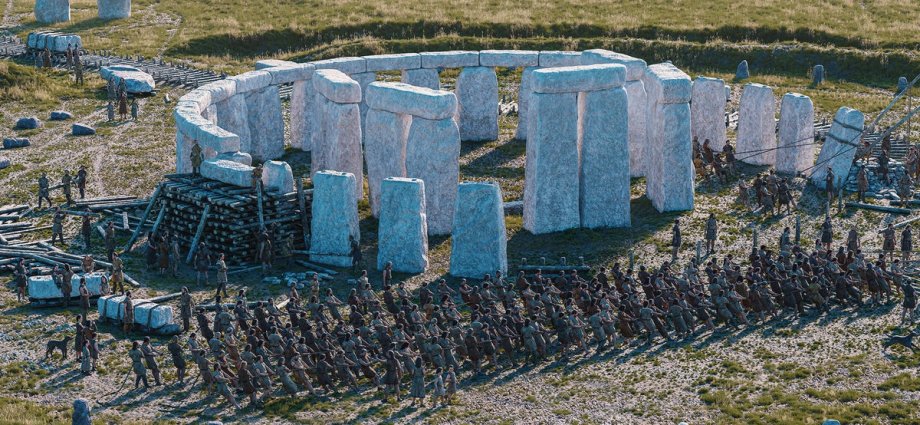
The most realistic image of the building of Stonehenge has been created, revealing for the first time how stones were pulled along wooden tracks “like a sort of railway” to the monument.
The World Heritage Site was built 5,000 years ago, first with the placing of bluestones transported from the Presili Hills in Wales, and then, hundreds of years later, it was altered with the arrival of huge sarsen stones to create the iconic stone circle.
The 25-tonne sarsen stones were brought from Marlborough Downs, some 15 miles away, and until recently, it was through that they were rolled over timber posts along the distance.
However, after studying cultures in Indonesia a century ago, some experts now believe they were hauled along trackways of laid-down wood in wetland parts of the route.
The theory has been presented for the first time in a new visual image showing how Stonehenge was constructed, including the transport of the stones, their positioning, and the social gathering.
Created from laser-scan data along with archaeological work, the image, made by English Heritage, appears in a new book by Dr Susan Greaney, lecturer in archaeology at the University of Exeter.
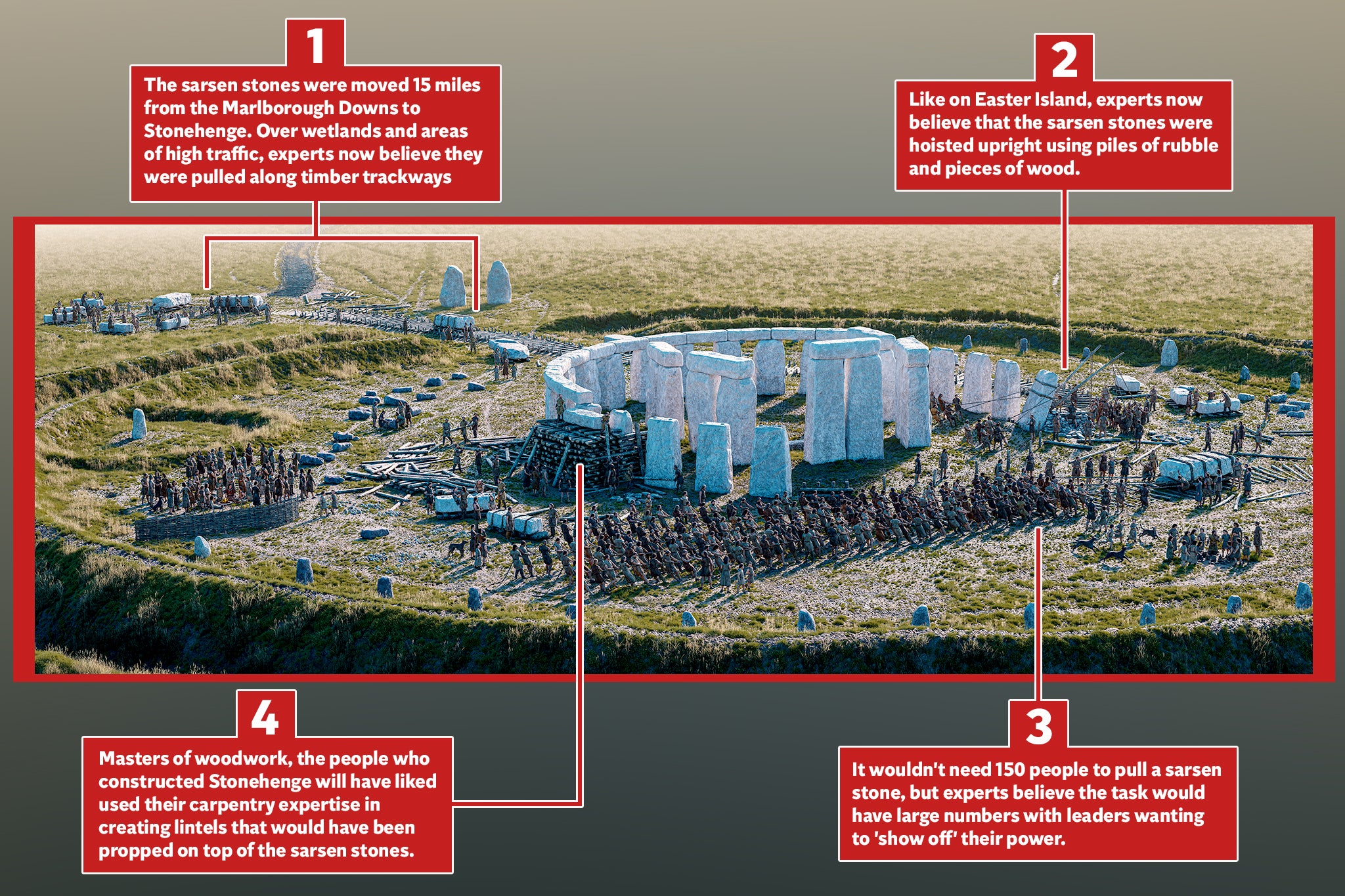
“For years it was accepted that the huge stones were moved using a sledge on rollers, but we now believe that to be a mistake,” said Dr Greaney. “There have been black and white pictures from the 1900s from Indonesia that show the pulling of megaliths along tracks of laid-down wooden timbers, like a sort of railway. And we believe it is likely the builders of Stonehenge used a similar method over wetland and areas of high traffic [of moving the stones].”
The Neolithic people would have been capable to lay down the tracks given their expertise in working with wood, said Dr Greaney, who suggests the tracks might have been up to three miles in length. The new image shows a stone being brought to the site by such a method, as well as a newly-thought theory on how the stones were hoisted up into position.
“On Easter Island it was noticed that the Rapa Nui [local people] used piles of rubble to help pus the stones upright,” said Dr Greaney. “We believe a similar method could have happened at Stonehenge.”
Another feature of the picture is the huge group of men and women pulling the sarcen stone.
Dr Greaney said evidence of mass feasting at Durrington Walls, where it is thought the builders of Stonehenge stayed, highlighted that more people were involved in moving stones and building the monument than necessarily needed.
“It could have all been about showing off,” she said. “How many people you could get to pull the stones may not have been about efficiency but presenting power when taking it through communities and to the site.”
Despite this, Dr Greaney believes people were not forced into taking part in the construction. Rather, they were led by a belief in it benefiting them somehow, either spiritually or through religion.
Stonehenge was built over several phases, the first was a circular ditch and bank constructed, then the arrival of the bluestones before the sarsen stones. The monuments Altar Stone, believed to have come from north-east Scotland, was also introduced at some unknown point.
The point of the site is unknown for sure, but experts believe, due to it aligning with the solstice sunrise and winter solstice sunset, that it is connected to the sun.
Today, more than one million people visit the English Heritage-run attraction each year. And although it not being the only stone circle in the region, it is the one which holds the most interest.
Dr Greaney said: “If you go to the other side of the world and show a picture, people will recognise it. There’s an element of mystery to the place too. It was built around 5,000 years ago with basic tools by people we may have thought as primitive, but really they were sophisitaced and much closer to the landscape we live than people today.”
The image of Stonehenge’s construction is taken from Stonehenge: The Story of an Icon, written by Dr Susan Greaney which is out now.