










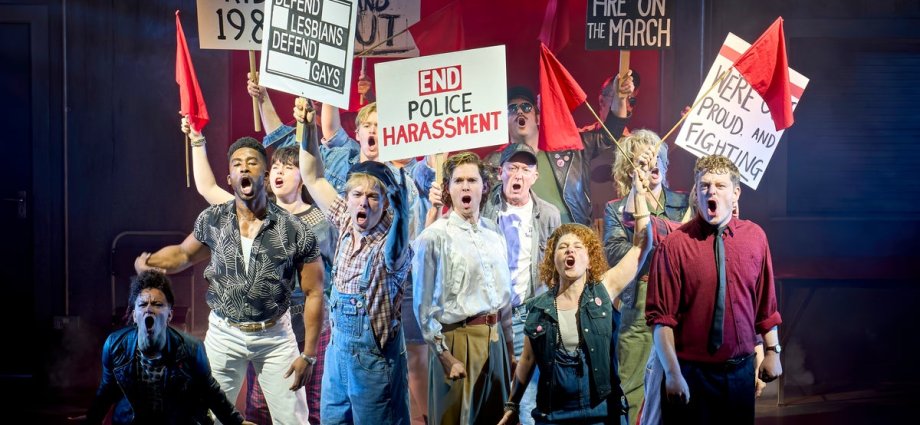
Solidarity is the watchword in the new stage musical Pride, as it was in the feelgood 2014 film that inspired it. Set in 1984, during the height of the miners’ strike, the true-life story follows a group of London-based gay activists who start raising funds to support a Welsh mining community, having realised they have enemies in common (ie, Margaret Thatcher and the right-wing press).
Pride, produced by P&P Productions with the National Theatre, transcends its source material in most every way: it’s funnier, more moving, and more joyous than the film. (Both incarnations are directed by Matthew Warchus.) It also – crucially – feels more queer. My big gripe with the film was that it seemed designed with a straight audience in mind: for a tale about people living radically unconventional lives, it was stubbornly traditional in its form. Musical theatre, on the other hand, is a medium that comes pre-queered. (That’s not to say that Pride narrows its appeal: an early joke about “trade” aside, the script largely avoids the sort of less-normalised gay argot that might fly over straight heads.)
Pride’s story loosely focuses on Mark Ashton, a charismatic young Irish activist and the driving force behind the formation of LGSM (Lesbians and Gays Support the Miners); Jhon Lumsden is credibly magnetic in the role. Really, though, Pride is an ensemble piece, with the spotlight – and musical numbers – divvied up generously among its cast. Samuel Barnett is a particular standout as a sardonic ex-thespian, bringing the house down twice with his limber voice and even more limber dance moves. Lewis Cornay, playing what later generations would refer to as a “baby gay”, handles an understated coming-out-of-his-shell arc with impressive full-body physicality. On the miners’ side of things, the performances are just as compelling, from future politician Siân (Sarah Pugh, in tremendous voice) to Cliff (Darren Lawrence), an older Welshman with his own private reasons to sympathise with LGSM’s cause.
At first, the music – composed by Christopher Nightingale, Josh Cohen and DJ Walde, with lyrics by Stephen Beresford – falls into that category of slick pop-rock that’s numbingly ubiquitous in musical theatre these days. But as it goes on, shades are revealed: the miners pull from the sounds of traditional Welsh folk music. Elsewhere we have show-tunes, disco. It’s eclectic, but subtle about it.
There are valid criticisms you could make of the script, particularly the marginalising of the LGSM’s lesbian contingent – here more or less compressed into the character of Steph (Courtney Stapleton). In reality, lesbians were more significantly represented within the organisation; in late 1984, some of them formed their own splinter group, Lesbians Against Pit Closures, after schisms developed over sexism and gender disparities within LGSM. (This, naturally, is not explored in the play.) But, given that it is fundamentally a work of populist entertainment, Pride can be forgiven for over-simplifying some aspects of the queer struggle.
“Uplifting” and “crowdpleasing” are adjectives that cynics tend to baulk at, but Pride is utterly successful in owning them. When things take a sombre turn towards the end – any queer story set in 1984 is inevitably going to brush up against the Aids crisis – it navigates this tonal shift remarkably well. People around me in the audience were sobbing. That everybody ultimately left the theatre feeling not devastated but enlivened is a testament to Pride’s deft, noble manipulations.
‘Pride’ is at the National Theatre’s Dorfman until 12 September