








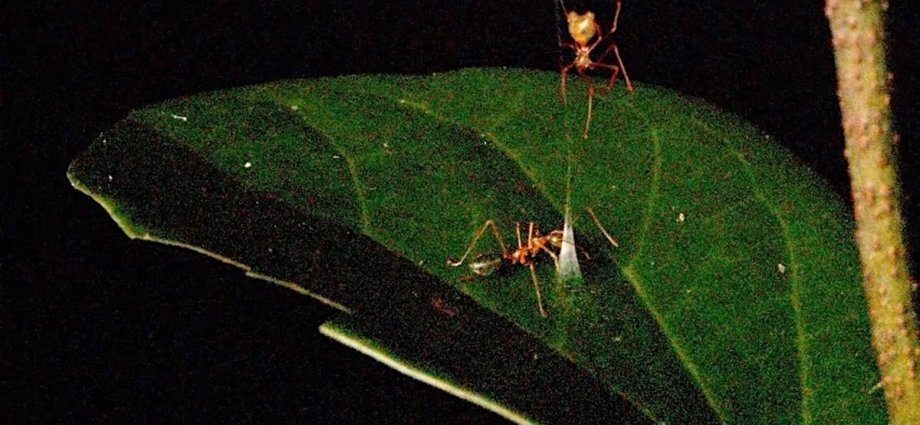
A new spider species has been discovered in the rainforests of north Queensland that is capable of weaving powerful spring-like snares that trap and launch prey at an astonishing speed.
The spring-actuated snare is built to catch only one species of ant, one at a time, in what researchers describe as “the ultimate specialisation”.
Dubbed the ballista spider, after the ancient Roman weapon that launched bolts or stones, it has evolved its special ability to trap only the highly territorial and aggressive green tree ant Oecophylla smaragdina, scientists say.
Yet to be officially named, the spider was first observed by biomedical scientist Greg Anderson, who is also a spider researcher and photographer.
Then a team of scientists from Macquarie University in Australia spent 10 days and nights in the rainforest near Cooktown, far north Queensland, locating the spiders, observing them in detail and capturing their behaviour using high-speed and infrared cameras.
-Ballista-spider-rests-underneath-a-leaf-during-the-day-(B)-Ballista-spider-waits-for-the-prey-in.png)
Researchers were perplexed at first that the spider’s diet consisted mainly of ants, a challenging prey. “Ants have a range of chemical defences – including the ability to sting in some species – and they use alarm signals to rapidly recruit hundreds and even thousands of other ants as backup to overcome potential predators,” said Ajay Narendra, an author of the study from Macquarie University.
“It’s very unusual for a spider to feed on ants, because they’re notoriously dangerous, and even more bizarre to find a spider that eats only one particular ant species,” Dr Narendra said.
Scientists observed that during the day, the ballista spider tends to take refuge on the underside of leaves above areas where the green tree ants are actively foraging.
Then, as night falls, the spider descends 50cm or more to lay an anchor point on the leaf, a branch, or the forest floor.
It spends up to four hours at this point engineering 15-60 vertical silk tension lines bundled together in a cone near the ground.
The spider then wraps the cone with a thinner type of silk, then rapidly retreats upwards, holding onto the thread until the right ant arrives.
Researchers observed that the snare works like a miniature catapult disguised as a tunnel.
Within seconds after the snare is built, a green tree ant is attracted, reacts aggressively, biting and detaching the cone from the anchor point.
This causes the snare to spring, launching the ant deeper into the cone at an acceleration comparable to what’s seen in a severe automobile crash.
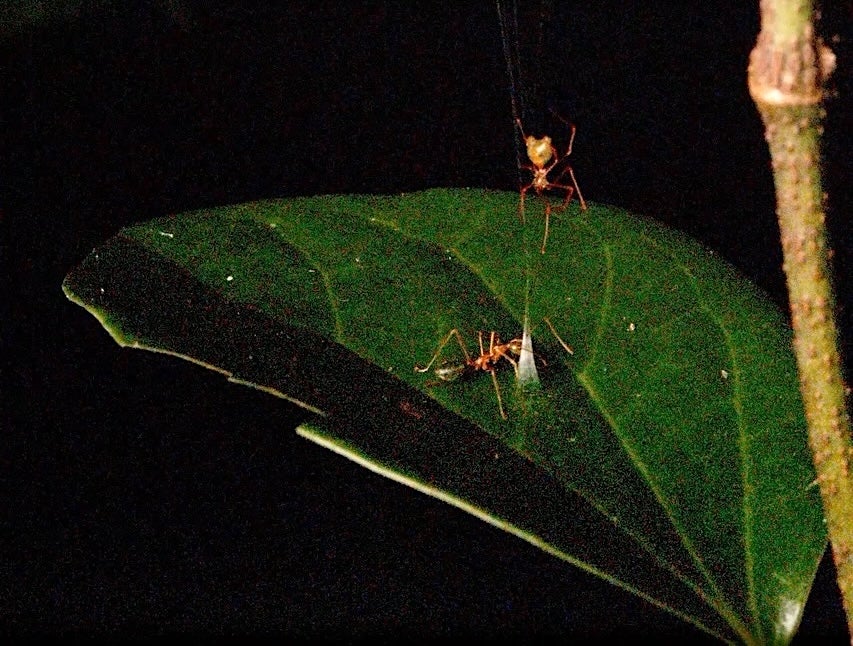
The spider engineers its snare to store elastic energy and rapidly release it, researchers say.
It waits for the ant to be fully entangled in its web before wrapping it further with silk.
“We suspect during the final construction stage the spider adds a pheromone that specifically lures worker ants and induces an aggressive attack, triggering the snare,” Dr Narendra said.
“This seems to be the only case where a spider’s web is designed to catch a single prey species, and where the mechanism is triggered by the prey rather than by the predator,” he explained.
Researchers theorise that the snare mechanism evolved as a highly specialised way for the spider to pick off potentially hazardous prey one at a time and transport them away from ant trails and nests.
They also suspect that the spider has evolved to only hunt one species of ant that follows predictable trails, and behaves in ways that make this ambush strategy effective.