










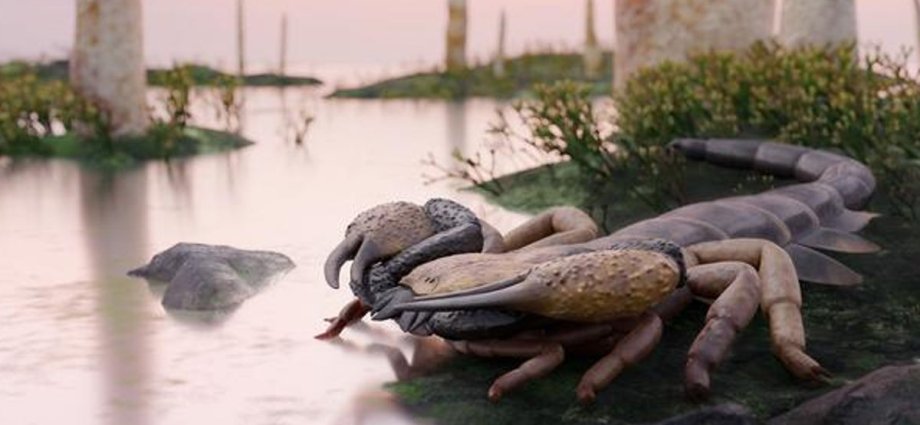
Giant scorpions, with formidable pincers over 16cm long, once roamed the floodplains of England and Wales, a new fossil study reveals.
The metre-long scorpion, named Praearcturus gigas, is the largest of its kind to ever exist, say researchers from the University of Manchester, who identified the species based on fossils from the St Maughan’s sandstone geological formation in Wales.
It lived during the Early Devonian, about 415 million years ago, when small plants and fungi had just begun to spread, and complex land ecosystems like forests had yet to emerge.
This was a time well before the evolution of trees, when life on land was only just getting started, researchers say.
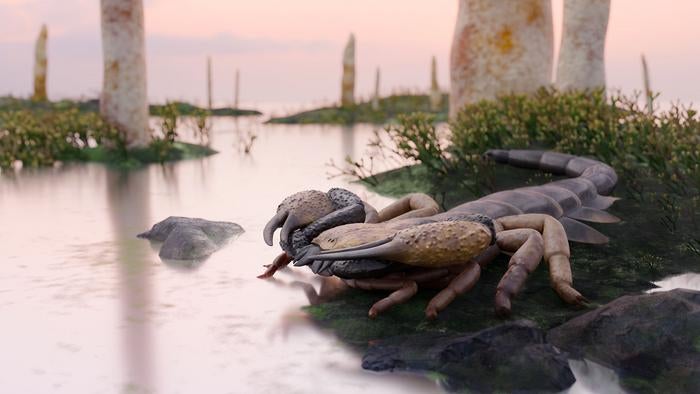
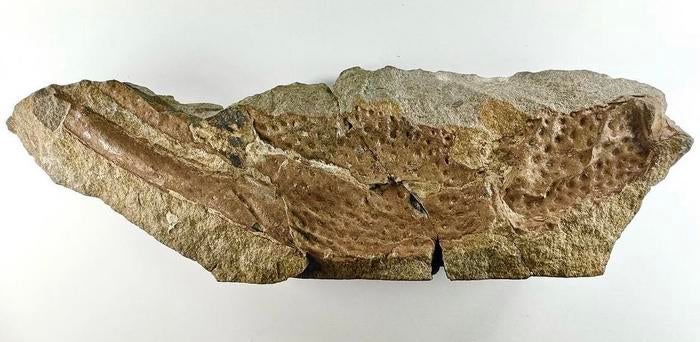
The species was identified based on a fossil specimen held in the Natural History Museum’s collection for more than 150 years that had puzzled scientists for more than a century.
It was originally thought to be a giant crustacean, similar to a woodlouse, due to the fragmentary nature of fossils lacking key features such as a tail for over 100 years.
But better-preserved fossils discovered in recent years and advanced analytical techniques have now revealed that the fossils belong to a distinct scorpion species.
“Confirming that this animal is a scorpion fundamentally changes our understanding of how and when these creatures evolved to such extraordinary sizes,” said Richard J Howard, lead author of the study published in the journal Palaeontology.
“By bringing together material from several collections and using cutting-edge imaging techniques, we’ve been able to build a clearer picture of the animal than was previously possible,” said Russell Garwood, a palaeontologist at The University of Manchester.
The scorpion, researchers say, lived at a time when life on land was otherwise very small. To reach such extraordinary sizes, they suspect it may have partly lived in water, where life was bigger.
It might have grown so big because there weren’t many competitors of such size on land, scientists say.
Fossils indicate it had flap-like structures on the abdomen – similar to those found in modern crustaceans like lobsters – that may have enabled it to move between water and land.
“The boundary between land and sea was much less defined at this time. Praearcturus gives us a fascinating glimpse into how early animals adapted to these changing environments,” said study co-author Greg Edgecombe from the Natural History Museum.
“Specimens collected over a century ago can still hold entirely new insights. By revisiting them with modern techniques, we can uncover discoveries that reshape our understanding of life on Earth,” Dr Howard said.