










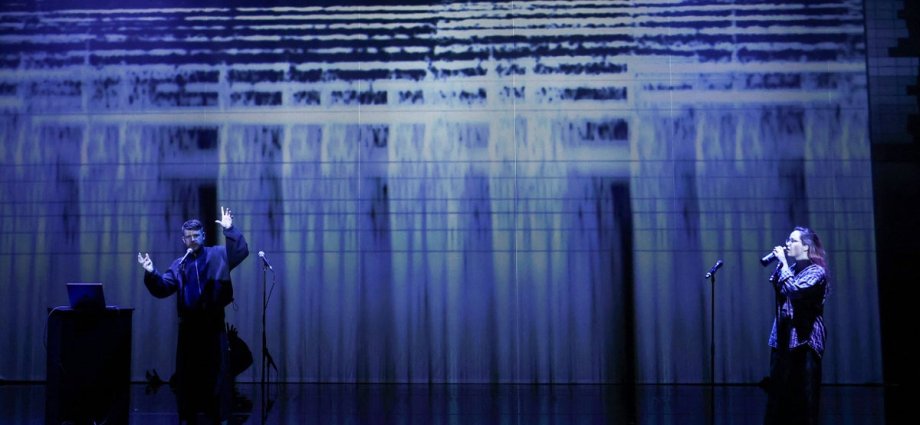
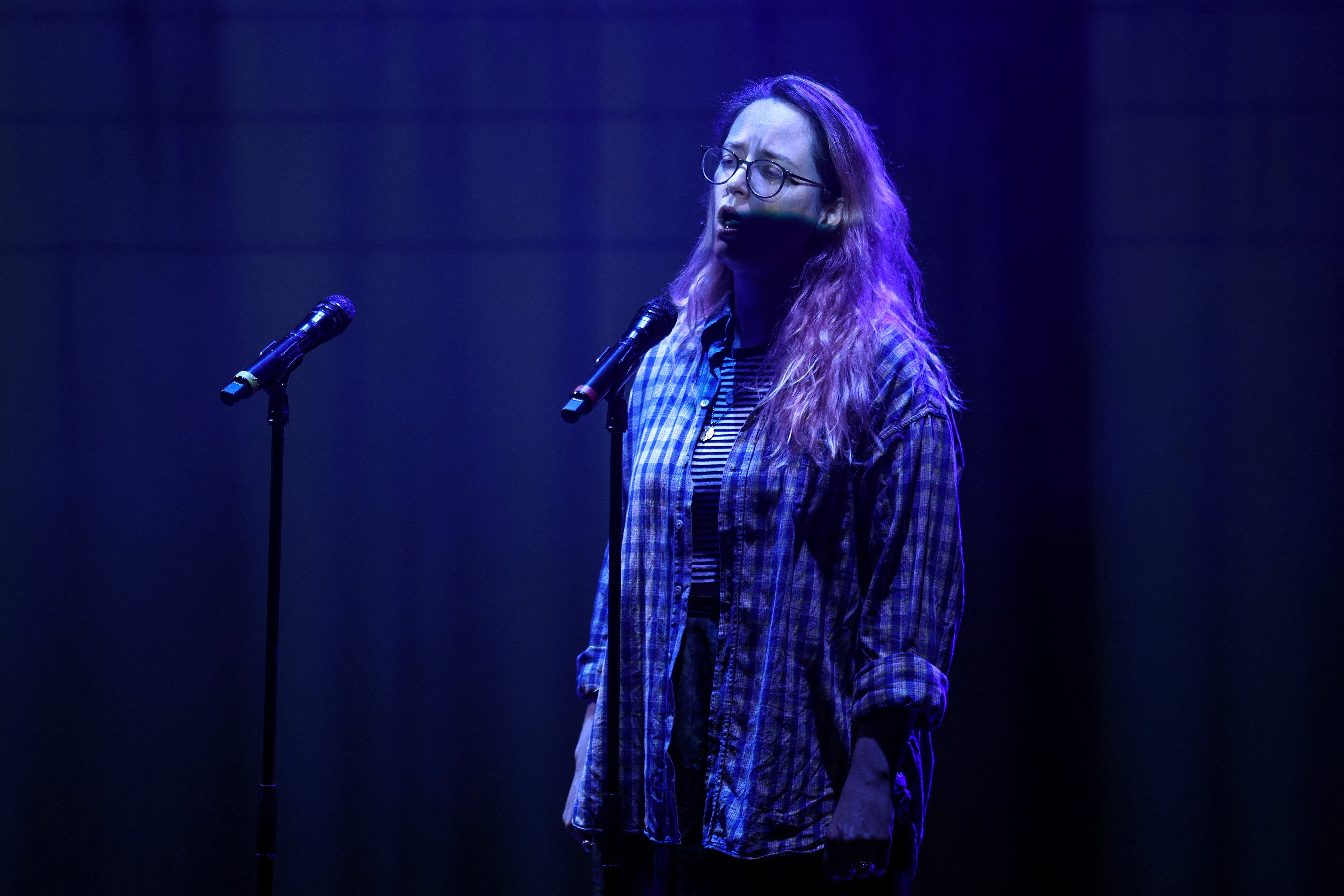
Patricia Auchterlonie, a singer who has performed at the Royal Opera House, was listening to a version of herself. “The first portion of the track was somewhat straightforward singing that really sounded like me, which was quite eerie,” she says. “And then all of a sudden it does this… what I would describe as almost like a bird call, which is very high and very weird and quite guttural.” She hadn’t ever made that noise before, though now she can.
The version of herself that Auchterlonie was listening to was produced by artificial intelligence; it was made by Harry Yeff, a beatboxer she is working with at the festival, who feeds recordings to AI and uses that process to discover new sounds he might be able to make. Auchterlonie is one of a number of practitioners taking part in an upcoming event at the Royal Opera House, RBO/SHIFT, that aims to explore how opera and artificial intelligence can interact.
Many people are unhappy. “We started programming SHIFT because there is a bit of a crisis in the performing arts with regards to machine learning,” says Netia Jones, associate director at the Royal Opera who is programming the event. “There’s absolute panic. And in fact last year, when we announced it, some leading people in the arts were describing AI as evil and as the devil, in very emotive language that has continued throughout the year.”
She blames the fact that so much reporting about AI is “emotion-based reporting”. “I feel the misery of my colleagues and fellow creatives and practitioners; I don’t feel that personally. So I was thinking this is interesting: why am I not threatened? Why do I not feel so threatened?
“Partly it’s because I’ve worked with technology forever. Secondly, it’s because what I do believe is when there is any overwhelming, very dominant technology, certain voices lead – and actually what we need in that space is the subversive voices, the people who are using it wrong, or the artists, the teachers, the philosophers who go into otherwise corporate spaces and start to make mistakes.”
Many of them didn’t want to be involved. When she launched a similar event last year, and asked practitioners to come in and explore the possibilities of the technology, some were “excited and inspired” but others were “repulsed, and exited”, she said; “that was already quite interesting”. But those who stuck around began the process that led to this year’s event: one of them was Yeff, who goes by the stage name Reeps One, and Jones paired him with Auchterlonie who sang in last year’s production of Last Days.
She hopes that the pairings – and the many like it that will take place over the four days of the festival – will inspire new ways of thinking about technology. But she knows that not everyone is ready for it. “We have to be teaching the machine really cool things. And there’s enough amazingly cool, brilliant people to be churning some really great things in the machine.” The Royal Opera House with its focus on tradition, preservation and fundamentally human work might seem an odd place for such a position, she admits, but she says that is exactly what makes it able to hold all these ideas at once.
But she knows her views will be provocative. “I’m quite excited by change, and I know there are many brain wiring that are not – and that’s absolutely fine. You don’t all have to be ready for the huge seismic shift, but I don’t think the shift has to be so negative; I think there’s space for humanity in a fairly exciting way, and we’ll just see. There’s definitely going to be change, but I think it’s change that we can have agency over, and we can affect, and we can have some kind of influence over.”
The changes she foresees are not small. “I think what’s going to be interesting is the idea of ownership – this is the idea that I think I have that’s maybe unpopular, because I know this has been exercising many leading arts voices – is the idea of ownership of copyright. But it’s quite a young idea, it didn’t exist in the 18th century – and you might say that’s because the musicians were suffering and they were treated really badly, which is true, but there will be new paradigms and we have to find new ways.
“I’m not totally convinced about the idea that an idea is owned. Philosophically, my brain can’t handle it. I think if you make something, you share it, and it belongs to everybody; I know that’s a bit utopic, and it really freaks a lot of people out because they get so angry about the idea of copyright and ownership, because it’s the only way that anybody can make a living, but I think that’s the bit we need to change.”
But those worrying about the effect of AI on creativity and the arts are not worried about a new era of sharing ideas in community, but a worry that their work will be stolen and used by rapacious technology companies who have little regard for the time and labour that went into it in the first place. Jones’s vision might be one of a utopia of creation but there is little evidence that the AI industry has much concern for building such a world; instead, it seems mostly set on gathering data with little regard for where it came from or what consequences that might have for the people who made it.
“I think the thing you can’t avoid is that there’s a very small number of companies that have trained models, therefore there is this kind of like ludicrous, almost insane Everest of wealth. Yeah, the Everest of wealth isn’t even Everest anymore. It’s like this kind of shard of what is so sharp, isn’t it? It’s insane. And the word billionaire now is like hand in hand with AI,” Jones says.
“Everybody is a bit revolted by that, it is revolting, especially for artists, because they’re always, you know, scraping. But I think that if you boycott a technology because it’s made some really unpleasant people really, really, really rich, I don’t know, that just doesn’t seem sophisticated enough to me.
“It’s not that I have the answers, but I just have maybe slightly different questions. Because I’m not sure that huge amounts of litigation are gonna be the thing either. I think this is it’s much bigger than if you’re if you have a machine learning system that wants everything. It almost obliterates the notion of copyright, because your thing is so tiny, a percent. Yeah, so if you think, OK, well, pay that person for the percentage of what that machine has learned, that’s probably [less than 0.0001 per cent].”
That doesn’t mean she will start commissioning AI work, she says. “If somehow I, as a commissioner, paid whatever corporation to write me an opera in the style of Thomas Adès, and they did that; I can’t see the world where that’s going to happen.” Not because it wouldn’t be able to – “I’m sure it would” – but because she wouldn’t ask it to.
“Who would want that? In a lot of this discourse it’s as if there’s nobody making decisions. But there are people making decisions: there’s audiences, there’s consumers, there’s practitioners and all these people. I just can’t see the complete unravelling of something that is very, very central to our existence as human beings.”
Working with technology could actually be a way of returning to something fundamentally human, she suggests. “There’s no reason why we should still be playing the same instruments that we were playing 300 years ago,” she says. “Why do we do it? We do it because we are moved by it. We love it, and we pursue it with madness. Because to get to a virtuoso level on any instrument, you have to be insanely dedicated, and it is life affirming. When we watch a virtuoso player, or singer, or performer of any kind of level, it’s so exciting because human skill is so exciting.”
She points to the work of Paola Prestini, for instance, who has used AI to enable non-verbal actors to take part in live opera performance. Or Stephanie Dinkins, a transdisciplinary artist who examines the ways that AI can leave out real people’s voices, particularly the Black and brown communities that she centres in her work. They are two of a number of people – from traditional musicians to those actively working with AI, along with technologists and others – who will join Auchterlonie on stage in trying to understand what AI is doing to technology.
Patricia Auchterlonie says that her work with AI is already putting her in touch with a kind of organic, human work that is defined by being surprising, or weird, or human. “For me, that’s what it’s all about: being in the room and – it might sound a bit woo-woo – but to feel the energy of the other performers. You need the human energy.” There is something fundamentally irreplaceable and real about being in the Opera House and hearing the human voice directly that AI can’t rival, she suggests.
“AI is just another level of artifice, and already in our society we already function at quite a high level of artifice,” she says. “When you go see performers, for instance, there’s a series of sort of codified physical and musical languages that we use to indicate to people that certain emotions are being felt, and quite often when you go see live performance and you’re not touched by it, it’s almost as if the person is like putting on a performance of what they think a performance should look or feel like.”
AI “really feels it can make a really good imitation of stuff, but I don’t know that it’s ever going to be able to like make something that feels the way that really good, like weird, amazing human music making does feel”, she says. “It can generate stuff that surprises you, or is funny, or like sometimes a bit comical, or whatever, but it is ultimately just copying everything.”
The strange bird-like call that came out of the AI system – she sent Yeff a series of recordings and he fed them into an AI system to produce a virtual version of herself – was one of those surprises. After hearing it, “I discovered that making that sound was quite fun and quite possible – but I found it very eerie how much it sounds like me”, she says. “I wasn’t really sure about that”.