









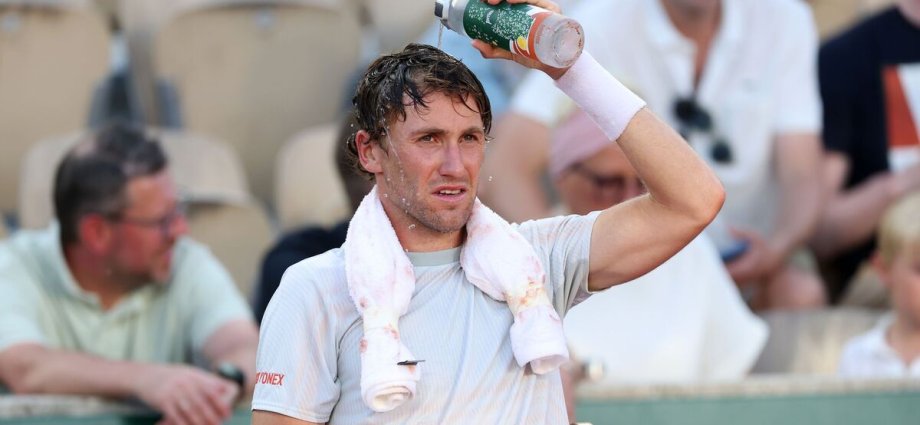
Casper Ruud struggled with the heat during his opening match and called the doctor (Image: Getty)
We’ve had a very hot start to the French Open, not just with the tennis. Temperatures have soared up to 34 degrees Celsius across the first few days of the tournament, and the players have been feeling the heat. Aussie wildcard Adam Walton called the doctor during his clash with No. 6 seed Daniil Medvedev, going on to win. And world No. 1 Aryna Sabalenka was seen using an unusual cooling device as she booked her place in the second round.
In the most severe case, Casper Ruud suffered from symptoms of heat stroke during his first-round match against Roman Safiullin and could barely move during the fourth set. He had a vacant look in his eyes, and called the doctor, but also went on to win in five.
However, the conditions have not been drastic enough to suspend play. Roland Garros has its own protocols for the tournament which allow organisers to respond to changing weather conditions, including extreme heat, rain, and thunder.
There are two sensors on the grounds, one on Court Philippe-Chatrier and one on Court 14, which monitor realtime temperatures. The tournament has defined thresholds when, if met, can allow organisers to suspend matches.
They measure heat using the wet bulb globe temperature, which takes into account temperature, humidity, wind speed, sun angle and cloud cover. Measured for adjustment, if the WBGT hits 30.1 degrees Celsius, organisers are able to take action.
The rules outline that a 10-minute rest period may be implemented for female players after the second set, or after the third set for male players. If another temperature threshold is exceeded, matches may be temporarily suspended until the temperature drops. But none of these measures have come into effect so far at the 2026 French Open.

Aryna Sabalenka used a £130 device to stay cool during her match (Image: Getty)
It hasn’t been too humid in Paris, and there has been enough of a breeze on the courts, meaning the WGBT hasn’t come close to the 30.1C threshold. The tournament also has a separate threshold tailored to the needs of para-athletes is in place for wheelchair tennis events.
The tournament may also issue recommendations to the public in the event of extreme heat, reminding them to take precautions such as using sunscreen, wearing a head covering, having a watter bottle to hand, and using shaded areas.
Some players have still been feeling the heat, however. After surviving a huge scare to beat Safiullin 6-2 7-6(5) 5-7 0-6 6-2, two-time finalist Ruud said: “As we know, there’s a bit of a heat wave at the moment, and that can sometimes cause a bit of problems.
“Yeah, felt like it was a bit of a kind of heat-stroke feeling. I had experienced something similar some years ago when I played in Washington D.C., and I had to retire in the third set because that’s the only time I had that same feeling as I had today in the fourth set, where I felt, you know, at times really dizzy and just really tired and walking around like a zombie almost.”
EXPRESS SPORT ON FB! Get all the best sports news and much more on our Facebook page
Our community members are treated to special offers, promotions, and adverts from us and our partners. You can check out at any time. Read our Privacy Policy