



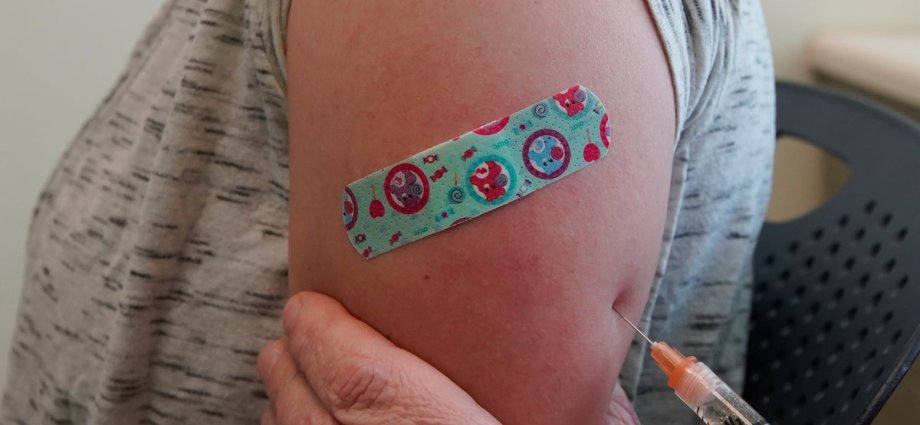
Americans who regularly get their news from right-wing media outlets are more than twice as likely to be hesitant about getting vaccines, according to a new Johns Hopkins University survey.
The findings reinforce previous research linking a conservative political outlook to vaccine hesitancy — although the majority of the 2,970 U.S. adults in the latest survey still believe the preventive benefits of the measles-mumps-rubella vaccine outweigh the risks of infection, and just one in six said they were hesitant about it.
Misinformation about vaccines from various sources led to vaccine hesitancy in communities affected by the worst measles outbreaks in decades and doctors cite vaccine hesitancy as a factor fueling surges of pediatric measles, Covid and flu deaths.
Vaccine skepticism has increased over the last decade, with a drop in childhood vaccination rates nationwide. It comes in the wake of the Covid-19 pandemic and the growing influence of vaccine skeptics like Health and Human Services Sec. Robert F. Kennedy, Jr.
The Johns Hopkins University researchers say their results indicate that people’s media consumption can fuel these trends. It remains unclear how much the participants’ beliefs may have already been swayed by other factors, such as religion or past experiences — as well as how much of an influence these sources had.
“Our work reveals a strong association between people’s specific media habits and their attitudes towards vaccination,” Lauren Gardner, director of Johns Hopkins’ Center for Systems Science and Engineering, explained in a Monday statement. “Our findings suggest that when everyone is already engaging online, where and how they choose to do so matters.”
As well as relying on conservative media, adults who were vaccine-hesitant were also more likely to rely on non-authoritative sources for health information.
Those sources include social media influencers and newsletters from the vaccine-skeptical non-profit Children’s Health Defense, which Kennedy founded.
These adults were more likely to be younger and parents. They were also more likely to be less educated, lower-income and racial minorities.
Nearly 40 percent identified with the Republican Party and 33 percent were Independent.
“Hesitant adults were also more likely to identify with the Make America Healthy Again movement, or MAHA, 43 percent, than non-hesitant adults, 27 percent,” Johns Hopkins said.
What remained the same across the political divide was the level of news consumption.
Some 87 percent of the participants said they followed the news and nearly everyone said they were online at least once a day.
But non-vaccine-hesitant adults were less likely to seek out right-leaning “new media” channels and much less likely to obtain information from non-authoritative sources.
That suggests that relying on experts had a protective effect against vaccine hesitancy.
To improve vaccination rates, health communicators must share how and where Americans should find information about vaccines, the researchers said.
“With public health becoming increasingly polarized, it’s critical to understand people’s attitudes about vaccines, and this work suggests people’s media preferences play an outsized role in influencing those attitudes.” Amelia Jamison, an assistant research scientist at Johns Hopkins, said.
The measles-mumps-rubella vaccine is 97 percent effective against the measles virus, which can lead to brain swelling and death — especially in young children.
The majority of the measles cases recorded during last year’s historic influx – the most since the highly contagious disease was eliminated in 2000 – were in people who were not vaccinated, federal data shows.
However, past outbreaks in South Carolina and Texas resulted in increasing vaccination rates that helped to get outbreaks under control.
“Vaccination – combined with other opportunities for good, solid public health work – really can be effective, even against some of the most contagious viruses,” Dr. Brannon Traxler, deputy director and chief medical officer with the South Carolina Department of Public Health, said at a news briefing last Wednesday.
Still, coverage nationwide is not where it should be to prevent future outbreaks and measles infections are continuing to spread in Utah.
There are now 607 cases in the Beehive State, 514 of whom were unvaccinated, according to state data. Many of those cases have been tied to schools.
While Utah requires that public school students have two doses of the vaccine, parents can opt out of those requirements for personal, religious or medical reasons.
Utah’s non-medical exemption rate among young children is already higher than the national average, according to the Johns Hopkins Bloomberg School of Public Health.
Vaccination rates need to be above a 95 percent threshold to limit the spread of measles. Right now, national coverage is at 93 percent, according to Johns Hopkins University.