









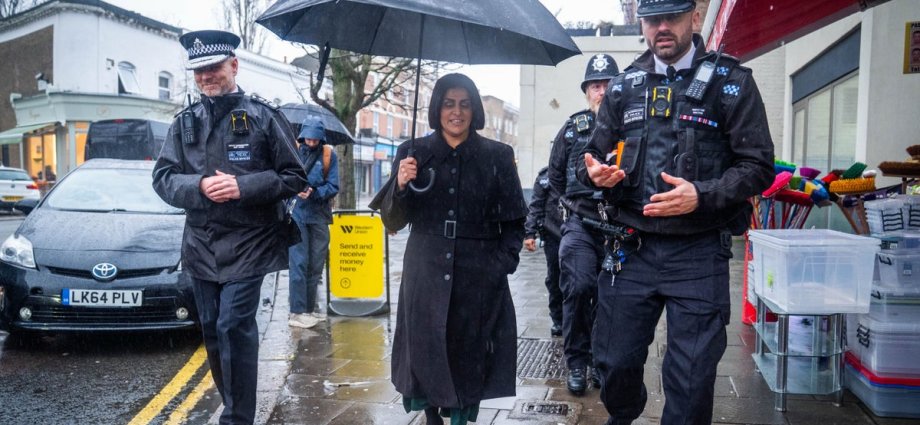
The home secretary has announced plans to ramp up the use of AI and live facial recognition as she unveils sweeping reforms to fix Britain’s “broken” policing system.
Shabana Mahmood is investing £140million to roll out technology which she hopes will free up six million police hours each year, the equivalent of 3,000 officers, as part of the biggest overhaul of an “outdated” policing model designed for another century.
Artificial intelligence technology will be deployed to rapidly analyse CCTV, doorbell and mobile phone footage, detect deepfakes, carry out digital forensics and speed up administration such as form filling, redaction and transcription.
Ms Mahmood said: “Criminals are operating in increasingly sophisticated ways. However, some police forces are still fighting crime with analogue methods.
“We will roll out state of the art tech to get more officers on the streets and put rapists and murderers behind bars.”
The government is also increasing the number of live facial recognition vans five-fold, from ten to 50, which will be used by forces across the country to help catch wanted criminals.
The measures, announced on Monday, are part of the biggest overhaul to policing in England and Wales in 200 years. Other changes include:
- Formation of an FBI-style National Police Service (NPS) to tackle terrorism, fraud and serious organised crime
- A “significant reduction” in the number of police forces in England and Wales which could see the the 43 forces merged to as few as 12 mega-forces
- Neighbourhood policing teams in every council ward to tackle the “epidemic” of every day crime
- Officers required to hold and renew a mandatory “licence to practice” in order to serve
- Home secretary given powers to sack chief constables and drive up standards in struggling forces
The government’s Police Reform White Paper also announced plans to review whether the policing of non crime hate incidents is “proportionate”.
Police chiefs welcomed the overhaul as “long overdue” on Monday, with chairman of the National Police Chiefs Council (NPCC) Gavin Stephens telling journalists there are currently “too many chiefs”.
“You’ve got rapidly changing new technologies which show huge promise, then you can’t get them rolled out because there are too many decision makers in the system,” he said.
“If we want to put in the hands of every neighborhood cop, every local team, the best available technology, we’ve got to do that once for everybody and then get it rolled out.”
More follows on this breaking news story…