









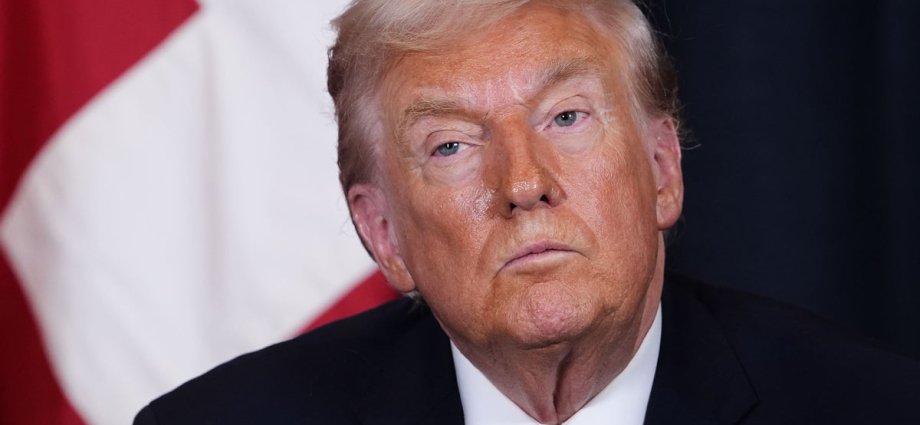
The FTSE 100 shrugged off a weak start to close slightly higher on Wednesday after US president Donald Trump said he would not use force to take control of Greenland, but insisted America must still have “ownership” of it.
Kathleen Brooks, research director at XTB, said Mr Trump’s speech at Davos, in Switzerland, had two key takeaways for markets.
“Firstly, Trump will not take Greenland by force and second, Trump wants the economy to run hot to send US stocks flying north,” she said.
The FTSE 100 index closed up 11.31 points, 0.1%, at 10,138.09.
The FTSE 250 ended 113.42 points higher, 0.5%, at 23,071.29, and the AIM All-Share closed up 7.45 points, 0.9%, at 808.59.
In a wide-ranging, often rambling speech at the World Economic Forum, Mr Trump said: “We probably won’t get anything unless I decide to use excessive strength and force where we would be, frankly, unstoppable, but I won’t do that.”
But he demanded “immediate” talks on Washington’s acquisition of Greenland, renewing his push to seize control of the autonomous territory from Nato ally Denmark.
“It’s the US alone that can protect this giant mass of land, this giant piece of ice, develop it and improve it,” Mr Trump told world leaders.
“That’s the reason I’m seeking immediate negotiations to once again discuss the acquisition of Greenland by the US.”
Prime Minister Sir Keir Starmer earlier told Parliament he would not give in to pressure from Mr Trump over the future of Greenland.
“I will not yield, Britain will not yield on our principles and values about the future of Greenland under threats of tariffs, and that is my clear position,” he told MPs, adding that he would host Danish counterpart Mette Frederiksen in London on Thursday.
Mr Trump has threatened to slap tariffs on Britain and other European countries for opposing his claims on Greenland.
“Greenland could still be an issue for financial markets, since Trump has said that he wants to gain control of Greenland and will start immediate negotiations to do so. However, today’s speech suggests that Nato is not under immediate threat, for now,” Ms Brooks said.
In European equities on Wednesday, markets were mixed. The CAC 40 in Paris closed up 0.1%, while the DAX 40 in Frankfurt ended 0.6% lower.
In New York, financial markets were higher at the time of the London equity market close.
The Dow Jones Industrial Average was up 0.9%, as was the S&P 500, while the Nasdaq Composite climbed 1.0%.
Bond markets were calmer after Tuesday’s sharp moves. The yield on the US 10-year Treasury was quoted at 4.27%, trimmed from 4.28% on Tuesday. The yield on the US 30-year Treasury was quoted at 4.89%, narrowed from 4.91%.
Back in London, analysts played down a surprise spike in UK inflation, calling it a “blip”.
“It was always likely that the December figures would post a rebound on account of the rise in tobacco duty rates showing up in the December data rather than November (as it did in 2024) due to the later timing of last year’s budget,” analysts at Lloyds Bank said.
“Some unwinding of the ‘early’ Black Friday discounting seen in the November data also looks to have been behind the upward move, as well as base effects associated with a sharp rise in airfares last month relative to a more subdued increase in December 2024,” the bank added.
Headline consumer prices index (CPI) inflation accelerated in December, with CPI rising by 3.4% year-on-year, up from 3.2% in November, according to data published on Wednesday by the Office for National Statistics (ONS). It was ahead of the FXStreet-cited consensus of 3.3%.
It was the first time headline inflation has risen since July, when the annual rate rose to 3.8% from 3.6% in June. Figures for October at 3.6% and November at 3.2% were lower than the consensus forecast at the time.
The ONS said alcohol, tobacco and transport made the largest upward contributions to the monthly change.
Core CPI, which excludes energy, food, alcohol and tobacco, was unchanged at 3.2%, better than the 3.3% consensus.
The CPI goods annual rate rose to 2.2% from 2.1%, while the CPI services annual rate rose to 4.5% from 4.4%, but below the 4.6% consensus.
RBC Capital Markets expects the December “blip” to fall away sharply in the first half of 2026.
“Not only therefore did the December outturn leave services and headline CPI inflation broadly in line with the BoE’s (Bank of England’s) projections from November but also the main upward contributions to both headline and CPI were concentrated in non-core or more volatile categories,” the broker said.
Deutsche Bank expects inflation will take a big step down in January, pushing to near 3% year-on-year.
And by spring, the bank expects the BoE’s 2% inflation target “to be in sight”.
The pound was quoted lower at 1.3437 US dollars at the time of the London equities close on Wednesday, compared to 1.3462 dollars on Tuesday.
The euro stood at 1.1707 dollars, lower against 1.1733 dollars. Against the yen, the dollar was trading at 158.18 yen, higher from 157.95 yen.
On the FTSE 100, trading statements boosted Burberry but weighed on Experian.
Luxury goods manufacturer Burberry rose 5.0% after announcing an increase in comparable store sales over the festive period, while it expects its annual adjusted operating profit to be in line with analyst consensus estimates.
Comparable sales by region in the third quarter of financial year 2026, which runs until March 28, were up 6% in Greater China and 5% higher in Asia Pacific. They were up 2% in the Americas. Further, comparable sales were flat in Europe, Middle East, India & Africa due to declines in tourist spend.
Miners were in demand with Rio Tinto, up 5.2% after a well-received fourth quarter production update, and Glencore, which Rio is trying to buy, up 3.7%.
Bank of America said it believes “GlenTinto” – should a deal be sealed – offers “compelling value”.
Rio has until February to firm up an approach for Glencore.
Heading south, insurer Admiral, down 4.2%, after Goldman Sachs downgraded to “sell” from “buy”, while Experian slipped 4.9% despite reporting in-line trading.
On the FTSE 250, Currys shares sparked 7.7% higher as the electricals retailer rose profit guidance, while Premier Foods climbed 7.1% after it signalled top-end full-year profits.
But pub chain JD Wetherspoon failed to cheer investors, with shares down 8.1%, as it said higher costs were offsetting growth in sales.
Brent oil traded lower at 64.82 dollars a barrel on Wednesday, down from 64.89 dollars late on Tuesday.
Gold was quoted at 4,833.66 dollars an ounce on Wednesday, after hitting another record high, up from 4,742.56 dollars on Tuesday.
The biggest risers on the FTSE 100 were Rio Tinto, up 327.00 pence at 6,641.00p, Burberry, up 61.00p at 1,280.00p, Bunzl, up 97.00p at 2,086.00p, Anglo American, up 158.00p at 3,401.00p, and JD Sports Fashion, up 3.78p at 82.06p.
The biggest fallers on the FTSE 100 were Experian, down 157.00p at 3,070.00p, Admiral Group, down 128.00p at 2,948.00p, London Stock Exchange, down 198.00p at 8,782.00p, Rolls Royce, down 26.00p at 1,255.00p and Sage Group, down 16.50p at 1,025.00p.
Thursday’s global economic calendar has public sector net borrowing figures, plus GDP data, initial jobless claims and personal consumption expenditures data.
Thursday’s UK corporate calendar has trading statements from discount retail chain B&M European Value Retail and trading platform AJ Bell.
Contributed by Alliance News