










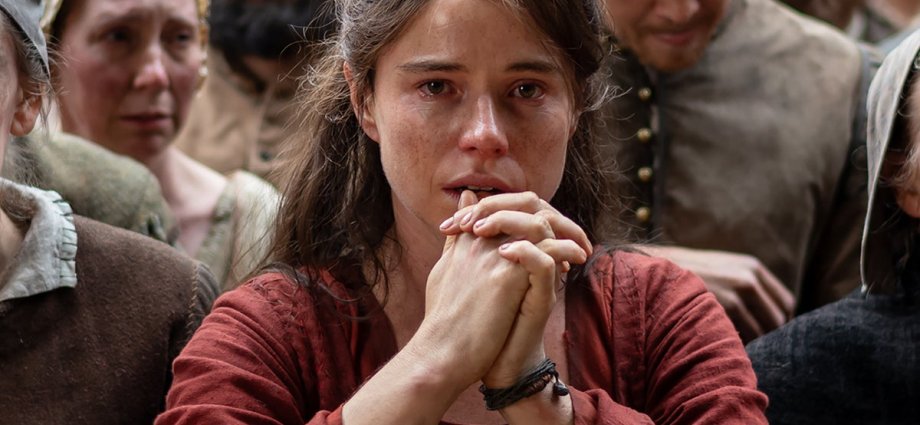
What would it have been like to stand among the first audiences of Shakespeare’s Hamlet? Rough-clothed shoulder to rough-clothed shoulder, muscles swollen from a hard day’s work, a stink of garlic and beer in the air – yet, from on stage, those words of madness, of the futility in grief, quietly tethering heart to heart, stranger to stranger? At least five major outbreaks of the bubonic plague struck London within Shakespeare’s lifetime. It’s hard to imagine who in his audiences would not have been touched by some untimely loss of life.
Chloé Zhao’s Hamnet, adapted from Maggie O’Farrell’s largely speculative novel about the play’s conception, builds to an immaculate depiction of one of its first performances. We see only a handful of its scenes performed. Still, you feel the full force of its impact, like an enormous, shuddering release of long-held breath.
What we know is that Shakespeare and his wife, Anne Hathaway, lost their only son Hamnet to unknown causes in 1596. Names, at the time, were more fluid. Anne was often recorded as Agnes. Hamnet was often written as Hamlet. O’Farrell’s book, and in turn Zhao’s film, which she co-wrote with the author, view Hamlet then as an act of collective catharsis. Shakespeare is played by Paul Mescal, Agnes by Jessie Buckley, Hamnet by Jacobi Jupe, and Hamlet (pointedly) by his older brother, Noah Jupe.
The film has been accused of too single-minded a wilfulness in making its viewers cry. At some points, I’d be inclined to agree. The Nomadland (2020) director has Shakespeare recite “to be or not to be” while contemplating hurling himself into the Thames, and she pairs the film’s climax with Max Richter’s exhaustingly popular piece “On the Nature of Daylight”, already associated in your mind with Shutter Island (2010), Arrival (2016), The Last of Us (2023) – take your pick.
But I’d rather label these choices unnecessary rather than outrightly manipulative, since Zhao’s film elsewhere colours so precisely the lives of those who walk hand in hand with death. As Shakespeare’s mother (Emily Watson) counsels, “what is given may be taken away at any time”, and there’s an urgency here with which life is scoured for meaning. It’s a deeply contemplative film, its candlelit shadows provided by cinematographer Łukasz Żal, as if painted by one of the Dutch masters. The camera focuses on spaces as opposed to people, moving as slowly as curtains drawn across a stage.
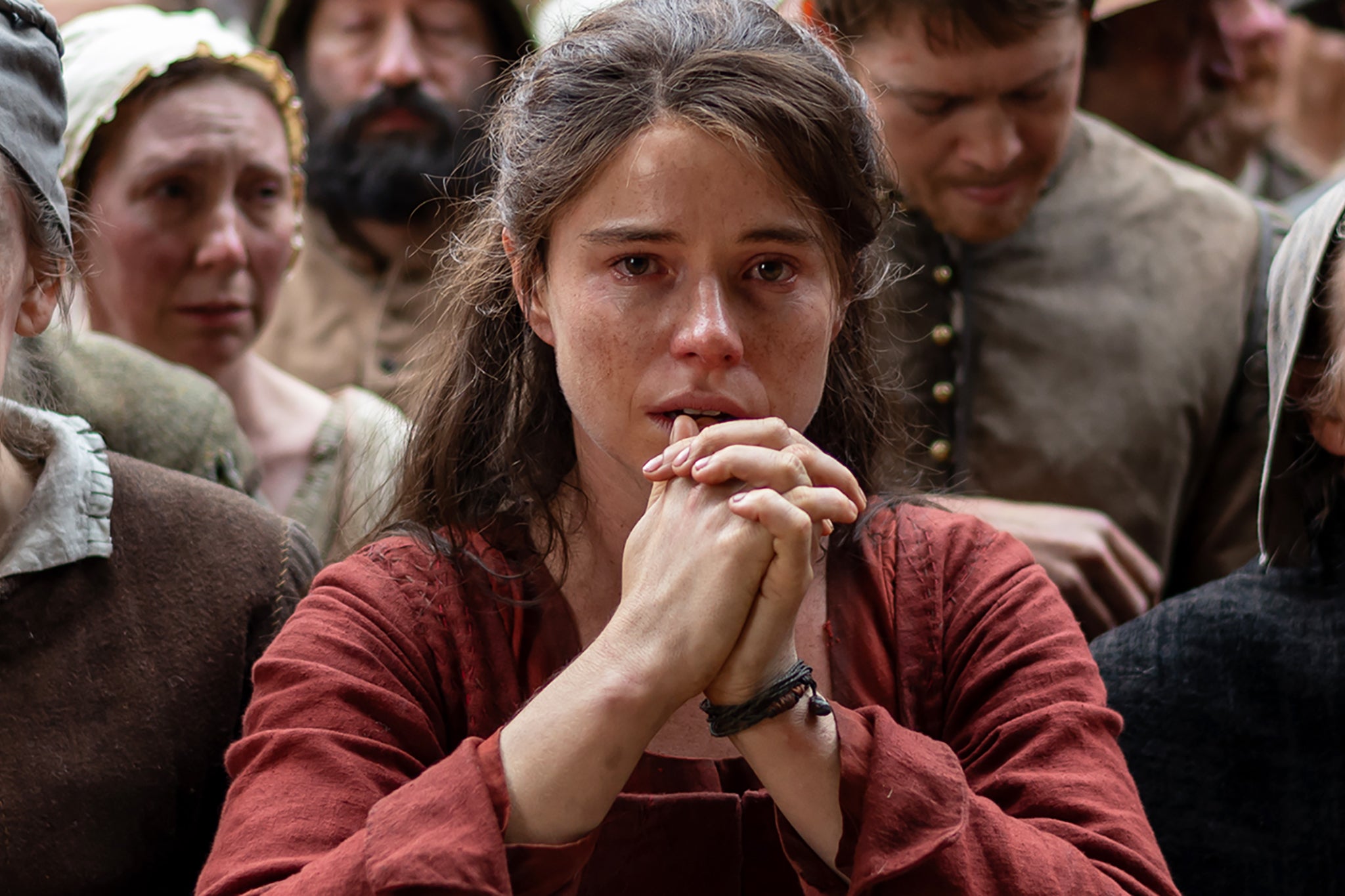
William, moulded under his father’s violent hand, has become inarticulate everywhere but on the page. Mescal’s a gift to the role, since he has a way to break down mid-sentence and make you feel as if the words crumbled right on his tongue. Agnes, in contrast, is rumoured to be the daughter of a witch – in reality, she’s a herbalist, who repeats the names of plants and their meanings as their own soliloquies. William seeks certainty in imagination; Agnes in prophecy. She’s defined her life by the vision she once had of two figures standing at her deathbed.
Buckley, already a frontrunner for the Academy Award for Best Actress, lives up to all the chatter and more. Like Mescal, she’s well-placed to express Agnes’s particular grief. When she speaks or cries or twists her mouth into a disbelieving smirk, it’s like peering into the mouth of a cave, all earthiness and unfathomable depth. She wails not only with her pain, but with her mother’s, and her mother’s mother’s. It’s through her we feel that quiet tether transcending all of human history. Because, while O’Farrell notes there are many ways to grieve, it will still always seek out a hand to hold in the dark.
Dir: Chloé Zhao. Starring: Jessie Buckley, Paul Mescal, Emily Watson, Joe Alwyn. 12A, 126 minutes.
‘Hamnet’ is in cinemas from 9 January