









Health secretary Wes Streeting has warned the NHS is “not out of the woods yet”, as flu cases have spiked following festive and new year gatherings.
Figures published on Thursday showed that the number of patients in hospital beds with flu has risen by 9 per cent on the previous week to 2,924, following two weeks where that number had fallen.
Norovirus and Covid figures have also increased, with the average number of patients in hospital up on the previous week.
Overall bed occupancy was up 5 per cent on the previous week at just under 92 per cent.
“Today’s data shows we are not out of the woods yet. While the NHS is better prepared and performing more strongly than this time last year thanks to the tireless work of staff, the current cold snap is putting fresh pressure on frontline services,” Mr Streeting said.

“Flu can be serious, particularly for older people, young children and those with underlying conditions, and vaccination remains the best protection. I urge everyone who is eligible to get their flu jab as soon as possible.
“By acting now, we can help keep people out of hospital, support our NHS staff through the toughest weeks of winter, and ensure emergency care is there for those who need it most.”
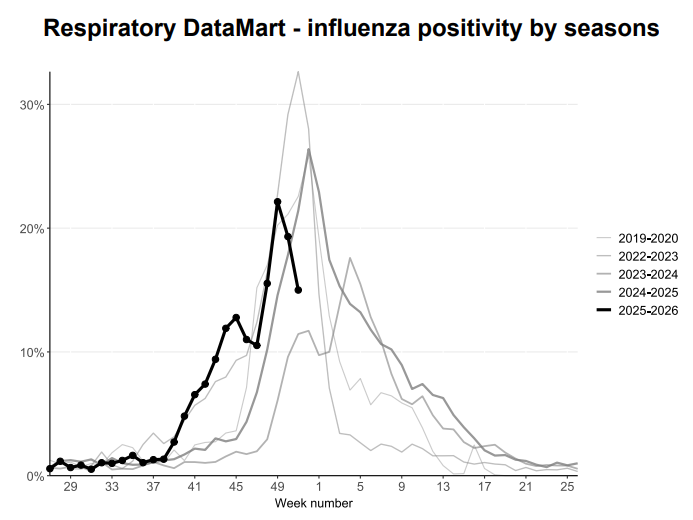
It comes after data in December suggested the UK could face the worst flu season in decades. In the first week of December 1,717 patients were admitted to hospitals in England with the infection, up 56 per cent on the same week in 2024, according to NHS England.
Although flu cases reached a peak in the first week of December according to UKHSA data, they have since dropped.
The UK’s flu season was underway week’s before it usually starts mounting pressure on the NHS. It’s thought a new strain of influenza, influenza A H3N2 subclade K, was infecting the majority of people. This strain has seven mutations that differentiate it from the previous H3N2 strain.
In the run up to Christmas an average of 19,120 resident doctors were on strike each day between 17 and 22 December – that’s slightly higher than the 17,236 average in the last set of November strikes.
However, the majority of hospital appointments still went ahead and more than 5,000 fewer patients were in hospital on Christmas Day compared to last year, with 78.8 per cent of beds occupied.
But following this week’s rise in flu cases, NHS national medical director Professor Meghana Pandit has warned the “worst is far from over for the NHS this winter”.
“The cold weather also means we are also seeing more vulnerable patients with respiratory problems in A&E and more injuries from slips and falls due to the icy conditions, so it remains an extremely busy time,” she added.
“Staff continue to work incredibly hard and we are seeing teams across the country pulling out all the stops to ensure patients get the care they need. It remains important that people come forward for care as usual and there are still plenty of opportunities to get vaccinated and get protected against flu.”
There were 101,177 ambulance handovers- that’s over 5,100 more than the same week last year. These figures include New Year’s Eve, one of the busiest nights of the year for ambulance crews.
Despite the pressure, the average ambulance handover time of 37 minutes 44 seconds, was more than 16 minutes quicker than the same time last year – although was down on the week before.
The data comes with demand on the NHS remaining high as it manages the impact of a cold snap.
Data published last week showed it received the second-highest number of calls to 111 in two years on Saturday 27 December, with 87,318 calls answered.
A total of 414,562 calls to NHS 111 were reported as answered during Christmas week, almost 24,000 more than the previous week.
Responding to the figures, Sarah Woolnough, chief executive of The King’s Fund, said: “The NHS faces a frosty start to 2026 with pressure on NHS services running hot in the face of a cold snap and a rebound in winter viruses. The health services talk of a period of ‘calmer waters’ before the new year has come to an end but with the number of beds occupied by flu patients 46 per cent lower than this time last year the pressure is not as acute as the previous winter.
Although bed occupancy rates are “slightly better” than expected for this time of year, Ms Woolnough stresses this level should not be considered as “sustainable”.
She added: “Many NHS staff and leaders have worked around the clock to protect patients as best they can, planning for months in advance, despite the additional disruption caused by industrial action and spikes in flu cases.
“There is no doubt these actions have prevented the system from becoming overwhelmed, with bed occupancy rates standing at 92 per cent for the first week of January – slightly better than we have come to expect for this time of year. But this should not be treated as a sustainable level of pressure and is certainly not one that is providing the best possible outcomes for patients.”