









By the time Molly Parkin was in her 80s, she said she had lived in 52 houses. Such was her lucky streak that she ended up in sheltered council housing in the King’s Road at World’s End, the location of many of her youthful dalliances and triumphs. Born Molly Thomas in the Welsh Valleys, but brought up in the seedier suburbs of London, she wrote 10 novels and several other books, including a volume of poetry, a collection of her journalism, a cookery book and two memoirs. She accounted herself a good painter “in the Abstract-Expressionist style” and a good writer of “erotic-humorous novels.”
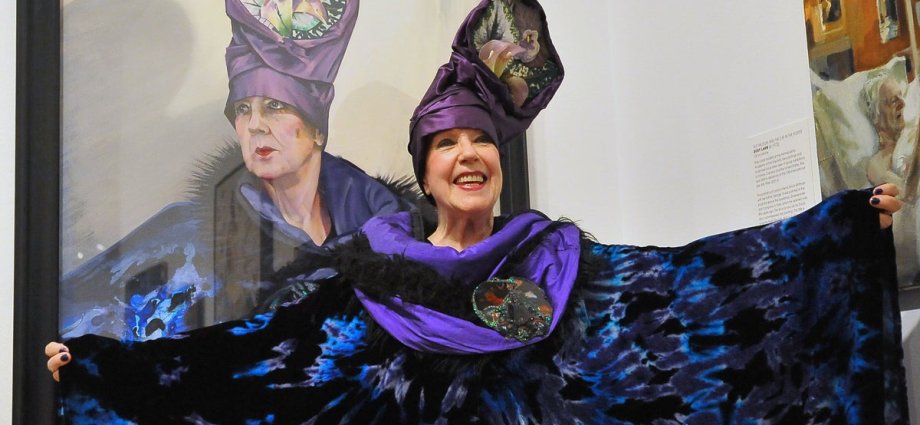
Hers was a familiar face on television from the 1960s well into the 2010s, as well as being known to partygoers and art-world private view guests. She was always strikingly dressed, never without a hat or her hair wrapped in a turban. Parkin saw herself as a minor celebrity, though a good chunk of her second autobiography Welcome to Mollywood (2010) consists of comparing her life to Elizabeth Taylor’s. She felt that Taylor, born a few weeks after her in February 1932, and she were meant to be “astral twins”, but her mother “skidded on my Auntie Lizzie’s scullery lino” and went into labour early. She listed her similarities with Taylor: “Both beautiful, high-achieving, talented, foul-mouthed, alcoholic, over-eating, artistic, fag-hag, sex-sirens.”
Knowing Molly Parkin was a little bit like the aphorism about the Sixties: if you can remember the occasion, you probably weren’t there. (Or, at least, not drinking as much as she was.) In her second memoir she wrote: “Whenever I was out for the evening, I wanted to make it a memorable occasion in every possible sense of the word, without having to remember any of it the next morning … So just the word ‘scotch’ fills me with fondness for all the fun and adventures it secured for me in the past.” In 1987 she conquered her alcohol addiction with AA. She also admitted to sugar addiction, and smoking, both of which she renounced.
Describing herself as a “Chapel girl”, she said she was sexually abused by her drunkard father, Rueben Thomas, and felt her mother, Rhonwen – from a higher social class than her husband, and ambitious for her daughter – was probably anorexic. Her parents ran tobacconists-cum-sweetshops, and neither of them, she wrote, actually loved her. After her father’s death, her mother made several suicide attempts. Parkin began work aged 11, making dolls’ clothing, and briefly had a paper-round, before having a cycling accident that caused her to miss a year of school. A bright child, she had a grammar school education in Wales and England. In 1949, with a scholarship, she began a course at Goldsmith’s College of Art, then moved to Brighton Art School the next year. In 1954 she did an additional fifth year, qualifying as a teacher. Living in London, she had her first real sexual affair with the older actor James Robertson Justice, whom she came to think of as the love of her life. The affair ended when her father died. She had thought his death would free her from the web his abuse had caught her up in, but she later reflected that it had instead caused her to reject older lovers.
In 1957 she married “the first young man who asked me,” the popular, charming Michael Parkin, a product of public school and Oxford, who was only a few months older than she. Her family was considerably more pleased than his. In the 1970s, without much experience, he became a Belgravia art dealer, whose opening parties made him known to everyone even remotely connected to the art world. They had two daughters, Sophie and Sarah, before the marriage ended in 1963. Within five years she married again, to the artist Patrick Hughes, seven years her junior; she wrote that she had a miscarriage when she was 39, but they remained married until 1980, so that she was “married 22 years, counting both husbands.”
Between marriages, needing to support the children and slightly out of love with her own painting, Parkin turned her eye to fashion, making bags and hats for Barbara Hulanicki at Biba. She also worked with Mary Quant, before opening her own Chelsea boutique, which featured in the famous Newsweek piece that immortalised “Swinging London.” She sold the shop to her partner, Terence Donovan, and turned to journalism, becoming founding fashion editor of Nova magazine, the glossy manifesto for the Sixties, in 1964. She moved on in 1967 as fashion editor of Harper’s & Queen, and then in 1969 to the better-paying Sunday Times, and was crowned Fashion Editor of the Year in 1971. Her career as a television “personality” began at this time, though she was banned from the BBC for swearing on air.
Having written a 750-word outline for her first novel, Love All, she was disappointed by the negative reaction of the publishers Anthony Blond and Desmond Briggs; however, the office secretary insisted that she liked it and her judgment prevailed. Molly’s next effort was more sexually explicit, and Up Tight (1975) achieved notoriety also for Harry Peccinotti’s cover of a model wearing see-through knickers, with the publicity bonus that Hatchard’s announced it would be keeping its stock of books under the counter. She lived in New York City for a few years, including in the infamously debauched Chelsea Hotel, returning in 1980 when she split up with her second husband, and was faced again with the need to earn a substantial living, this time to pay for her daughters’ education. She was now drinking heavily, and by the time of her third novel, Breast Stroke (1983), was aware of her alcoholism. At some point she became bankrupt and lost the Welsh cottage she loved.

With the publication of her first autobiography, Moll, in 1983, she took up painting again, and had a show in Penarth, of abstract work inspired by Celtic landscapes. She was fond of the word (and concept) “Celtic,” as she felt this was her heritage, though the colours of these later works owe a good deal to her travels in India at this time. In Welcome to Mollywood, her indiscreet second memoir published when she was in her late 70s, the world learned that her lovers went from Bo Diddley to John Thaw, and included John Mortimer – who like to be spanked on the bare buttocks, which she found tiring, as she had the children to look after as well as her work – and also George Melly, whom she regarded as her “soul mate”. Her most embarrassing lover, said her daughter Sophie in a piece published in 2007, was a “22-year-old surfer she met in Las Vegas last year, when she was 74.”
In 2012 Molly Parkin was awarded a rare Civil List Pension by the Queen “for service to the arts.” She said of the unexpected honour: “I was very surprised and just astonished. I was the boozing companion of Francis Bacon. I don’t think I’m the type of person who gets these.”
In her latter years she suffered a cancer scare and, in 2019, a diagnosis of Alzheimer’s disease, but was notedly a devoted grandmother (and great-grandmother as of last year), and found a new-found contentment after embracing spirituality.
“I know that they are up there looking down and waiting,” Molly said of her many departed friends and lovers in 2017. “It’s like there is a lament: ‘For god’s sake Moll, when are you coming? We’re having a big party ready for you here’.”