










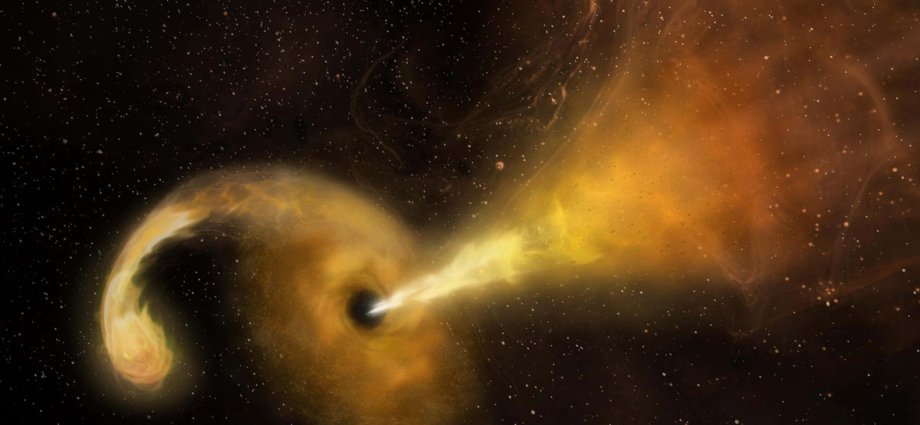
Volunteers are being sought for an online challenge to help find stars being torn apart by black holes.
Astronomers at Queen’s University Belfast and the Leiden Observatory in the Netherlands are seeking help to shape how scientists detect massive black holes for the next decade.
A new project, the Legacy Survey of Space and Time (LSST), will capture the night sky over the next 10 years from the Vera C Rubin Observatory in Chile.
Dr Matt Nicholl, from the School of Mathematics and Physics at Queen’s, said it is expected to compile more astronomical data than has been available up to now, meaning it is no longer possible for scientists to search it manually.
He said: “Having access to data from the 10-year LSST will revolutionise astronomy and it is very exciting to think that we could detect thousands of black holes consuming passing stars.
“There will be a huge amount of data – an estimated 10 million alerts every night from the LSST alerts stream.
“However, the sky is full of different kinds of sources that change in brightness, so finding what we’re looking for is like searching for a needle in a haystack.”
Astronomers at Queen’s have come up with simulations of what they believe the data could show.
Dr Nicholl said: “We’re calling for any tech-savvy armchair astronomers to use AI and machine learning to work through the simulated data and learn how to pinpoint stars that are getting torn apart and destroyed by black holes.
“You don’t need to be an expert in black holes – anyone with experience in machine learning could provide valuable insight.”
Dylan Magill, a PhD student from Queen’s who created the simulations, said: “We’re particularly interested in objects called tidal disruption events.
“This is when an unlucky star is ripped apart by the immense gravitational forces it experiences as it approaches too close to a supermassive black hole.
“The new data will give us a huge opportunity to find more of these but there is a huge amount of data to work through.
“By creating simulations and enlisting the help of armchair astronomers, we’re really hopeful that we can use AI and machine learning so that we’re in a position to unlock so many more mysteries of our universe.”
Dr Sjoert van Velzen from the Leiden Observatory, who co-founded the challenge, says: “Tidal disruption events are a relatively recent astronomical discovery and to date we haven’t discovered many.
“However, those that we have found have proven to be tremendously scientifically valuable, particularly for investigating the properties and feeding conditions of black holes that are very difficult to observe.”
Information on the online project can be found at kaggle.com/competitions/mallorn-astronomical-classification-challenge/overview.
There is a top prize of 1,000 euro for the participant with the best score.